One of my biggest weaknesses continues to be clicking on the ads on the Korea Times website. Today they led me to Flyday.co.kr and to
Only 14,000 won. Goes nicely with the G-ma$ta classic:

Showing posts with label Lost in Translation. Show all posts
Tuesday, October 18, 2011
Thursday, April 21, 2011
Saturday, April 9, 2011
The Hitler Walker.
From 오가게.
Home Plus has a decent selection of big-size shoes for western feet, but if you're looking for something a little more trendy for the Slow Walking Festival, consider the Hitler Walker (히틀러워커).
A variety of colors, materials, and styles for about 40,000 won. A lesser blogger would have titled this post "These boots are made for goose-steppin'."
Tuesday, January 18, 2011
Some readers don't care for the Chosun Ilbo's cartoons.
A Dave's ESL Cafe poster started a thread with a complaint letter he sent to the Chosun Ilbo regarding a cartoon accompanying a recent article on the Chevrolet Volt.
Although I usually enjoy reading the Chosun Ilbo in English, it has a reputation among Western expats in Korea as being biased or unreliable. Generally, I don't mind, since I love the pictures of the day and I like the wide variety of news you provide. However, the cartoon accompanying the article "Volt's Car of the Year" (seen here: http://english.chosun.com/site/data/html_dir/2011/01/17/2011011700756.html) is incredibly racist and offensive. How would you feel if an American newspaper wrote an article insulting a Korean car and drew a racist cartoon of Korean people? Americans do not have noses like that - it is a racist depiction, reducing us to features that Koreans perceive as 'different' - and we are not all white with blonde hair, either, which is something Korean media seems to ignore.
The cartoon was pulled from the English-language translation but is still found on the Korean-language original.
Tuesday, October 5, 2010
Holy fucking shit, look at that shirt.
Or, "Friends don't let friends go with 'nigger frog faggot wop limey dyke honkie mick kike chink spic beaner'." From Kelly in Korea comes the most awesomely bad t-shirt I've ever seen in Korea.

Originally found by Morgan Dale this past summer, though it turns up on a few earlier Korean blog entries, including this and this.

"Here is a perfect, real-life example," Kelly in Korea writes,
To that I'd also add---as I've said about Gibberlish and nonsense, vulgar English---that what amounts simply to symbols and decoration for Koreans often has actual meaning for a good many people and extends beyond a domestic context, a possibility that needs to be taken into account when using English publically or deciding a t-shirt with an extensive rundown of ethnic and gender slurs is a good idea for the train station.
See also: how Korean-English dictionaries aren't helping.

Originally found by Morgan Dale this past summer, though it turns up on a few earlier Korean blog entries, including this and this.

"Here is a perfect, real-life example," Kelly in Korea writes,
of why you shouldn’t wear clothing emblazoned with words you don’t understand. This is more common than you’d think and almost never done out of irony.
To that I'd also add---as I've said about Gibberlish and nonsense, vulgar English---that what amounts simply to symbols and decoration for Koreans often has actual meaning for a good many people and extends beyond a domestic context, a possibility that needs to be taken into account when using English publically or deciding a t-shirt with an extensive rundown of ethnic and gender slurs is a good idea for the train station.
See also: how Korean-English dictionaries aren't helping.
Tuesday, September 14, 2010
Dick Stick, by popular demand.
A digression from the conversation about the recent MBC piece on awkward English in Seoul's public places focused on "Dick Sticks" (딕스틱), an arguably worse name for a snack product than "Ricetard." From commenter Mark:
Fortunately a Naver blog entry from July provides pictures and a taste test:
I was shopping in a corner store with my wife once when I spotted a small ramyeon sized container of pepero sticks. What caught my attention was the name of the product: Dick Sticks. :| At least they got the English right though. I figured those would be a collectors item so I bought a batch.
Fortunately a Naver blog entry from July provides pictures and a taste test:
Tuesday, June 29, 2010
Put a white guy in there.
An amusing read in the Atlantic via this ExpatKorea thread about Chinese companies who hire white guys for meetings to make the company look international and well-connected.
I'm sure people in Asia can think of tons of other examples. Recently while looking up information on weddings in Japan I found some articles and posts about using white people as fauxfficiants. From the BBC in 2006:
And from the Taipei Times in 2005:
In my twitter feed, and sometimes on this blog, I follow examples of white people used to sell stuff.

From Yonhap, and this post.
Foreigners used in promotional material for local festivals aren't fake tourists, but they're highlighted to a sometimes unrealistic extent make the event seem more cosmpolitan and international, and sometimes to make locals feel proud---here's a recent example---of their attractions and assets. Whether the end result seems inclusive or insulting, the objectification of white people is something that deserves more attention, and a more sophisticated, scholarly treatment that looks beyond just their supposed power and status. After all, white people don't hold the same positions in Asia as they do in their home countries.

A pair of English teachers from Suncheon on the Jindo Moses Miracle festival website.
I became a fake businessman in China, an often lucrative gig for underworked expatriates here. One friend, an American who works in film, was paid to represent a Canadian company and give a speech espousing a low-carbon future. Another was flown to Shanghai to act as a seasonal-gifts buyer. Recruiting fake businessmen is one way to create the image—particularly, the image of connection—that Chinese companies crave. My Chinese-language tutor, at first aghast about how much we were getting paid, put it this way: “Having foreigners in nice suits gives the company face.”
I'm sure people in Asia can think of tons of other examples. Recently while looking up information on weddings in Japan I found some articles and posts about using white people as fauxfficiants. From the BBC in 2006:
Mark Kelly is originally from Lancashire in England. He has been living in Japan for six years and, at the weekend, he is a fake priest.
"I was living in Sapporo, studying Japanese, and I needed the money. It's far better paid than teaching in a language school," he said.
"Being a fake priest is big business in Japan - I've done a TV commercial for one company," he added. "In Sapporo, there are five agencies employing about 20 fake priests. In a city like Tokyo, there must be hundreds."
The fake Western priests are employed at Western-style weddings to give a performance and add to the atmosphere. These are not legal ceremonies - the couples also have to make a trip to the local registrar.
And from the Taipei Times in 2005:
Only 1.4 percent of Japan's 127 million people are Christians, but Christian-style ceremonies now account for three-quarters of Japanese weddings. To meet market demand, bridal companies in recent years have largely dispensed with the niceties of providing a pastor with a seminary education, keeping the requirements simple: a man from an English-speaking country who will show up on time, remember his lines, not mix up names and perform the ceremony in 20 minutes.
From a small beginning a few years ago, the Western wedding "priest" has suddenly become an established part of modern Japan's cultural tableau. The lure of easy money has prompted hundreds of foreign men to respond to newspaper advertisements here, like the one that read: "North Americans, Europeans wanted to conduct wedding ceremonies."
In my twitter feed, and sometimes on this blog, I follow examples of white people used to sell stuff.

From Yonhap, and this post.
Foreigners used in promotional material for local festivals aren't fake tourists, but they're highlighted to a sometimes unrealistic extent make the event seem more cosmpolitan and international, and sometimes to make locals feel proud---here's a recent example---of their attractions and assets. Whether the end result seems inclusive or insulting, the objectification of white people is something that deserves more attention, and a more sophisticated, scholarly treatment that looks beyond just their supposed power and status. After all, white people don't hold the same positions in Asia as they do in their home countries.

A pair of English teachers from Suncheon on the Jindo Moses Miracle festival website.
Tuesday, June 15, 2010
Hagwon instructor teaching Koreans swear words and shit.
Via a friend's Facebook page comes the guy from Anderson English giving a lesson on how to swear, sort of, in English.
That, um, creative display goes along with the frequent errors in Korea's English textbooks, the ubiquitous inaccuracies in test prep materials, and the constant gibberlish of TV programs as further evidence that you really oughtn't trust too much English education to these Korean snake oil sales(wo)men. He deserves credit for telling viewers not to use them, though, because I've run into too many instructors who find students' cursing amusing.
On the topic of curse words, of course just about everyone who learns a new language is curious about body parts and crude one-liners. But using swear words is dangerous, and not just for the obvious reason. It's like when the foreign English teacher tries too hard to use his or her very limited Korean in class, and quickly goes from impressing the students to sounding like an idiot. For the benefit of any students reading today, let me tell you that while calling somebody a "son of a bitch" is extremely offensive, an immigrant saying "you son of beach" is completely ridiculous.

One of the 8th-graders almost got it right.
That, um, creative display goes along with the frequent errors in Korea's English textbooks, the ubiquitous inaccuracies in test prep materials, and the constant gibberlish of TV programs as further evidence that you really oughtn't trust too much English education to these Korean snake oil sales(wo)men. He deserves credit for telling viewers not to use them, though, because I've run into too many instructors who find students' cursing amusing.
On the topic of curse words, of course just about everyone who learns a new language is curious about body parts and crude one-liners. But using swear words is dangerous, and not just for the obvious reason. It's like when the foreign English teacher tries too hard to use his or her very limited Korean in class, and quickly goes from impressing the students to sounding like an idiot. For the benefit of any students reading today, let me tell you that while calling somebody a "son of a bitch" is extremely offensive, an immigrant saying "you son of beach" is completely ridiculous.

One of the 8th-graders almost got it right.
Thursday, June 10, 2010
Okay, you go ahead and do that.

That's one new couple look this summer from Johnny Tango, a shirt both amusing and punny.
Some day I really ought to do a post about my favorite couple tees and the best couple tee resources. For now, I'll share one that might just be my favorite, one I've never actually seen and long thought apocryphal until some recent research indirectly proved its existence:

Like how they prove the existence of invisible celestial objects by the verifiable influence they exert on others, so too does Naver 자식in assist our understanding.
Friday, May 28, 2010
The Ministry of Food, Agriculture, Forestry and Fisheries should have left English alone.

This is your authority on the English language and what foreigners like.
The Korea Times reports, via The Marmot's Hole, that the dolts interested in "globalizing" Korean food and beverages have decided that makgeolli will be given the nickname "Drunken Rice" (드렁큰라이스) in English to make it more appealing for non-Koreans.
"Makgeolli," the country's traditional rice wine, has garnered the nickname "Drunken Rice" through an event aimed at boosting sales of the milky white drink outside Asia's fourth-largest economy.
The Ministry of Food, Agriculture, Forestry and Fisheries (MOFAFF) said Wednesday that Drunken Rice got the highest score as the nickname for makgeolli in a rivalry with such candidates as Makcohol, a combination of makgeolli and alcohol.
Other contenders included were Koju, Kori, Soolsool, McKorea and Rainydaywine but they failed to beat Drunken Rice.
"Midway through this month, up to 3,910 people offered various English nicknames for makgeolli, which is hard to pronounce and understand for expatriates," MOFAFF official Park Seong-gi said.
"Drunken Rice topped the podium at the screening of the five-member panel, which features a linguist, a food columnist, an alcohol specialist and tourism experts. These names will hopefully help the brisk exports of the wine."
The Korean-language articles say other names under consideration were Markelixir---a combination of makgeolli and elixir---and makcohol.
I'm curious, how many on the five-member panel were members of the target audience? And how many English-speakers did they consult before creating an English nickname? There is every reason to believe the answer to both is zero, given Korea's track record (1, 2, 3, 4, 5, 6, to cite but a few) but it looks like they talked with Korean-American food blogger and consultant Daniel Gray of Seoul Eats and marketing manager Michael Spavor.
The Korea Times closes with:
In the meanwhile, MOFAFF asked 210 foreigners last month in 11 cities including New York, Los Angeles, Singapore, Hong Kong and Tokyo regarding what is the best English-language explanation of makgeolli. The best one on the list was Korean rice wine.
Clearly, Drunken Rice isn't as laughable as makcohol, as absurd as markelixir, but what's the point of an English nickname? What does "Drunken Rice" accomplish that makgeolli doesn't? In what way does it make it easier for non-Koreans to comprehend and understand makgeolli, considering most non-Koreans have even never heard of the drink? Finally, what evidence is there of a lack of comprehension and understanding among non-Koreans of makgeolli, and does it exist to so great an extent that an entirely new English name is necessary? The answers to these important questions were likely trumped by the desire to have an English nickname to sound cosmopolitan and smart, forgetting of course that it has the opposite effect on people who actually use the language.
The government's interference in English to further the globalization of Korean food reminds me of the decision last spring to change the English spelling of 떡볶이 to topokki, because, according to one researcher at the Topokki Food Research Institute:
“Using a name that’s easy for foreigners to pronounce is our first step to help the spicy rice cake gain global popularity.”
You won't build a strong connection with non-Koreans and "foreigners" when the English-language name is different from the Korean one, and incomprehensible to Korean-speakers.
Sunday, May 9, 2010
A couple of classic Korean wedding videos.
A big wedding in the family last weekend is occasion enough to repost one of my favorite Korean videos. It's only a minute long, but the action begins at 0:43.
That's one way to come in. You might be interested in renting some dancing girls doing "sexydances"---not sexy dances---to walk you out.
In that January 7, 2008 post, only the 79th in this site's history, I gave an unsophisticated little talk about western-ish wedding ceremonies in Korea, admittedly never having had one myself:
In those days I rarely got comments, but A.S. was nice enough to stop by and write:
I mentioned pizza earlier in that post, and if you read my interview in the Moon Living Abroad in South Korea guidebook you might recall I said, in response to a question about why I chose to live in Jeollanam-do over places more favored among foreign teachers:
In the February 2010 post introducing the guidebook I added:
You can apply "Uncanny Valley" to our perceptions of Korea's "western" weddings, too.
That's one way to come in. You might be interested in renting some dancing girls doing "sexydances"---not sexy dances---to walk you out.
In that January 7, 2008 post, only the 79th in this site's history, I gave an unsophisticated little talk about western-ish wedding ceremonies in Korea, admittedly never having had one myself:
Well, nowadays the trend for Western-ish trappings at weddings is so entrenched that people are just keeping up with the Kims. The Western-ish ceremony is just for show, anyway, not only a display of wealth but also an opportunity to reenact the stereotypes associated with Westerners and their exotic rituals (ceremony, photographs, and sex). The white gown is just part of an elaborate costume party marketed as the height of sophistication.
In those days I rarely got comments, but A.S. was nice enough to stop by and write:
I think the problems foreigners have with Korean weddings arise when we judge them within the context of our own wedding traditions. It looks like a western style wedding, but it's not. Pizza is a good example too.
I mentioned pizza earlier in that post, and if you read my interview in the Moon Living Abroad in South Korea guidebook you might recall I said, in response to a question about why I chose to live in Jeollanam-do over places more favored among foreign teachers:
I actually spent a year in Bundang, a trendy district in a satellite city of Seoul, before coming down here. Looking back, I think it was actually a little more, well, culture shocking going to Bundang than Jeollanamdo because of the appearance of close similarity up there. I'm sure there's a proper term for it, but the closest I can get is to say, "Look up 'Uncanny Valley' and apply it to Christmas, coffee, and pizza."
In the February 2010 post introducing the guidebook I added:
. . . I happen to think that plenty of expats---not including the immature and the maladjusted---react just fine to the unfamiliar "Korean" aspects of the country. It's the things that at first glance look familiar---Christmas, pizza, English, "westernization"---that are the most jarring.
You can apply "Uncanny Valley" to our perceptions of Korea's "western" weddings, too.
Tuesday, April 13, 2010
Some awkward placards in Geoje.
A while ago a reader passed along some pictures of a display in Geoje, in South Gyeongsang province. He writes the flags and the placards are put up to reflect the international influence the shipyards have on the island. A nice thought, but as with a lot of the bad English and the cultural mistranslations in Korea, you really have to wonder how they got it so wrong.
You'll find the flags near the ferry terminal in Gohyeon-dong. He notes that someone noticed the error on "language" and fixed it with a sticker, but didn't think the other information needed any more work.
Anticipating the response from some that I'm not being constructive, I'll share with you the numbers and locations for the tourist information centers, if you're in the area and would like to provide some pointers for the next draft of the placards. Of course, they really should have checked with native English speakers before doing it in the first place, but some people get upset when I point that out.
Sunday, March 28, 2010
"Uncle Bob" selling phones in Korea.
KT's started using Bob Ross to advertise its "Qook and Show" service:
The commercial, which mixes footage of 밥로스 아저씨 with some white guy they stuck in a wig, was made last month but has hit the internet, and the forums, recently. As is the norm for Korean TV shows, music videos, and commercials, this also has a "making" video where at the two-minute mark they talk a little with the foreigner they recruited.
Other commercials with celebrity impersonators include Faux-bama for Skylife and Faux-prah for IBK. If they use Mr. Rodgers next I swear to God I'll beat the whole cast and crew with their own Keds.
There are certified "Joy of Painting" contacts throughout the world, and South Korea's is in Cheongju.
The commercial, which mixes footage of 밥로스 아저씨 with some white guy they stuck in a wig, was made last month but has hit the internet, and the forums, recently. As is the norm for Korean TV shows, music videos, and commercials, this also has a "making" video where at the two-minute mark they talk a little with the foreigner they recruited.
Other commercials with celebrity impersonators include Faux-bama for Skylife and Faux-prah for IBK. If they use Mr. Rodgers next I swear to God I'll beat the whole cast and crew with their own Keds.
There are certified "Joy of Painting" contacts throughout the world, and South Korea's is in Cheongju.
Wednesday, March 3, 2010
Pop-punk group works without a contract, thanks to jeong.
The Korea Times has sort of a write-up about group No Brain, but the writer spends most of the time talking about other things, such as how the group works without a contract:
The author of The Joshing Gnome had an interesting series in 2008 called "What is Jung and How Can We Kill It?" and each time I read about how unique Korea's jeong is, I think about this passage from part three:
No Brain works under the label Rock Star Music. But the group says it has never signed a contract with the label. Yes, the band that has risen to superstar status in the past 10 years has never signed a contract concerning labor conditions or distribution. This would be impossible for a small- or medium-sized label, let alone a major record label. How did this happen? This is when we began thinking of the culture of the Korean sentiment, ``jeong.''
Out of all the Asian countries that use Chinese characters, only Korea and Japan use ``jeong'' as an independent word. It's a difficult concept to explain to a foreigner. Koreans unconsciously define and remember relationships through ``jeong.''
This cultural practice could be difficult to understand in the Western world, where contracts are crucial, and from a Chinese perspective. But in Korea, the close connections of a ``jeong'' culture positively influenced certain areas of rapid economic development. The culture of ``jeong'' can also be found in a cultural world growing as fast as the economy. The reason No Brain was able to work without a contract can be found in Korea's ``jeong'' culture.
We asked the band how it was possible for them to work without a contract. Vocalist Lee Sung-woo replied, ``Having a contract just makes us nervous, and I think we work harder because we don't have one.''
It is clear that the relationship between No Brain and their label comes from Korea's culture of trust and ``jeong.'' But there's more to it. We might have understood this relationship through Korea's unique culture of ``jeong,'' but in 21st century Korea, that couldn't be the only reason.
The author of The Joshing Gnome had an interesting series in 2008 called "What is Jung and How Can We Kill It?" and each time I read about how unique Korea's jeong is, I think about this passage from part three:
Koreans claim that jung is an untranslatable Korean concept. The reason that Koreans have a difficult time translating jung is that it is, in fact, an alien concept to them. Korean culture draws that ten foot trench between those you care about and those for whom you feel nothing. To feel some affinity for someone on the other side of that trench is jung. And it’s totally outside of the basic bounds of the culture. That’s why jung is such a hard thing for Koreans to explain to you. Because you already feel it all the time. It would be like you explaining buoyancy to a fish. You’s be at such a loss to express the concept that fish would merely nod in wonder when you told them ‘I guess buoyancy is a human concept that you just wouldn’t get.’
Tuesday, March 2, 2010
What can happen when Koreans use English without proper supervision.
This is a couple weeks old but what do you care, you were on vacation all month:

From Extra! Korea.
That's Ga-in of the girl group Brown Eyed Girls on the February 13th episode of "We Got Married" (우리 결혼했어요), using an electronic dictionary on her phone to talk to a brown person. That's the kind of, um, shit that comes out when you "study" "English" for a decade in Korea, when the point of an episode is omigodomigodomigod meeting a foreigner, and when English is customarily rendered ridiculous by pop culture. I like how commenter Walter Foreman put it last July:
The episode is available on YouTube, with lots of "silly sounds made by silly people," though that particular segment has been removed. Read more about it at Extra! Korea and allkpop.

From Extra! Korea.
That's Ga-in of the girl group Brown Eyed Girls on the February 13th episode of "We Got Married" (우리 결혼했어요), using an electronic dictionary on her phone to talk to a brown person. That's the kind of, um, shit that comes out when you "study" "English" for a decade in Korea, when the point of an episode is omigodomigodomigod meeting a foreigner, and when English is customarily rendered ridiculous by pop culture. I like how commenter Walter Foreman put it last July:
I've often thought that one of the (many) obsticles toward English gaining traction in Korea is its constant portrayal in the media . . . as nothing other than silly sounds made by silly people.
The episode is available on YouTube, with lots of "silly sounds made by silly people," though that particular segment has been removed. Read more about it at Extra! Korea and allkpop.
Saturday, February 27, 2010
Australian referee Hewish needs police protection in Vancouver after Korean threats.
The Australian referee who disqualified the Korean women's short-track team in the 3,000-meter relay now requires police protection. The Australian.com.au looks at the threats made by angry Korean fans against Jim Hewish:
Yes, there was a bomb threat made to the Australian embassy in Seoul:
Hewish was the referee who disqualified Kim Dong-sung in 2002, a decision that gave Ohno the gold, and the Korean coach was prepared for that:
Some Korean netizens called for a boycott of Australian products and put up contact information to the Australian Amateur Ice Racing Council, believing, like they did in the aftermath of their 2006 World Cup loss, that a large number of protest letters would force a rematch. Others posted Hewish's address, including a map to his house

This latest news come via commenter ElCanguro on a Marmot's Hole on The Marmot's Hole, and a follow-up Marmot's Hole post, and he wrote on my site:
Indeed, there is a disturbing trend of Korean threats and overreaction to perceived slights in international competition. A Korean commenter on my post yesterday wrote:
Rather than appreciating "asking for the justice," I suspect event organizers will be alarmed that their officials are subject to threats and violence should a decision go against Korea. I've had to write countless times that no, the actions of these enthusiastic netizens are not representative of all Koreans, but it should be the responsibility of Koreans as a whole to preach against these outbursts and go through the proper channels to find "justice," if they continue to feel listening to a referee's decision is unjust or an improper channel. Then again, when we see how Korean lawmakers express themselves in the National Assembly when they feel slighted, there might be issues larger than simply sports.


A small collection of netizen artwork found on blogs and messageboards.
AUSTRALIAN short track referee Jim Hewish is under police protection in Vancouver..
Hewishr raised the ire of the Korean speedskating team and its fans by disqualifying its women's 3000m relay on Thursday.
A bomb threat was made by a disgruntled fan against the Australian embassy in Seoul the next day but was later described as a hoax. However it is understood that threats have also been made against Hewish personally and his house in Sydney has been placed under guard.
Yes, there was a bomb threat made to the Australian embassy in Seoul:
Major Korean internet news website Joins.com reported the embassy was searched for 40 minutes and five staff were evacuated.
Officials at the embassy confirmed the incident with AAP, a staff member saying it turned out to be a hoax but "Korean authorities responded very quickly and it was resolved".
Joins.com reported Kim was angry that Australian short track speed-skating judge Jim Hewish had disqualified the Korean team from the women's 3000m relay final after their last skater crossed the line first on Wednesday (Vancouver time).
Hewish was the referee who disqualified Kim Dong-sung in 2002, a decision that gave Ohno the gold, and the Korean coach was prepared for that:
"Before the race, I told the players to be careful because the chief referee was the same one who disqualified Kim Dong-sung (at the Salt Lake Olympics in 2002). But it happened again,'' Choi said.
Some Korean netizens called for a boycott of Australian products and put up contact information to the Australian Amateur Ice Racing Council, believing, like they did in the aftermath of their 2006 World Cup loss, that a large number of protest letters would force a rematch. Others posted Hewish's address, including a map to his house

This latest news come via commenter ElCanguro on a Marmot's Hole on The Marmot's Hole, and a follow-up Marmot's Hole post, and he wrote on my site:
I wonder if the netizens realise that they've blown any chances of Pyeongchang getting the winter Olympics anytime soon or Korea getting the 2022 World Cup with their childish, passive-aggressive displays behind the computer.
Indeed, there is a disturbing trend of Korean threats and overreaction to perceived slights in international competition. A Korean commenter on my post yesterday wrote:
There is always e-mail threatening after any events (sports, business closing tables, and etc). But many times, I see some of those threatening pictures as the expression and voice of anger, requesting, and asking for the justice. I see this kinds of threatening everywhere; some are small and some are big. With these kinds of expression of media or posts should be viewed as voices instead of annoying things.
Rather than appreciating "asking for the justice," I suspect event organizers will be alarmed that their officials are subject to threats and violence should a decision go against Korea. I've had to write countless times that no, the actions of these enthusiastic netizens are not representative of all Koreans, but it should be the responsibility of Koreans as a whole to preach against these outbursts and go through the proper channels to find "justice," if they continue to feel listening to a referee's decision is unjust or an improper channel. Then again, when we see how Korean lawmakers express themselves in the National Assembly when they feel slighted, there might be issues larger than simply sports.


A small collection of netizen artwork found on blogs and messageboards.
Sunday, January 24, 2010
Some tossers going to school in Seoul.
Saw this on my way home recently. It's a bus for Toss English (토스잉글리쉬), a poorly-named chain of children's English schools in South Korea.
The name of the school is bad enough, probably the worst use of English by an English school since YBM's "Let's SpeaKING." The "Toss Your Way Up" banner might rank among the worst uses of English in the country.
For those of you who get bothered when I post about bad English in Korea, and for the readers who somehow think it unbefitting a teacher to point out ridiculous uses of English here---it's not, by the way---it's stuff like this that bothers me, not Koreans in general struggling with a foreign language. I don't see anything wrong with putting down a goddamn English school that named itself after a slang term for masturbation. Some people will say it's just harmless coincidence, it's one that would have been noticed had a native English speaker been involved in the decision-makig process, and thus it demonstrates yet another case of English being used thoughtlessly in Korea and English being completely divorced from its speakers.
The name of the school is bad enough, probably the worst use of English by an English school since YBM's "Let's SpeaKING." The "Toss Your Way Up" banner might rank among the worst uses of English in the country.
For those of you who get bothered when I post about bad English in Korea, and for the readers who somehow think it unbefitting a teacher to point out ridiculous uses of English here---it's not, by the way---it's stuff like this that bothers me, not Koreans in general struggling with a foreign language. I don't see anything wrong with putting down a goddamn English school that named itself after a slang term for masturbation. Some people will say it's just harmless coincidence, it's one that would have been noticed had a native English speaker been involved in the decision-makig process, and thus it demonstrates yet another case of English being used thoughtlessly in Korea and English being completely divorced from its speakers.
Sunday, December 27, 2009
Do you know Christmas tree? It is kind of traditional Korean plant. Do you have Christmas tree in your country?
So this was in the Korea Times on Christmas. The original title of the article was, believe it or not, "'Christmas Tree Originated From Korea.'" And an alternate title to this post might be "The Korean Grinch that Stole Christmas," as a guy from the National Institute of Biological Resources is trying to claim that the Christmas trees people use in the west originated from Korea, and is trying to get a slice of profits made from selling Christmas trees around the world.
This was also blogged by What the Kimchi??? You'll find a story here, in Korean with video, from YTN. The oft-cringeworthy Arirang TV did a segment on this called "The Lost Right of the Christmas Tree" for its December 25th edition; an excerpt:
Wikipedia has more on the Abies koreana, the "Korean fir." I'm certainly no expert on Christmas trees or Christmas tree cultivation, but a quick look shows that these Korean firs are not even listed among the trees commonly grown for use at Christmas, let alone "one of the most popular trees used for this special occasion." The Times story is characteristically vague, not mentioning the scientific name of the fir, the man who introduced it to the west, where it is believed to enjoy popularity, or how that popularity is calculated. But it does succeed in conveying the arrogance and the crassness of the NIBR man who, after suggesting that Korea might have a small role in a celebration associated with one of the biggest holidays in the world---one Korea does not really celebrate in any traditional sense---shows he's most interested in getting paid and in avenging what is perceived as Korea's loss.
As an aside, I graduated from Indiana University of Pennsylvania, located in a county that calls itself "The Christmas Tree Capital of the World." The Indiana County Christmas Tree Growers website, if that's any authority, doesn't list it as among the most popular tree types grown there.
What contribution have Christmas-unenthusiastic Koreans made to the Western tradition of celebrations on the day when Jesus was allegedly born?
For those who have given up guessing, here is a tip ― check your Christmas tree.
According to Korea's National Institute of Biological Resources (NIBR), it is a Korean fir tree, which he says is one of the most popular trees used for this special occasion, although most Western Christmas enthusiasts may be unaware of this.
The institute is working hard to have its claim officially recognized, as it may enable Korea, as a place of origin, to claim a slice of the profits from their commercial use.
According to the institute, the Korean fir is an indigenous evergreen, which grows on the slopes of Mt. Halla, Mt. Jiri and Mt. Deokyu.
The ``type specimen'' of the Korean fir tree currently belongs to the Smithsonian Institution in the U.S. A European botanist took the specimen out of Korea in 1904 and donated it to the institute.
``It is lucky that there is a type specimen ― even in an overseas location ― to prove the origin of the plant or animal is Korea. There are many more species of our indigenous creatures being used without recognition,'' Kil Hyun-jong of the NIBR said. ``That is why a type specimen is so important as it is proof of origin.''
The NIBR currently houses approximately 1.6 million specimens and expects the number to increase to 5 million by 2030.
The institute estimates at least 20,000 type specimens were taken out of the country and some 280 of those are being used commercially.
Korea plans to insist on a ``recovery of rights'' at the Convention on Biological Diversity next year.
Kil said there will be discussions regarding the right to trade plants and animals. ``We will try to restore our rights for original Korean fauna and flora,'' he added.
Though the tree originated from, and is now growing in Korea, companies in the West recognized the value of the tree first and made profits from it, Kil said.
Other than Korean fir, the Netherlands has type specimen rights to the Korean lily, Hungary has stonefly type specimens and the U.S. has those of the dark sleeper and northern loaches, both fresh-water fish indigenous to Korea, he added.
This was also blogged by What the Kimchi??? You'll find a story here, in Korean with video, from YTN. The oft-cringeworthy Arirang TV did a segment on this called "The Lost Right of the Christmas Tree" for its December 25th edition; an excerpt:
An interesting fact about Christmas tree.
Most people may not be aware of this... but Korea's National Institute of Biological Resources says... it's a Korean fir tree... that is one of the most popular trees used for Christmas.
The Korean fir is an indigenous evergreen... that grows on the slopes of major mountains in the country.
Eoh Jin-joo has more.
The Korean fir is a tree that is commonly known as a Christmas tree in the United States and Europe.
The clear, triangle shape and its conspicuous green color is just right for the Christmas atmosphere.
However, not many people know that the tree was an indigenous plant found only in Korea.
Wikipedia has more on the Abies koreana, the "Korean fir." I'm certainly no expert on Christmas trees or Christmas tree cultivation, but a quick look shows that these Korean firs are not even listed among the trees commonly grown for use at Christmas, let alone "one of the most popular trees used for this special occasion." The Times story is characteristically vague, not mentioning the scientific name of the fir, the man who introduced it to the west, where it is believed to enjoy popularity, or how that popularity is calculated. But it does succeed in conveying the arrogance and the crassness of the NIBR man who, after suggesting that Korea might have a small role in a celebration associated with one of the biggest holidays in the world---one Korea does not really celebrate in any traditional sense---shows he's most interested in getting paid and in avenging what is perceived as Korea's loss.
As an aside, I graduated from Indiana University of Pennsylvania, located in a county that calls itself "The Christmas Tree Capital of the World." The Indiana County Christmas Tree Growers website, if that's any authority, doesn't list it as among the most popular tree types grown there.
Tuesday, November 17, 2009
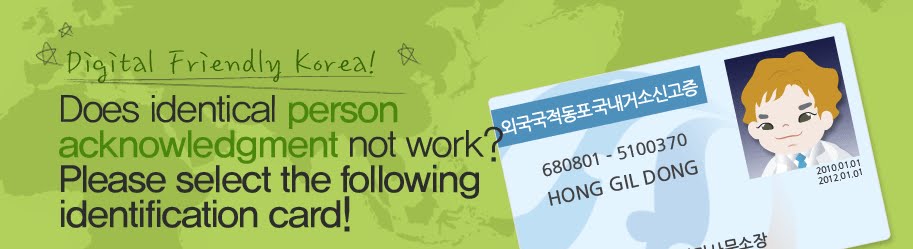
"ifriendly.kr" another major English fail by the Korean government.
Christ Almighty, this has to be a joke:
I read in the Chosun Ilbo about a page designed to help foreigners register with Korean webpages.
This is what they came out with.


Foreigners do complain about how difficult it is to register for Korean websites, not simply because of the language barrier but because our alien registration numbers are not compatable. But I wish they would have given the "English" a once-over before unveiling a webpage designed to help, among others, English-speakers. I'm trying to be mild, but . . . the fuck?
Found via both the Korean Government's Twitter page, and Gangwon Notes, the latter . . . noting that the generic foreigner they chose, Hong Gil-dong, is a character in a Korean folk tale akin to Robin Hood.
See also: "Visit Korea Year: 2010-2012."
"Internet guide of identical person acknowledgement on alien in Korea"
"Alien in Korea can confirm identical person through Internet easily with alien registration or passport."
"Making Republic of Korea
where communication is available by digital"
"'Identical person acknowledgement'is
to confirm identical person on the Internet
in order to settle using culture of sound internet"
"Citizens staying in
a foreign country
who are residing in Korea"
"Does identical person
acknowledgement not work?
try to confirm the followings!"
I read in the Chosun Ilbo about a page designed to help foreigners register with Korean webpages.
The Korea Communications Commission is offering another way to make life easier for foreigners living in Korea.
In cooperation with the Korea Association of Information and Telecommunications, the commission on Monday opened a Web site (www.ifriendly.kr) to help foreign expats with problems they might face when joining Korean portals.
This is what they came out with.


Foreigners do complain about how difficult it is to register for Korean websites, not simply because of the language barrier but because our alien registration numbers are not compatable. But I wish they would have given the "English" a once-over before unveiling a webpage designed to help, among others, English-speakers. I'm trying to be mild, but . . . the fuck?
Found via both the Korean Government's Twitter page, and Gangwon Notes, the latter . . . noting that the generic foreigner they chose, Hong Gil-dong, is a character in a Korean folk tale akin to Robin Hood.
See also: "Visit Korea Year: 2010-2012."
Subscribe to:
Posts (Atom)