Showing posts with label Japan. Show all posts

Saturday, July 9, 2011

Ferry to run between Fukuoka, Yeosu during 2012 Expo.


Test run from Fukuoka to Yeosu. (Yachtpia)

The Beetle Ferry, which currently operates between Busan and the Japanese city of Fukuoka, will make daily trips from Japan to Yeosu next year while the Jeollanam-do city hosts the 2012 World Expo. From the Korea Herald last week:
The state-run Korea Tourism Organization said Wednesday that it has secured a sea route linking the southern port city of Yeosu to Fukuoka, southwestern Japan, in preparation of next year’s Yeosu World Expo.

The organization, together with the South Jeolla provincial government and the Yeosu city government, has arranged for a chartered ferry service by Japan’s Kyushu Railway Co. (JR Kyushu) over the route.

The high-speed ferry “Beatle” [sic] will travel once a day between Yeosu port and Fukuoka’s Hakata port during the 2012 Yeosu Expo, scheduled to run May through August next year.

Beatle is capable of accommodating 200 people and takes three hours and 45 minutes for a one-way trip, with the ferry service estimated to cost about 200,000 won ($185.36) per passenger.

Fukuoka is probably best known to foreign teachers in Korea as a nearby visa-run destination, but as I learned in late-2009 it's fine for a short vacation, too.

Monday, November 1, 2010

The 1924 광주고보야구사건 and the Kwangju Students' Independence Movement.

November 3rd is the anniversary of the Kwangju Students' Independence Movement (광주학생항일운동), an that is said to have been set in motion in 1929 when students were apprehended for fighting with Japanese schoolchildren on a train from Naju to Gwangju.

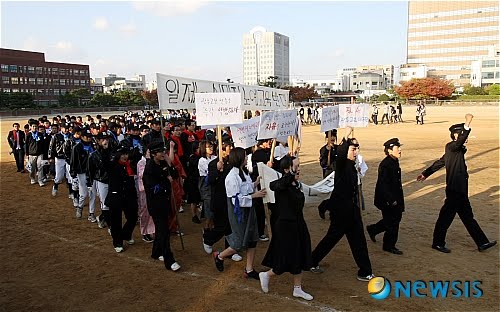
Last November, while looking for information related to this, I came across some captivating pictures out of Gwangju's Jeil High School, a reenactment of what I'll translate as the Gwangju High School Baseball Incident (광주보고야구사건, after 광주고등보통학교, the former name of 광주제일고등학교).


No English-language information exists to give background, though November 1, 2009 Newsis articles briefly summarize:
'광주고보 야구사건'은 일제강점기 시절인 1924년 6월 중순 두 팀이 광주고보 운동장에서 친선경기를 벌이던 중 심판 판정에 불만을 품은 일본팀 단장이 광주고보 투수를 폭행하자 선수들과 학생, 시민 등 400여명이 경기장으로 뛰어들어 항거했던 사건이다.

According to a lengthier article, a June 1924 baseball game between the Gwangju high school and a Japanese student all-star team ended with a play at the plate and a 1-0 upset, leading to a brawl at the mound among the teams and their fans. The nine Gwangju athletes were arrested and imprisoned for three months, a game and an outcome that would remain influential five years later.

Newsis photographers were on hand last year for a reenactment to coincide with the anniversary of the 1929 uprising.


Tuesday, June 29, 2010

Put a white guy in there.

An amusing read in the Atlantic via this ExpatKorea thread about Chinese companies who hire white guys for meetings to make the company look international and well-connected.
I became a fake businessman in China, an often lucrative gig for underworked expatriates here. One friend, an American who works in film, was paid to represent a Canadian company and give a speech espousing a low-carbon future. Another was flown to Shanghai to act as a seasonal-gifts buyer. Recruiting fake businessmen is one way to create the image—particularly, the image of connection—that Chinese companies crave. My Chinese-language tutor, at first aghast about how much we were getting paid, put it this way: “Having foreigners in nice suits gives the company face.”

I'm sure people in Asia can think of tons of other examples. Recently while looking up information on weddings in Japan I found some articles and posts about using white people as fauxfficiants. From the BBC in 2006:
Mark Kelly is originally from Lancashire in England. He has been living in Japan for six years and, at the weekend, he is a fake priest.

"I was living in Sapporo, studying Japanese, and I needed the money. It's far better paid than teaching in a language school," he said.

"Being a fake priest is big business in Japan - I've done a TV commercial for one company," he added. "In Sapporo, there are five agencies employing about 20 fake priests. In a city like Tokyo, there must be hundreds."

The fake Western priests are employed at Western-style weddings to give a performance and add to the atmosphere. These are not legal ceremonies - the couples also have to make a trip to the local registrar.

And from the Taipei Times in 2005:
Only 1.4 percent of Japan's 127 million people are Christians, but Christian-style ceremonies now account for three-quarters of Japanese weddings. To meet market demand, bridal companies in recent years have largely dispensed with the niceties of providing a pastor with a seminary education, keeping the requirements simple: a man from an English-speaking country who will show up on time, remember his lines, not mix up names and perform the ceremony in 20 minutes.

From a small beginning a few years ago, the Western wedding "priest" has suddenly become an established part of modern Japan's cultural tableau. The lure of easy money has prompted hundreds of foreign men to respond to newspaper advertisements here, like the one that read: "North Americans, Europeans wanted to conduct wedding ceremonies."

In my twitter feed, and sometimes on this blog, I follow examples of white people used to sell stuff.


From Yonhap, and this post.

Foreigners used in promotional material for local festivals aren't fake tourists, but they're highlighted to a sometimes unrealistic extent make the event seem more cosmpolitan and international, and sometimes to make locals feel proud---here's a recent example---of their attractions and assets. Whether the end result seems inclusive or insulting, the objectification of white people is something that deserves more attention, and a more sophisticated, scholarly treatment that looks beyond just their supposed power and status. After all, white people don't hold the same positions in Asia as they do in their home countries.


A pair of English teachers from Suncheon on the Jindo Moses Miracle festival website.

Thursday, June 10, 2010

Muan International Airport to accommodate more international flights this summer.

Muan International Airport will operate a few flights between Muan county and Osaka in July and August, writes the Jeonnam Ilbo, to accommodate school and research trips.

As mentioned a few times, most recently in May, Muan International Airport is the newest but the second least-busiest airport in the country. It currently operates flights to China---Beijing, Shanghai, Sanya, and Changsa---but will, according to the news page, make trips to Baekdusan, Vietnam, and Cambodia in July and August.

Monday, March 15, 2010

"Taste of Japan" Japanese Indie Film Festival at Gwangju Theater: March 18 - 31.


Korean festivals and expos will often throw "international" into the title for decoration and with little actual international involvement, but one local place that has always impressed me with its international sensibility and lack of pretension is Gwangju Theater (광주극장), which runs international and independent movies all the time. From March 18th through the 31st it will be showing ten Japanese movies as part of the Taste of Japan "Japanese Indie Film Festival" (일본인디필름페스티벌). There's a timetable here in Korean, and descriptions of the ten movies are available here, again in Korean. I'll let Google be your friend with more information about the movies in English:
* Antarctic Chef 南極料理人 남극의 쉐프
* Chameleon カメレオン 카멜레온
* Drop ドロップ 삐뚤어질테다
* Flavor of Happiness しあわせのかおり 행복의 향기
* Instant Swamp インスタント沼 인스턴트 늪
* Nonchan Noriben のんちゃんのり弁 논짱 도시락
* One Million Yen And The Nigamushi Woman 百万円と苦衷女 백만 엔과 고충녀
* School Days with a Pig ブタがいた敎室 P짱은 내 친구
* Tokyo Rendezvous 東南角部屋二階の女 도쿄 랑데뷰
* Yatterman ヤッタ-マン 이겨라 승리호

A Korean documentary Restoration (회복) is showing at that time as well, and is highlighted in pink on the timetable. Tickets are 7,000 won for adults, and the Japanese movies will be in Japanese with Korean subtitles. So, I guess no sense in doing an English post, but whatever, I'd like people to know it's there.

The theater routinely has these mini film festivals, and off the top of my head I recall ones for Japanese, Spanish, and Mexican movies. They show domestic and foreign movies all year round, and often have English-language movies, too. I went to the theater once, for a Japanese movie last year, and had a look around. It opened in 1934 and is one of several old theaters in Gwangju, though to my knowledge the only one still in use. It seats 856, but when I went there were fewer than ten people watching Aruitemo aruitemo.

Tuesday, January 26, 2010

Brian's second trip to Japan.

SDC10169

I was in Fukuoka from December 14th through 17th, four months after my first trip. I went alone this time and had a pleasant few days. The picture up there is the sun setting on the ferry terminal in Fukuoka; here are a few more.

SDC10186
SDC10192
SDC10191
SDC10190
SDC10206

Those are some pictures around Tenjin Central Park (天神中央公園), and the house is the former Prefectural Guest House. It's a couple blocks up from Canal City, which you'll see in some of the pictures, and a few more blocks from my hotel, which in turn was a couple blocks from Hakata Station. In spite of the cold weather I walked pretty much all over the city, as far west as Momochi Beach, and except for some sore legs in the morning there was nothing unpleasant or difficult about it.

SDC10197

The city was beautifully lit up for Christmas. Here are a few displays, in the daytime because I suck like that, in front of Solaria Plaza (ソラリアプラザ) department store:

SDC10223
SDC10230
SDC10224

A little further is Maizuru Park and Fukuoka Castle.

SDC10242
SDC10249
SDC10253
SDC10258

It was probably my favorite spot during the trip, and totally deserted because everyone was at work or at school.

SDC10252
SDC10269
SDC10277

You get a nice view from the top. You'll see the Yahoo! Japan Dome, home of the local baseball team, on the far right, and Fukuoka Tower. In the foreground is Ohori Park.

SDC10273
SDC10286
SDC10288
SDC10290
SDC10294
SDC10299

I took pictures in Ohori Park the next day, but for the sake of order I'll put them next. It's served by its own subway station, Ohori Koen, if you're not in the mood to walk.

SDC10426
SDC10424
SDC10428

Within the park is a little Japanese garden.

SDC10409
SDC10403
SDC10399
SDC10394
SDC10412
SDC10416

I didn't meet any of these.

SDC10389

A good bit of Korean at tourist attractions in the city. I was thankful for the hiragana, too, since I can't read or pronounce the characters.

SDC10387

From the park I walked toward Momochi Beach and the dome. I followed a map part of the way, though after a couple blocks I could see the dome and Fukuoka Tower. The Korean Consulate is about a block from the Yahoo! Japan Dome.

SDC10314

The stadium is home of the SoftBank Hawks.

SDC10317

Here's Momochi Beach, accessible by Nishijin subway station:

SDC10331

And here's the 234-meter-high Fukuoka Tower:

SDC10340

And a bulldog statue:

SDC10337

It costs 800 yen to go up the tower, though when I went the ticket office gave me a coupon book which gave me a discount. The view is nice.

SDC10350

That's looking at the beach, and this is looking back the way I came.

SDC10348

The carpet was a trip, too.

SDC10367

I'll pause here to put up a few pictures of food. I had breakfast at McDonald's, where there seems to be a strong aversion to filling the cup with coffee.

SDC10171

My second night I got some ramen from a yatai along Nakagawa next to Canal City and the soaplands.

SDC10446
SDC10444

Across the street from Fukuoka Tower I had some Indian-style curry---according to the menu, at least:

SDC10347

And, to get out of the cold, some Mister Donut:

SDC10484

My fiance has a bad memory, and is thus surprised each and every time I tell her that Mister Donut actually started as an American company. I saw them all over the place when I was a kid in Pittsburgh, but I can't remember the last time I saw one in the US. Wikipedia tells me some were bought out by Dunkin Donuts, some closed, and some were absorbed by Donut Connection. I think they're the best donuts you can buy.

Another place I visited was Dazaifu, a city inside Fukuoka Prefecture and a twenty-five minute train ride from Tenjin Station downtown. It's best known for Dazaifu Tenmangu Shrine a short walk from the train station.

SDC10497
SDC10514
SDC10503
SDC10506
SDC10521
SDC10538

Kanzeonji Temple is about a twenty-minute walk from the train station. Next to it is Kaidanin, an old ordination hall, which I visited first.

SDC10557

It's got a different setting.

SDC10558
SDC10559
SDC10560
SDC10561
SDC10563

Nobody around except for artists:

SDC10565

Here are a couple from Kanzeonji, next door:

SDC10573
SDC10581

And a few from the neighborhood:

SDC10582
SDC10583
SDC10585

Across from the train station I had some ramen and dumplings. I'm a man who likes his ramen and mandu.

SDC10588

I'm getting tired now, too, so thankfully we're at the last thing, a temple across from Dazaifu Shrine:

SDC10592

There's a small courtyard out back:

SDC10600
SDC10609

Back in Fukuoka, the unwelcoming committee was out:

SDC10619

Here's my favorite character Rilakkuma---relax + bear---dressed up for Christmas:

SDC10459
And, a match made in heaven:

SDC10643

I've long since lost interest in transitions and cohesion, so I'm just gonna go ahead and talk about ramen again, recommending Ichiran as a place to get some fine Hakata ramen. There are locations all over the place, and I can't make sense of the pamphlet I got, but probably the most convenient ones are at the huge Canal City mall and underground near Hakata subway station. It's distinctive in that you sit in a little booth with partitions on either side of you and a curtain in front. You place your order through a machine at the front of the store, and your food is passed to you beneath the curtain. Here's more.

One final note---and the note will be about something other than the massage parlor catalogue I picked up outside a Lawson's---on the post I did about my trip to Japan last August I talked about trying to use my international debit card and not having any luck. Well, I was able to use it a couple times last month at 7-11---like commenter Randi said---so if you have an international debit card from KEB, and if it has the VISA Plus logo on the back, you should be able to use it. But don't take my word for it, because all too often people go overseas thinking their card will work only to find it doesn't.

I'll reiterate it was a really nice time, and I'd of course recommend Fukuoka to anyone in Korea looking to get away for a few days. In conclusion, Japan is a land of contrasts. Thank you for reading my essay.