Showing posts with label Animals. Show all posts

Thursday, January 13, 2011

Bird flu spreads throughout Jeollanam-do.

Arirang reports:
A state of emergency has been declared on Tuesday here in Korea as avian influenza continues to spread.
According to the agriculture ministry, the flu is spreading rapidly throughout South Jeolla and Gyeonggi provinces.
As preventive measures, chicken and ducks within a three-kilometer radius of the affected farms will be put down, and the sale of these animals will be banned in traditional markets starting Thursday lasting until the 27th of January.

While the Dong-a Ilbo writes:
Six duck farms in Naju and Yeongam County, South Jeolla Province, were found Tuesday to be affected by highly pathogenic strains of avian influenza.

. . .
With 13 farms affected by bird flu in the province, the number of birds culled surpassed 800,000 Tuesday. A quarantine official said, “We are making every effort to prevent the virus that has already affected South Jeolla Province from spreading to other regions.”

The first case of bird flu in Jeollanam-do was reported in Yeongam county on January 6th. That's still three-and-a-half times fewer birds killed than the last time bird flu hit South Korea big, in 2008. An additional casualty then was KFC's "Zinger Burger," temporarily dropped from the menu because of the high cost of chicken at the time, making me wonder if the now-discontinued 5,000 won bucket from Lotte would have lasted very long anyway.

Tuesday, November 2, 2010

"New" dinosaur named after Boseong county.

From the Chosun Daily, about the Koreanosaurus Boseongensis (코리아노사우루스보성엔시스):
After seven years of research and restoration efforts, the Korea Dinosaur Research Center at Chonnam National University on Monday unveiled an indigenous dinosaur that lived on the Korean peninsula during the Late Cretaceous period. Koreanosaurus Boseongensis is a Hypsilophodontid, or small ornithopod.

A team of researchers at university discovered the fossil remains in the Boseong region in May 2003.

Monday, October 18, 2010

Acorns off limits to park visitors.

As someone who steps over hundreds if not thousands of acorns when walking around my Pittsburgh neighborhood---way more than even the ubiquitous 다람쥐 can put away---I can appreciate the spirit of conservation that drives some Koreans to collect them. But the Korea Times tells us of new penalties that await those that do.
The Korea National Park Service (KNPS) said Thursday it will impose a ban on picking from trees things such as acorns, nuts and berries in public places to protect wild animals.

Acorns are a food source for wild animals living in the parks such as squirrels, wild boars and Manchurian black bears in the autumn. It is also a part of the ecological system as insects, including rice weevils, spawn in the nut.

“The amount of acorns decreased this year and we have to protect the supply for the wild animals to feed on,” a KNPS official said.

Under the regulations, those caught collecting acorns at the scene will face up to three years in prison or a maximum 30 million won ($27,000) fine, depending on the amount. Even those caught with a handful of acorns will be fined 100,000 won.

“Some visitors pick up a handful of acorns without any sense of guilt. We ask them to stop doing so since even just one is connected to the ecosystem of the park,” he said. Last year, 61 people were caught collecting acorns and other plants, down from 89 the previous year.

Reminds me of a visit to Nagan Folk Village last spring:

CIMG0454

Monday, June 21, 2010

Ulsan Whale Festival (울산고래축제), July 1st - 4th.


The 16th annual Ulsan Whale Festival (울산고래축제) will run from July 1st through July 4th. It was originally scheduled for April 22nd through 25th, but like several other festivals, was delayed following the sinking of the Cheonan. The official website provides a schedule, a set of programs organized by theme, and a map, all in Korean. There is an English-language page, though it's of the quality that makes you wonder why they even bother.

Ulsan is the country's seventh-largest city---perhaps best known for the Hyundai car factory, the largest in the world---and is accessible by regularly-scheduled buses from just about every city. Buses from Gwangju start the 250-minute trip from gate 4 at 07:10(우등), 9:10(우등), 11:10(일반), 13:10(우등), 15:10(우등), 17:10(일반), 19:10(우등), and 22:10(심야우등), according to the bus terminal's website. 우등 buses are nicer, and the seats fewer and larger, but tickets cost 6,600 won more.

Jogging my memory about the festival, which I wrote a little about last year, were a couple of recent articles about whaling off the country's southeast. In the JoongAng Daily today is an article about the demand for whale meat feeding what is nominally an illegal whaling industry in South Korea:
According to the Korean Coast Guard, roughly 660 whales were caught each year from 2007 to 2009, with the whales allegedly getting caught in fishing nets and traps set for other marine life. During the same period, 243 minke whales, a bigger cetacean variety, were caught.

Fishermen auction off the meat whenever the whale gets trapped in their nets, and whales can fetch prices of 20 million won each, due to high demand in the area.

“There were only four or five whale meat eateries six years ago in the central area of Ulsan, but now there are around 20,” said Ju Tae-hwa, 59, who runs a whale meat shop in the region.

Whaling is illegal, though fisher(wo)men are permitted to sell whales "accidentally" caught in nets. The Korea Times wrote two weeks ago, following news of illegal whale poachers off Ulsan:
Poaching whales for commercial purposes is banned worldwide, with Korea being one of most stringent enforcers against the illegal hunting of the endangered species.

Unless whales are caught accidentally in fishing nets, which is the jackpot for a catcher, it is strictly prohibited to hunt them here for profit. But whale meat has been a local delicacy for those living in the southeastern part of the country for many years, and is sold at higher prices than ``hanwoo,'' Korea's homegrown beef.

Ulsan has an ambivalent relationship with whaling: it's supposed to be illegal, but it's part of the city's heritage dating back thousands of years to some famous cave drawings. That ambivalence is found in an opinion piece in the Korea Times in 2008 "Ulsan, Whaling City," and most strongly in what is my favorite article on the topic, from the JoongAng Daily in January 2008. It opens with:
Eating whale meat here can be an unsettling experience.
The International Whaling Commission banned commercial whaling worldwide in 1986. That means, according to law, restaurants in Ulsan are only allowed to serve whale meat that has been caught “by accident” in fishing nets or washed up on shore already dead.

And closes with recommendations of the city's best whale-meat restaurants:
For whale meat, check out Wonjo Gorae Matjip (052-261-5060), or The Original Whale Deli, which charges 30,000 won ($32). The better known whale meat restaurant is Gorae Halmaejip (052-265-9558), or Whale Grannie’s House. The menu includes whale stew.
A cheaper option is to buy whale meat in Joongang Market in central Ulsan, but be ready to compromise on sanitation.


A 2007 reenactment of a hunt, from the JoongAng Daily.

Wednesday, June 16, 2010

Gwangju has a new elephant.

Gwangju's Uchi Park has a new baby elephant, born on June 3rd.


From Newsis.

Not to be a Debbie Downer, but Jimmy from Strange Lands really disliked it on his recent visit, and to be honest I've never heard a good thing said about the zoo. But, regardless, the zoo is accessible by buses 15, 26, 86, 95, 180, and 184, and costs 1,500 won for adults to get in.

Sunday, June 6, 2010

Muju Firefly Festival (무주반딧불축제), June 12th - 20th.


The 14th annual Muju Firefly Festival (2010 무주반딧물축제) will run from June 12th through June 20th in North Jeolla province's Muju county. I'm pretty sure it was scheduled for an earlier date and pushed back. Anyway, there isn't an English-language website this year, but you can find programs and timetables on the Korean-language version. Saturday the 12th at 8:08 they've scheduled fireworks.

Tuesday, April 20, 2010

2010 Jinju Bullfighting Festival cancelled, Uiryeong's festival April 21st - 25th.

I've written about Korean bullfighting before, but didn't think to post about this spring's festivals until a reader asked about them on my Facebook page.


The 118th bullfighting festival in Jinju (진주전국민속소싸움대회), scheduled this year from April 30th through May 5th, has been cancelled. The website says it's because of the tragic events in Incheon last month:
언론보도한 바와 같이 관계기관에서
2010년 4월 8일 인천 강화지역의 구제역 발생과 관련하여
축산물을 대상으로 하는 행사는 전국적인 방역조치의 우려 때문에
연기 또는 취소하라는 요청이 있어
부득이 다음과 같이 알려드리오니
널리 양해하여 주시기 바랍니다.

That's not the only festival cancelled or delayed in the aftermath of the Cheonan sinking. The Ulsan's Whale Festival scheduled for April has been pushed back until July, and Ulsan's Bonggye Bulgogi Festival (봉계한우불고기축제) scheduled from the 23rd through the 25th has been cancelled. It's been a bad couple seasons for festivals; a good many last summer and fall were cancelled ostensibly because of swine flu.


The Uiryeong Bullfighting Festival (의령전국소싸움대회) will run from April 21st through 25th in Gyeongsangnam-do's Uiryeong county. The fights will take place each day from 10 am to 6 pm.

They're held in Uiryeong-eup, the county seat, at the 전통농경문화테마파크. The address in Korean is 의령군 의령읍 무전리 116번지 일대, there's a map here from Naver, and because neither the festival site nor the county one says anything about buses going that way you'll have to check when you get there or take a cab. The internet also says no buses go there from Gwangju, bus there are eight a day from Jinju's intercity bus terminal (시외버스터미널) and about one per hour from Masan's intercity terminal (마산시외버스터미널), with both mid-sized cities being accessible by frequent buses from Gwangju and Suncheon. You can get schedules out of both cities, in Korean, via USquare.co.kr.

The bigger and better-known festival, the Cheongdo Bullfighting Festival (청도소싸움축제) takes place each March in Gyeongsangbuk-do's Cheongdo county, and was held this year from March 17th through 21st.

This is the sort of event that attracts western media attention once a year. Last year the International Herald Tribune had an article out of Jinju:
Unlike Spanish bullfighting, there is no matador. In South Korea, bull fights bull. Tons of muscle charge at each other, and clumps of bloody hair fly as the animals bang heads, their horns clashing like sabers.

That may sound brutal, but bulls rarely die in the ring. The fight is over when one turns tail. Some matches stretch on for hours. Others end before they start: the bulls stare each other down, and one walks away.

Popular interest in bullfighting, once regular village entertainment in South Korea, has waned in recent decades, a victim of television, the Internet and more-global spectator sports, like soccer and baseball. But in the last few years, some cities have begun promoting bullfighting as a tourist attraction and the government now hopes to reignite the old passion by legalizing ringside gambling, starting in July.

. . .
[One of the local rancher-trainers] dismissed concerns that the pastime’s revival might attract charges of animal abuse.

“All male herd animals fight each other for reproduction,” he said. “This is not about man conquering nature, as in Spanish bullfighting. We are simply observing nature in action.”

Here's another lengthy article from the JoongAng Daily from 2008, with plenty of others available from our friend Google.

Monday, March 8, 2010

Two moon bear cubs born on Jirisan.


That's a look at two moon bear cubs, from Yonhap. The JoongAng Daily has the story in English:
An Asiatic black bear, protected as endangered species in Korea, has given birth to two cubs on the Mount Jiri, the National Park Service said yesterday. It is the second time that the bear, known more commonly as a half-moon bear in Korea, gave birth after being released to the wild.

According to park authorities, researchers from the Species Restoration Center found the cubs and the mother on Feb. 23. The team made the discovery when the members visited a cave on the mountain.

The article goes on to talk about the effort started in 2004 to reintroduce these Asiatic Black Bears (반달가슴곰) back into the wild in Jirisan National Park (지리산국립공원), which spans three provinces including eastern Jeollanam-do. When Googling around for more information I realized I was the first Google search result, so here's the post I did last March, the last time cubs were born there. Actually that was the first time cubs were born on Jirisan without medical assistance.

CIMG6725
A sign telling visitors to mind the wild animals, photographed while visiting Jirisan's Piagol Valley in 2007. You're unlikely to come across a moon bear while hiking Jirisan, and as a matter of fact it took a couple of years before anybody ever got a picture of one, back before they tried reintroducing them, that is.

As that post says, one obstacle to sustaining a population in the wild is that people still hunt them for food and medicine. The site MoonBears.org provides perspective on that. A post in November points to a JoongAng Daily article in October about Vietnamese urging Korean businesspeople and tourists not to engage in the bear trade in Vietnam:
Unlike in Vietnam, bear farming and the sale of bear bile is legal in Korea. In the 1980s, the Korean government made it legal to breed bears. It was a way to assist struggling local farmers as well as boost the population of moon bears, an endangered species. Some bears are raised for sightseeing activities, but most are destined to be killed for their organs, bile and meat.

These black bears were designated as Natural Monument #329 by the Cultural Heritage Administration of Korea on November 4th, 1982.

Thursday, December 10, 2009

Buy a calendar, help cats in Korea.


From Facebook event page for "Special Calendar for the New Year" comes news of this desktop calendar selling for 9,000 won to benefit the Korean Organization for the Protection of Cats.
KOPC, the Korean Organization for the Protection of Cats is selling the desktop calendar. The money raised by selling these calendar will go to help rescued cats and cat shelters in Korea.

The photos in the calendars are of the cats who are being taken care by the KOPC members who practice the TNR(trap-neuter-return) programs and find homes for rescued cats around South Korea.

"KOPC" is, established in June, 2005, an online based community with about 8,600 members who individually practice TNR as well as take care of the neighborhood cats including feeding and medical care and volunteer for fostering and finding homes for the rescued ones.

Sunday, October 18, 2009

Kia Tigers' tigers.

Here are those tigers I talked about earlier from Gwangju's Uchi Park (우치공원) at Moodeung Stadium for Game 1 of the Korean Series between Gwangju's Kia Tigers and Incheon's SK Wyverns.


(1, 2)

And here's another one:


Plenty of pictures from the Game 1 festivities in this Sports Chosun gallery. Kia won Game 1 on Friday and won Game 2 today.

In addition to those three baby Bengal tigers, which debuted to the public on October 1st, Uchi Park also has three baby lions. I first learned about Uchi Park, accessible by several local buses, this past summer, when a Joongang Ilbo article said there are three tigers there. As of this summer there are also two in Jeonju; three, until one was killed by its lion neighbor.

Friday, October 16, 2009

Baby tigers to cheer on Kia.

Three baby Bengal Tigers from Gwangju's Uchi Zoo will be at Moodeung Stadium tonight for Game 1 of the Korean Series between the Kia Tigers of Gwangju and SK Wyverns of Incheon. The baby tigers debuted to the public on October 1st.


The Korean Series is the championship of the Korean Baseball Organization. Kia, formerly known as the Haitai Tigers, have won the title nine times since 1982, while SK has won the last two years.

Monday, October 5, 2009

The real reason they should be cancelling fall festivals.


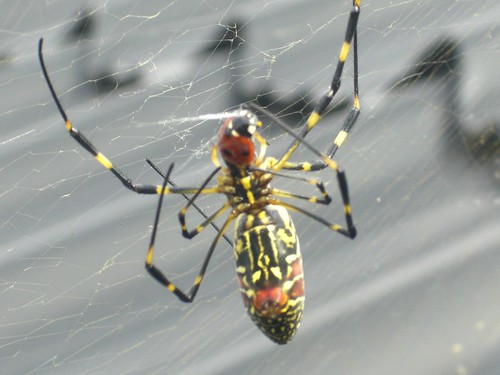
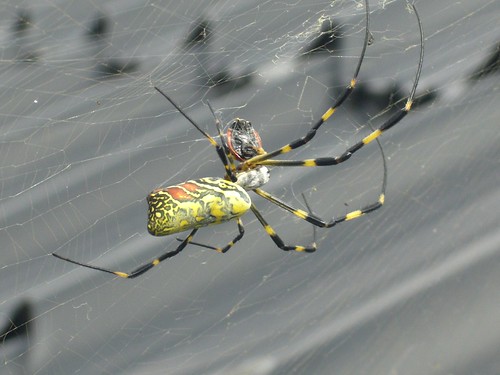
Forget swine flu, it's nephila clavata (무당거미) season. Those three---two females and a male---were hanging out *cough* near the entrance of Chonnam National University last week, as was this one:


Here are a couple photographs I took in Beolgyo-eup, Boseong county a couple of years ago. You'll find one of the pictures on Wikipedia because it's awesome and terrifying because I put it there.


When they reach maturity their bodies are roughly eight feet long and 600 pounds, and they live in colonies of up to 1,000.

Thursday, September 17, 2009

Elephant scores head shot at Children's Grand Park Zoo.

All kidding aside, I hope she's all right. An excerpt from the Herald on the incident at Children's Grand Park (어린이대공원):
Bewildered police, for the first time, are to investigate an elephant on charges of assault on a person.

The unprecedented case was reported to the Gwangjin Police Station on Monday in which a 48-year-old woman surnamed Kim claimed to have been hit with large stones, thrown by an elephant, according to police officials yesterday.

Kim was taking a walk on Monday morning in the Children's Grand Park Zoo in eastern Seoul, when she was knocked down by a blow to the back of her head.

When she recovered from the initial shock, she found two stones close by, each the size of a grown-up's fist.

The only potential aggressor that she could see in the perimeter was the elephant in a nearby cage, she said during police questioning.

The woman holds the zoo responsible for not supervising the animal, and police are checking the CCTV tapes. After reading about how vindictive elephants can be, and seeing how animals can be treated at zoos here, I wonder if we need to read anything into this attack on humans.

Wednesday, September 9, 2009

World's biggest pterosaur footprint found in Gyeongsangbuk-do.

Here's some exciting news, from the Dong-a Ilbo:
The world’s largest pterosaur footprint has been discovered in Gunwi County, North Gyeongsang Province, the National Heritage Center said yesterday.

An affiliate of the Cultural Heritage Administration of Korea, the center said, “A pterosaur footprint 354 millimeters long and 173 millimeters wide was found in late March. The footprint was discovered in a geological stratum belonging to the Cretaceous Period of the Mesozoic Era dating back 90 million to 110 million years ago.”

Given the size of the footprint, the pterosaur is estimated to have wings longer than six to seven meters.

After six months of study, the center concluded that the footprint is the world’s largest.

That is interesting news, but I bring this up for another reason: namely, the chance to repost one of my favorite entries. You see, prior to this discovery, the largest one was discovered in Haenam county, Jeollanam-do---meaning South Korea has the two largest pterosaur footprints in the world---and local researchers were working to get Jeollanam-do's many dinosaur sites registered on the UNESCO World Natural Heritage list. Said one of the researchers from Chonnam National University attached to the project:
"It's not impossible and we are hoping for the best. If they do decide to register the area, it will bring a whole new dimension to the study of Korean dinosaurs."

Ah, so now there are Korean dinosaurs. Please don't tell anyone, though, because then you'll never get them to shut up about "Do you know? Korea has 100 million years of history."

Thursday, September 3, 2009

Korea Times runs fake jellyfish photo, seems to be a fan of the Google image search.

I was reading over on Gangwon Notes about the growing jellyfish population this time of year, and noted with terror the photograph that accompanied the Korea Times article.


It's of a Nomura jellyfish, and the article has this to say:
Nomura jellyfish make up the majority of the population and are one of the largest types of jellyfish. They can grow up to two meters in diameter and weigh up to 220 kilograms.
The photograph is attributed to Yonhap, though Gangwon Notes wonders whether its real. I looked into it, too, and did a Google image search for "huge jellyfish" and came to this post on a blog named Cakehead Loves Evil which has the same debate in the comments section . . . and a great collection of jellyfish photos. A few seconds more and I found the "Real or Not" debate among divers on Divester.com, with the consensus being "not." I'll give the final word to the site Museum of Hoaxes, which says "probably fake." The Photoshopped jellyfish photograph is the second result for a Google image search for "Nomura jellyfish," so that's probably how that worked. For comparison's sake, here's another photograph of a diver and the business end of a Nomura jellyfish. The article even says "Sea of Japan," right in the first damn sentence, so case closed.

Sunday, June 21, 2009

The Joongang Ilbo always has neat features, and last week was one about tigers in Korean zoos and the challenge of finding mates for them. Who knew there were three Siberian tigers in Gwangju?

On the topic of wild cats, I've been having students read from a book about them for the school's afterschool English class. That reminded me of a post on Dave's from last summer about a teacher in Yeosu who came across a dead 삵 in the middle of the road. He explains that the Salg (삵) is a wild cat found in Korea, a fun fact I hadn't heard before or since. The Latin name is Prionailurus bengalensis euptailurus, and a search tells me they're better known as "Leopard cats."

Sunday, May 17, 2009

How about some whale chobap?


A chef displays some whale chobap (sushi) at the Ulsan Whale Festival (울산고래축제). I first heard of this three minutes ago via East Windup Chronicle. Ulsan does, as Shinsano says, have a conflicted relationship with whaling. It is illegal, one the one hand, but it has been a part of the city's culture for quite a while, dating back to some cave paintings. Here's a picture of a reenactment from 2007.


It comes from a Joongang Ilbo article from January, 2008, which is my favorite example of this ambivalence. The opening paragraph:
Eating whale meat here can be an unsettling experience.
The International Whaling Commission banned commercial whaling worldwide in 1986. That means, according to law, restaurants in Ulsan are only allowed to serve whale meat that has been caught “by accident” in fishing nets or washed up on shore already dead.

The informative piece on Ulsan's history as a whaling port closes with recommendations for whale restaurants.

For whale meat, check out Wonjo Gorae Matjip (052-261-5060), or The Original Whale Deli, which charges 30,000 won ($32). The better known whale meat restaurant is Gorae Halmaejip (052-265-9558), or Whale Grannie’s House. The menu includes whale stew.
A cheaper option is to buy whale meat in Joongang Market in central Ulsan, but be ready to compromise on sanitation.

For the record I don't have any problem with hunting whales for meat; certainly no worse than slaughtering them for oil, as the US once did, and provided the hunting is done responsibly among species that are not endangered, I see no difference between hunting whales and other wild animals. With regards to whaling in Korea, and certainly in Japan where it gets much more heat from the international community, I see the objections largely because the practice is rendered exotic to and by westerners, as a backwards and barbaric practice that is supposed to be less civilized than the hunting done in their own countries.

In some ways it's no different from dog meat in Korea, and indeed the title and the opening picture of raw meat is a much more sensational introduction than, say, a cave drawing would have been, and is the kind of thing people are looking for when they hear of whaling in Korea. I would be lying if I said I didn't have a soft spot in my heart for dogs over other animals, but my objection to eating dog meat, and this objection is echoed by many other foreigners, is because of the way these animals are treated and tortured. However, when people look down their noses at Asians for eating dog---and all Asians eat dog, or so the ignorant stereotypes would have you believe---it's because these animals are considered part of the family, unlike the chickens, cows, pigs, deer, fish, or other animals we consume in massive quantities. Although Wikipedia has a fairly sizable run-down of the arguments for and against whaling, I suspect in the minds of many people, it doesn't get down to anything more sophisticated than "those people eat whale?!?!?"

Wednesday, May 6, 2009

A visit to the Hampyeong Butterfly Festival.


Here's a map of the festival grounds, from the festival website. Quite large, as you can see. Actually, the festival website still has information about the 2008 Expo, but I suppose that's close enough 2893u4q8ru39rfoajlsd.

This weekend was a big one for festivals, and I managed to get to four of them. Because I hate Korea so much, I ended up taking around 700 pictures, and will try to find time to get them up this week. The first one I visited was the Butterfly Festival in Hampyeong county. It runs through next weekend, so if you're in the area and looking for something to do, there's that. The festival site is huge, there are a lot of pretty flowers, and is relatively popular: this article says that about 110,000 people attended on May 2nd and 3rd. We didn't bother looking at the butterflies this year, and didn't look in many of the indoor exhibitions. I recall from last year that they were all pretty lame, and so I didn't want to waste any time standing in line to look at corn. As for the butterflies, I suppose I'm a little hard to please because there is a more impressive variety of animals and insects at my parents' house in Pittsburgh, and I would meet about as many butterflies on my way to the mailbox as I did last year at the World Butterfly and Insect Expo. Like I said, go if you'd like to take a stroll in a very big park; it's only thirty minutes from Gwangju.

It rained pretty good on Saturday and the weather was bad Sunday morning, so we didn't actually leave the house until about 1:00. My girlfriend had class on Monday, so we didn't stay long enough to see everything. Here are a few pictures I took with my new point-and-shoot; there are many more in my flickr gallery. First up is porn, a mainstay at festival dollar stores.


You would be surprised how many hits I get for "hospital porn" each day, and I will guess I am now your one-stop shop for "Hampyeong porn" on the internet. From the bus terminal to the festival site is a long market area rows of tents covering restaurants, games, clothes, souvineers, and various knick-knacks. Here's some food.


It was a beautiful day when we finally got there.


Clouds came and went, and I'll blame the overall poor quality of my pictures on them. Actually, I was playing with a new Casio point-and-shoot for the first time, and I didn't realize the photographs looked so bad until I got them home. It looks like I had the flash on for most of them, which gave them a yellowish tint. In fairness, though, you hardly ever accurately capture a festival on camera, so I'll just leave it at that.


There were statues of famous Korean entertainers. Here is Bae Yong-joon and Choi Ji-woo from the soap opera Winter Sonata ridiculous ridiculously popular among Japanese.


And here's BoA.


Here's the Obama cut-out that Hampyeong debuted in November. I suppose the "Yes we can" in Hampyeong's case refers to the county's efforts to become a leading eco-tourism destination.


I stood still for a couple seconds for the picture, and when I moved I startled a woman who assumed I was cardboard as well. "No," I said, "that's just my personality."

A few pictures of the scenery.


There was a field of painted cows.


And a large rope snake.


Here people could choose items for a hypothetical meal, and the cashier would scan the barcodes to tell them the nutritional information.


More scenery.


There's a hill behind the festival grounds, with a cute little exercise area halfway up. Don't bother waiting in line at the library upstairs unless you have small children.


Here's a view of half the festival grounds. There's a small amusement park and a pond with duckie boats int he background.


Because we had to leave early we skipped many of the exhibits, although we did look through the bat exhibit that had no bats. We also, unfortunately, hurried through the left side of the map up top.


Here children were catching mudfish (추어, in Korean), at what was probably the least favorite part of the festival for mothers.


As you can see from the splashes in the water, a man periodically threw more in.


The day's haul.


Some of the star performers.



Again, it's worth a trip if you live nearby and would like to stroll around outside for a little while. Don't expect too much on the butterfly front, though, and expect to be a little disappointed if you grew up around nature. I wonder if it's too early in the season to have butterflies outside, or if the climate has more to do with it. But for people who have spent most of their lives in cities and far from nature, I suppose the festival is more appealing. And since we're being cranky, if you're trying to promote your county as a world-reknowned eco-tourism destination, and if you're trying to push your festival as one of the best in the nation, it would be a good idea to have a foreign-language version of the website and to offer information current to this year.

It only takes about thirty minutes from Gwangju, and buses leave about once an hour. On the way back, though, there's a good chance you'll have to take one of the Hampyeong local buses that run frequently to Gwangju; they'll take about an hour to get back.