Showing posts with label Jeollanam-do. Show all posts

Monday, December 19, 2011

Old photos of Jeollanam-do and Gwangju.

1941 Jeollanamdo Provincial Office
Taken in front of the Jeollanam-do Provincial Office, 1941.

Sajik Park
Sajik Park observatory in the foreground, Gwangju and Mudeungsan in the background.

Building Chosun University 1951
Chosun University under construction, 1951.

For a while I've been collecting old photos of Jeollanam-do and Gwangju---politically part of South Jeolla province since 1986---and recently started to put them in one place. Finding pictures of what southwestern Korea used to look like is generally much harder than finding old photographs of Seoul, and even Pyeongyang. Some local governments, schools, and charitable organizations have fortunately documented and preserved the photographic history of the region.

Suncheon English class.
English class in Suncheon under Japanese rule.

Suncheon fortress, South Gate
Suncheon Fortress's South Gate in the 1920s, at the present-day location of the entrance of the 중앙시장 in "Old Downtown".

1960s Suncheon
Aerial view of Suncheon, 1960s.

About 200 more, and growing, on the Old Jeollanam-do Flickr gallery. Sources have been cited when possible, though a lot of these have circulated on numerous blogs throughout the years and it's hard to pin down dates, details, and credits. Frequently Naver bloggers will take old photos, put big watermarks across them, and disable right clicks, leading visitors to believe the best way to preserve local history is to make it inaccessible to everyone else.

Bbong Bbong Bridge 1960
뽕뽕다리 across Gwangjucheon, 1960.

Chonnam University 1959
Chonnam National University campus, 1959.

Gwangju cherry blossoms 1955
Cherry blossoms in Gwangju, 1955.

Tuesday, November 22, 2011

“The Living Ocean and Coast” means build as much shit on it as you can.


The Chosun Ilbo has some news about proposed development of some of Yeosu’s heretofore uninhabited islands.
Plans are afoot to develop parts of a sprawling archipelago in the sea near Yeosu, South Jeolla Province into tourism resources. The waters contain over 310 uninhabited islands, some featuring stunning scenery, and the provincial government aims to build up facilities at a select few to attract Chinese visitors given the recent boom in outbound tourism from the country.
. . .
Centering on some of the islands that are more accessible and easier to develop, the ministry plans to create a diverse list of tour programs including island treks, eco-friendly programs and maritime sports activities. According to the plan, yachts will shuttle visitors between the islands and the mainland free of charge.

But some critics have expressed concern about the risk of environmental damage. In response, the ministry conducted a survey on 680 of the 2,900 or so uninhabited islands in the seas off Korea and put 170 on a protected list, meaning development is prohibited in these areas to conserve the environment.

The rest have been categorized as appropriate for development, but the ministry plans to issue clear guidelines to make sure this is done in a sustainable and non-harmful manner.
“The Living Ocean and Coast” is, of course, the theme of the 2012 World Expo scheduled for May 12 through August 12, 2012, in Yeosu.

The local governments often send mixed messages on conservation versus exploitation. In 2008, the year the Ramsar Convention on wetland preservation was held in Gangwon province, the Saemangeum development project was in full swing on the west coast. From the International Herald Tribune:
[Developers] will replace natural wetlands with artificial ones and turn riverbeds into lakes. They will build a park along the road on the sea dyke and try to attract tourists with a theme park, convention center and even perhaps a casino.
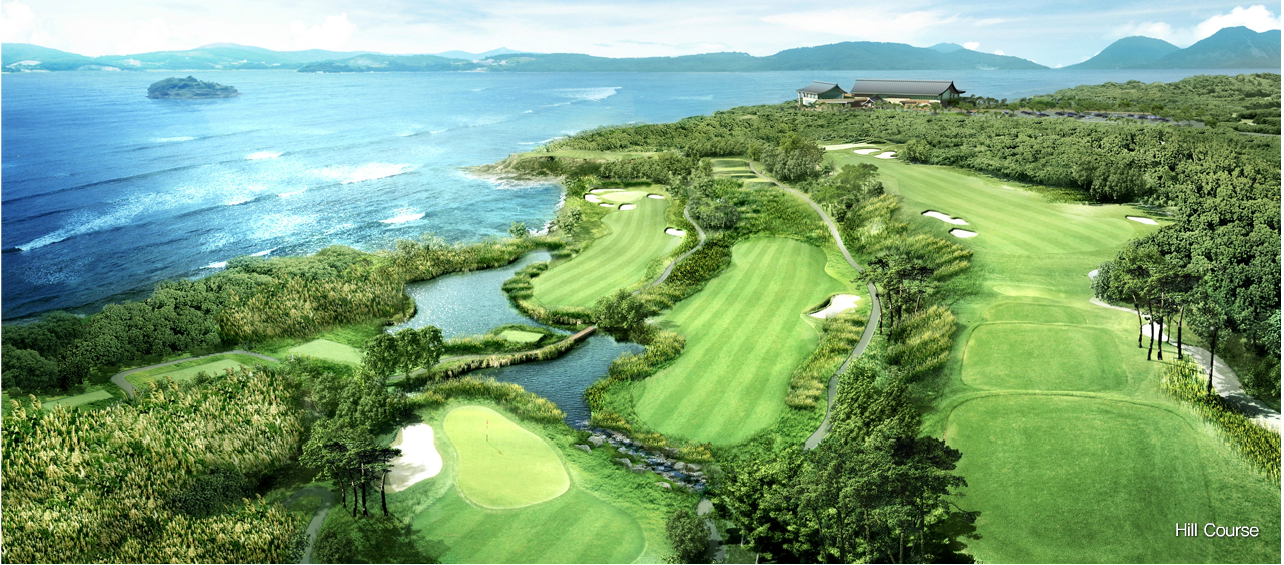
And in December 2007, a few weeks after Yeosu was awarded the Expo, developers announced plans to build five or six golf courses in rural parts of the city, thereby replacing some of the city’s green with greens (here and here are two looks at the construction of one). Interestingly one of the big projects in the news now includes turning an island into a golf destination:


The Yeosu Island Golf & Resort (여수 경도 골프&리조트) will be built on Gyeongho-dong's Daegyeong Island (대경도), and will include condos, villas, and three nine-hole golf courses. Daegyeong-do is next to Dolsan-do, and is right across from the Dolsan Bridge. It isn't uninhabited, though: there's a school, a few roads, these sweet-ass floating guesthouses, and 1,345 people at the last census. Construction began in September 2010, and should be finished by 2016.

According to figures from the Korean Coast Guard, there are 1,966 islands in Jeollanam-do, 1,688 of which are uninhabited. These numbers are a little out of date, and in April 2010 the government added another 281 uninhabited islands to the province’s total.

Sunday, November 6, 2011

Mudeung Stadium, then and now.

Here's a look at Gwangju's two stadiums in Im-dong in 1965:

Mudeung Stadium 1965

And here's how the area looked in March, 2009 via Naver's map system:

Gwangju Sinan-dong
According to the Gwangju city webpage, the population in 1965 was 365,611, and in 2010 it was 1,467,996. The old track stadium---opened in 1965---is being replaced with a new baseball stadium for the Kia Tigers' 2014 season.

Saturday, October 29, 2011

"Slow city" Jeung-do in transition.

Naver's looking out from above Eldorado Resort.

Claire Lee in the Korea Herald looks at Shinan county's Jeung-do nearly four years after it was one of four areas in South Korea designated as "Slow Cities" in December 2007.
Being the first slow city of Asia, along with the completion of the bridge that connects the island to the peninsula ― which opened last year ― brought many changes to Jeungdo. As the number of visitors increased dramatically, the island faced more demand for accommodations and tour packages. This had both positive and negative impacts on the island, placing Jeungdo somewhere in between further development and the expected “slowness.”

For more about Jeollanam-do's "slow cities"---actually two cities and two rural counties---over the years:
* February 15, 2008: Jeollanam-do's slow cities.
* March 24, 2009: Jeollanam-do is a little slow.
* December 28, 2009: "Slow City" in Shinan working hard to stay slow.
Nearly two years ago we read of Jeung-do in the JoongAng Daily that "A rare experiment to create an island free of cigarette smoking, cars and night lights has begun in Korea’s southern region." But in this month's Herald piece we see a conflicted Jeung-do:
Lee Jong-hwa, the representative of the local tour agency Gilbeot, on the other hand, has been receiving complaints from visitors and scholars, that Jeungdo isn’t “slow” enough. One of the scholars that contacted him pointed out that most buildings on Jeungdo are modern-day residential ones, carrying no particular aesthetic values. Unlike other slow cities in Korea, such as Changpyeong of South Jeolla Province or Yesan of South Chungcheong Province, Jeungdo doesn’t have any traditional Korean houses or ancient Buddhist temples. “He said we should in fact ‘create’ traditional homes, at least just to show the visitors, to serve the purpose of being a slow city,” Lee told The Korea Herald. “But we cannot live a lie for the sake of a slow city.”
Still interested in visiting? Search the Korea Tourism Organization's webpage for a couple of articles on it. There are a couple of big---well, um, slow city big---festivals: the Slow Salt Village Festival (SLOW 소금마을 축제) from May to July at the Salt Village, and a Mud Festival that hasn't yet been debauched (신안 섬갯벌 축제) in July.

Tuesday, October 18, 2011

Yŏsu-Sunchŏn Incident (여순반란사건), October 1948.


By Carl Mydans, for Life magazine.

Wednesday, October 19th, marks the anniversary of the "Yŏsu Rebellion," written in English also as the "Yŏsu-Sunchŏn Incident" or the "Yŏsu-Sunchŏn Rebellion," one of several bloody exchanges in Jeollanam-do last century, and one whose background serves to foreshadow the violence of the Korean War two years later. The 여순반란사건 was a crackdown against suspected communists in South Jeolla province, specifically the cities written now as Yeosu and Suncheon, that resulted in hundreds or thousands of deaths, depending on the source.

Saturday, October 15, 2011

US announces participation in 2012 Yeosu Expo.

On the 13th the US State Department officially announced its participation in the Yeosu Expo, scheduled for May 12th through August 12th, 2012.
Joining more than 108 countries and international organizations, USA Pavilion 2012 will build on the Expo’s overall theme of “The Living Ocean and Coast,” and showcase the diversity, spirit of entrepreneurship, innovation, and commitment to sustainable development of the American people. U.S. participation in Expo 2012 Yeosu Korea demonstrates U.S. commitment to deepening our friendly ties and strengthening U.S. – Republic of Korea (ROK) relations and engagement in the Asia-Pacific region.

I'm sorry to see the theme will incorporate my least-favorite buzzword, the s-word:
Focusing on the themes of Diversity, Wonder, and Solutions, the USA Pavilion 2012 is expected to reach millions of visitors through a host of exciting technologies and storytelling. A highlight of the USA Pavilion experience for visitors will be their interactions with Student Ambassadors. In partnership with the University of Virginia, 40 college-aged American Student Ambassadors proficient in Korean will be selected to serve as representatives of the United States, engaging directly with USA Pavilion visitors and supporting the USA Pavilion operation.

Official site of the USA pavillion here, brochure for University of Virginia Student Ambassador Program here. Canada, we learned in August, will not participate.


The International Pavilion (국제관).


Under construction in September.

Monday, July 25, 2011

Smaller mud festivals in Yeonggwang, Gochang counties this July and August.

If you'd like to try out a mud festival in Korea but don't want to deal with the overcrowding, the drunks, and the pervy photographers that are associated the famous one in Boryeong, there are a couple other options in the Jeolla provinces.


Yeonggwang county will be holding its 3rd annual Mud Marathon Festival (머드마라톤대회축제) on July 30th and 31st. The actual "mud runs" will take place the morning of Sunday the 31st (registration closed July 15th, but hey I gave you plenty of advance notice), though other performances and activities are scheduled, including a mud slide, mud sleds, and tug-of-war. A Korean-language program is available on the website. County buses run from the bus terminal in Yeonggwang-eup to Yeomsan-myeon and Baekbaui Beach (백바위해수욕장).

And check out Jeollabuk-do's Gochang county the next weekend for a similar set of events (전국갯벌스포츠축제). Hat tip to the Gwangju News editor for that one.

Saturday, July 9, 2011

Ferry to run between Fukuoka, Yeosu during 2012 Expo.


Test run from Fukuoka to Yeosu. (Yachtpia)

The Beetle Ferry, which currently operates between Busan and the Japanese city of Fukuoka, will make daily trips from Japan to Yeosu next year while the Jeollanam-do city hosts the 2012 World Expo. From the Korea Herald last week:
The state-run Korea Tourism Organization said Wednesday that it has secured a sea route linking the southern port city of Yeosu to Fukuoka, southwestern Japan, in preparation of next year’s Yeosu World Expo.

The organization, together with the South Jeolla provincial government and the Yeosu city government, has arranged for a chartered ferry service by Japan’s Kyushu Railway Co. (JR Kyushu) over the route.

The high-speed ferry “Beatle” [sic] will travel once a day between Yeosu port and Fukuoka’s Hakata port during the 2012 Yeosu Expo, scheduled to run May through August next year.

Beatle is capable of accommodating 200 people and takes three hours and 45 minutes for a one-way trip, with the ferry service estimated to cost about 200,000 won ($185.36) per passenger.

Fukuoka is probably best known to foreign teachers in Korea as a nearby visa-run destination, but as I learned in late-2009 it's fine for a short vacation, too.

Sunday, May 1, 2011

May 2011 festivals in Jeollanam-do.

Spring and fall are two excellent times for travelling around Jeollanam-do because of the dozens of festivals large and small taking place in its cities, towns, and villages. Here's a brief look at some of the bigger ones; a Naver search and a look around local websites will be your friend for more boring ones others.


Hampyeong Butterfly Festival (함평나비대축제) in Hampyeong country through May 10th. One of the region's better-known festivals, it's essentially a nice walk through a big park, I concluded during a 2009 visit it's somewhat lacking in butterflies in a natural setting (at least for those who come from places with abundant nature). A short walk from the bus terminal in Hampyeong-eup, in turn accessible by regular buses from Gwangju. Times available from the Gwangju U-Square terminal website, in Korean.


Damyang Bamboo Festival (담양대나무축제) in Damyang county from May 3rd through May 8th. One of the province's representative sites, it's a short bus ride from Gwangju. Worth a visit anytime during the spring and summer months, the festival offers the usual, um, festivities.


Shinan Heuksan Skate Festival (산안흑산홍어축제) on May 6th and 7th. One of the two big hongeo festivals in Jeollanam-do celebrating the region's affinity for the acquired taste of fermented skate. Somewhat out of the way on Heuksan-do, one of the 1,004 islands that comprise Shinan county, those with time and an interest in seeing an even more remote part of Jeollanam-do would probably enjoy the trip.


Jeamsan Azalea Festival (제암산철쭉제) on Mt. Jeam in Jangheung county on May 8th.


Seomjin River Azalea Festival (섬진강 철길 철쭉축제) in Gokseong county on May 7th and 8th.


Boseong Green Tea Festival (보성녹차대축제) in Boseong county from May 4th through the 8th. The tea fields in Boseong have provided this blog's header for years, and the area is worth a visit for anyone living, um, in the area. It offers the usual stuff, plus green tea samgyeopsal, green tea noodles, green tea ice cream, and green tea green tea. Buses run regularly to the main field from the terminal in Boseong-eup, and there is a small entrance fee.


Suncheon Nagan Folk Culture Festival (순천낙안민속문화축제) in Suncheon's Nagan Folk Village from May 13th through the 15th. In one of my favorite places in Jeollanam-do, here are some posts and pictures from previous years: from May 2008, October 2008, and an unblogged set from May 2009. The folk village is accessible from downtown Suncheon via city buses 61 and 63 (timetable, in Korean), and when you get off at the village you'll find a timetable for buses returning to town.

Thursday, April 21, 2011

2011 Yeongsanpo Skate Festival (영산포홍어축제): April 22nd - 24th.


Short notice with this---an earlier search told me it was actually scheduled for last week---but the 2011 Yeongsanpo Skate Festival (영산포홍어축제) will take place in Naju from April 22nd through 24th. Skate (홍어, hongeo) is ray that when eaten raw tastes, and smells, sort of like a cleaning product, but which has a strong enough following to inspire festivals in Naju and Shinan county. You'll find a little more information on the festival from the Naju city announcement, in Korean, and you'll find buses that stop in Yeongsanpo from Gwangju, Suncheon, most towns in western Jeollanam-do, as well as from Naju itself.


A big catch a few years ago, from Naver via this post.

Naju has a lot of historical points of interest but doesen't get as much attention as Gyeongju or even Buyeo, but is worth a visit all the same. It used to be a major port city during Japanese occupation, and Yeongsanpo still has a few architectural reminders, the old lighthouse in the poster above being one of them.

Saturday, April 9, 2011

Tulip, Slow-Walking festivals on Jeollanam-do islands this April.


The Cheongsando Slow Walking Festival(청산도슬로우걷기축제) is held each year on Wando county's Cheongsan island, probably the best-known of Jeollanam-do's much-publicized "Slow Cities" (paradoxical in times like this). There's an English-language overview here, though the highlights are the views of the sea and flowery hillsides. Buses run to Wando from Seoul, Gwangju, Gangjin, and Haenam, and from the Wando bus terminal you can catch a ferry to Cheongsan island (schedule here, in Korean). Now through April 30th.


From the official site's photo gallery.

The Shinan Tulip Festival (신안튤립축제) takes place from April 15th through 24th. It's held at Daegwang Beach (대광해수욕장) on Imja-do, an island of roughly 4,000 in Shinan county, one of the three counties in Jeollanam-do comprised entirely of islands. Imja-do is accessible by ferry from the terminal in Jido-eup (점암선착장), and Jido-eup is in turn connected to the mainland. The bottom of this page has ferry times and fees, in Korean. Buses make the two-and-a-half hour trip from Gwangju's bus terminal to 점암선착장---making several stops in between---each day at 6:45, 7:45, 8:20, 9:50, 11:30, 13:20, 14:25, 16:00, and 18:55, and buses from Mokpo head to Jido nearly once an hour, though in both cases make sure you check at the ticket counter and with the driver.

Thursday, March 31, 2011

Cherry blossoms in Jeollanam-do, and more flower festival cancellations.


The Korea Meterological Administration says Jeollanam-do can expect cherry blossoms from April 2nd, about a week later than in 2010. There are several "spots" in Jeollanam-do regionally-known for its cherry blossoms, and though Suncheon isn't really on that list I think it belongs there because of its beauty and its visitor-friendliness.

SDC10747
SDC10723
More on
cherry blossoms in Suncheon.

Several flower festivals in Jeollanam-do this April have been cancelled due to foot-and-mouth disease. These include the Yeongchuisan Azalea Festival (영취산진달래축제) in Yeosu, the Wangin Culture Festival (영암왕인문화축제) in Yeongam, the Seomjin River Cherry Blossom Festival (섬진강변 벚꽃축제) in Gurye, and the Yudalsan Flower Festival (유달산꽃축제) in Mokpo.


Like other cancelled festivals based on natural events, these blossoms won't be cancelled, just some of the accompanying festivities, so don't hesitate to go and take in the sights.

Thursday, March 24, 2011

Remote English classes continue for Jeollanam-do's island schools.

GFN 98.7 FM writes that the Jeollanam-do Office of Education will continue remote English classes for students on rural, geographically isolated islands in the province.
The Jeollanam-do provincial Office of Education is offering remote English courses from [March 22nd] The teachers are located in Canada, the United States and the United Kingdom.
Some 2 thousand students will benefit from the program. These include those studying at sixty-six mini schools on five islands and 52 schools with less than 60 students.
The program has been offered every year since 2009. Last year about 1,300 students learned from native English teachers.
One native teacher handles five students with the assistance of one Korean sub-teacher. Classes will be offered one hour a week for a year.

This blog has done a few posts on similar programs done throughout the country that use teachers in the state of Wyoming and other rural areas to teach Korean students via videoconferencing. Elutian, a Wyoming-based company, had the bright idea to both "insource" jobs to rural America and meet the demand of reduced-cost native speaker English teachers [NESTs] in South Korea, a place turning to robot English teachers, certified Indian teachers, and domestic instructors to cut costs. It has been working with the nearby Gwangju Metropolitan Office of Education since 2010, says a September 2010 article attributed to Yonhap:
GMOE disclosed Sep. 30 that, “Surprisingly, over 31,600 students are using the video class service for English conversation with U.S public school teachers.

The project began in earnest the latter part of June and by the end of August 22,300 elementary school students, 7,300 middle school students, and 2,070 high school students are engaged in the service.

Moreover, it is reported that 5,356 students from smaller schools in the farming areas, as well as Education Welfare schools, many of whom need special social consideration, are using the service.

Participating students also study English by directly conversing with the native English speaking teachers one-on-one through their school’s internet video system after school (7:00~11:00 PM).

Early this year GMOE selected 146 instructors from a pool of former and current school teachers, mostly based in Wyoming, US, [Eleutian Technology] for the service. A number of other Korean school district offices of education are now also using live native English video for regular classes, but GMOE is the first one to utilize the service for one-on-one sessions after school hours as well.

While there continues to be a large demand for native English speaking teachers in Korea, there has also been much controversy over the hiring of unqualified instructors. The ongoing GMOE project, however, is recognized as both very cost effective and effective at helping to improve the quality of instruction, as well as student results, through utilizing experienced US public school teachers.

Youtube has examples of the TV teacher in action:


The local office of education has also been operating remote teaching programs with native speaker English teachers from within the province since 2009. For information and teacher-created resources, see the Jeollanamdo Online Program board on Waygook.org.

Sunday, March 20, 2011

50,000 attend first day of Jindo Sea-Parting.


The 34th annual Jindo Sea-Parting Festival (or Jindo Sea Road Festival 진도 신비의 바닷길 축제) was one of several early-spring cancelled in February and March because of concerns over foot-and-mouth disease. However, 50,000 people---including 2,000 foreigners by Yonhap's estimation---participated in the twice-yearly sea-parting event between Gogumyeon's Hoedong-ri and the small island of Modo. The tide goes out and opens a 2.8-kilometer path, though on the 19th people could only walk out roughly 40 meters, according to the article.

In 2010, according to a Newsis article, 440,000 tourists attented the festival, among them 25,000 foreigners.

Friday, February 11, 2011

2011 Gwangyang "International" Maehwa Festival and other March events in Jeollanam-do.

Spring and fall are two big festival seasons in Jeollanam-do, with a good dozen festivals worth visiting. Pickings are slim in March, and may be even slimmer if festivals are cancelled this month due to foot-and-mouth disease (like they were in December and January), but there are a few big ones coming up.

The annual Gwangyang Apricot Blossom Festival (광양매화축제) will be called the Gwangyang International Apricot Blossom Festival (광양국제매화축제) for the first time in 2011, apparently for no real reason ("광양 매화축제, 이름만 '국제'" ), though domestic festivals are known to do this to sound more, well, international. It will run from March 12th through the 20th.


The Gwangyang Apricot Blossom Festival is usually the first spring festival, and marks the beginning of the season for southerners.

Both of my attempts to visit it were unsuccessful: once because I couldn't find the bus and another time because it was too damn cold. Your best bet is to take a bus to Hadong county in Gyeongsangnam-do and walk through town into Gwangyang. You'll find apricot blossoms along the river and will pass through a small market and festival area before finding the shuttle buses that will take you to the Apricot Blossom Village (매화마을). The official website hasn't been updated since last year. See this post of my half-visit in 2009 for more information.

In Gurye county the annual Sansuyu Festival (산수유꽃축제) runs from March 17th through the 20th. The official site hasn't been updated since last year, though it tells you buses run regularly from the terminal in Gurye-eup.


And, the regionally-famous Jindo Sea Road Festival (진도 신비의 바닷길 축제), known also as the Sea-Parting Festival and the Jindo Moses Miracle, will take place from March 19th through the 21st. A few times a year the tide goes out and allows people to walk the 2.8 kilometers between two small islands in Jindo county. The program on the homepage is still under construction, though you'll want to take care to visit on the day when you can actually walk between the two islands. In addition to wading into the sea there is the sort of food and performances you'll find at every Jeollanam-do festival, as well as Jindo dogs and other entertainment.


Here's a profile on the Sea-Parting Festival from the Korea Tourism Organization, and pictures from Jindo's biggest blogger, Living Life Frame by Frame, here and here. Accommodation will be scarce, so if you're from out of town I recommend you find a motel in one of the nearest transportation hubs: love motels are plentiful outside of the bus terminals in Gwangju and Suncheon, for example.

Saturday, January 29, 2011

People still care about Twinkies?

The exchange program between sister cities Gangjin and Snoqualmie, Washington, has gotten a relatively good bit of press the past couple years. This month a Gangjin middle schooler's trip over winter break made the local paper, the SnoValley Star.
Fresh off the airplane after a grueling trip from Korea, teenager Eun Seong confessed to one big objective for his monthlong trip to Snoqualmie.

“I want to eat a Twinkie,” he said during a reception at Mount Si High School in Snoqualmie, sister city of Seong’s hometown of Gangjin.

Thursday, January 20, 2011

FMD means Koreans urged not to travel (or travel to Jeollanam-do) for Lunar New Year.

The Korea Times writes about local governments' efforts to discourage Koreans from travelling around the country this Seollal in order to prevent further spread of foot-and-mouth disease.
Many Koreans who work and live in Seoul and other urban areas were born and raised in the provinces. It is a decades-old tradition that they visit their hometowns to see their parents, relatives and friends at least twice a year ― the Lunar New Year (or Seollal) and Chuseok holidays.

But this biannual ritual may not materialize during the upcoming Lunar New Year holiday from Feb. 2 to 6 as the mass migration could cause the spread of foot-and-mouth (FMD) disease and bird flu to uninfected areas.

Since the first FMD outbreak was reported in Andong, North Gyeongsang Province, on Nov. 29, the deadly virus has spread to nearly all parts of the country, except for the southern regions ― South Gyeongsang Province, North Jeolla Province, South Jeolla Province and Jeju Island.

. . .
In a desperate attempt to stop the devastating epidemic, scores of provincial governments have launched a campaign to prevent people from traveling to other areas during the Lunar New Year holiday.

Among others, South Jeolla Province, which has seen not a single case of FMD, is asking those who plan to visit there during the five-day holiday not to do so in a bid to stop the spread of the highly infectious virus.

The provincial government has asked dozens of organizations made up of individuals born in the country’s southwestern province not to visit their hometowns.

``If we can prevent FMD from spreading to our area during the upcoming holiday, we are positive that South Jeolla Province will remain FMD-free. It is not easy to say this but we desperately need people who have family members here not to come this time,’’ said Lee Ki-ho, director of the livestock quarantine department at the South Jeolla Provincial Government.

The other 362 days out of the year you couldn't convince many Koreans, or expats for that matter, to visit Jeollanam-do, but as The Waygook Effect says given how little vacation time Koreans take it's unlikely that local officials will discourage Koreans from driving cross-country for one of its biggest holidays.

Thursday, January 13, 2011

Conspicuous (burger) consumption in Gangnam?

I don't care much about the trend the 파이낸셜뉴스, and the Korea Times in English, is trying to note, but I was interested to learn a few facts about the fastfood industry in Seoul. From the Korea Times:
Lotteria operates the largest number of franchised stores in Seoul among the home-grown and foreign fast food chains, but the U.S.-based Burger King, which offers pricier selections, has more outlets in affluent southern Seoul districts such as Seocho, Gangnam and Songpa, the Center for Freedom of Information said Wednesday.

The center said there are currently a total of 327 fast food restaurants operating across the nation’s capital, with Lotteria owning the largest number at 130, followed by McDonald’s at 62, Burger King at 60, KFC at 43 and Popeyes at 32.

The basis for the title "Pricey Burger King popular in Gangnam" comes from comparing the most-popular items on the menus of Lotteria and Burger King. Lotteria's Hanwhoo Bulgogi Burger set costs 5,100 won, while Burger King's Double Whopper Set costs 8,600. It's worth noting that Lotteria's 한우불고기"세트" is only a burger and a small drink, while Burger King's has the more familiar medium fry and medium soda.

mk뉴스 tells us how many of each fast food chain are in Gangnam, the most affluent ward of Seoul:
강남구는 버거킹 11곳, KFC 7곳, 맥도날드 6곳, 롯데리아 3곳 순이었다. 서초구도 버거킹 10곳, 맥도날드 6곳, 롯데리아 5곳 순이었고 송파구는 버거킹 9곳, KFC 8곳, 맥도날드 3곳, 롯데리아 2곳 순이었다.

While Yonhap provides this neat map showing the geographic distribution of fast food chains Lotteria (blue), McDonald's (purple), Burger King (red), KFC (yellow), and Popeye's (green) in each ward throughout the capital.


For the sake of comparison, the whole of Jeollanam-do---not including Gwangju---has 42 Lotteria, 3 McDonald's, 0 Burger King, 0 KFC, and 2 Popeye's.

Bird flu spreads throughout Jeollanam-do.

Arirang reports:
A state of emergency has been declared on Tuesday here in Korea as avian influenza continues to spread.
According to the agriculture ministry, the flu is spreading rapidly throughout South Jeolla and Gyeonggi provinces.
As preventive measures, chicken and ducks within a three-kilometer radius of the affected farms will be put down, and the sale of these animals will be banned in traditional markets starting Thursday lasting until the 27th of January.

While the Dong-a Ilbo writes:
Six duck farms in Naju and Yeongam County, South Jeolla Province, were found Tuesday to be affected by highly pathogenic strains of avian influenza.

. . .
With 13 farms affected by bird flu in the province, the number of birds culled surpassed 800,000 Tuesday. A quarantine official said, “We are making every effort to prevent the virus that has already affected South Jeolla Province from spreading to other regions.”

The first case of bird flu in Jeollanam-do was reported in Yeongam county on January 6th. That's still three-and-a-half times fewer birds killed than the last time bird flu hit South Korea big, in 2008. An additional casualty then was KFC's "Zinger Burger," temporarily dropped from the menu because of the high cost of chicken at the time, making me wonder if the now-discontinued 5,000 won bucket from Lotte would have lasted very long anyway.