Today's my birthday. Justin Timberlake and I turn 28 today. In other news, Roboseyo and others have organized a ballot to vote for the best Korea-related blogs of 2008. Go to this entry on Hub of Sparkle and take the two-part survey. I'm nominated in these categories:
* "K-Blog Story of the Year"
* "Best Korea Blog 2008, Overall"
* "Most Thought Provoking Korea Blog"
* "Most Current and Timely Korea Blog, 2008"
* "Angriest Korea Blogger"
I'd like to bring home some gold in a couple of those categories, and not simply for "Angriest Blogger"---a designation I'm really sick of hearing---but I won't influence your voting too much here. Oh, remember, today is my birthday. Perhaps I'll do a "State of the Blogosphere" post when I get back from vacation. You can read my thoughts on the topic from way back in May, and it's interesting to see how much the blogosphere has changed as old blogs have either stopped updating or become simply unreadable, and new ones have grown in popularity. In the meantime, try to vote between now and February 5th, and remember today is my birthday.

Saturday, January 31, 2009


Wednesday, January 28, 2009
Us versus them: more about 외국인.
After finding a 1965 article in Korea Journal about teaching English in South Korea in the 1960s---it's absolutely a must-read---I looked around a little more and found one from 1990 written by David Kosofsky, titled "Exploring Korean Culture Through Korean English." It's short, so give it a read. I'd like to direct your attention to page 75 and the discussion of "foreigner." Even way back in 1990 foreign academics were commenting on the tendancy to refer to all non-Koreans as "foreigners," even when Koreans themselves would fit our definition of foreigner.
The article continues with the common practicing of attributing uniform likes and dislikes to all foreigners. For example, I've heard that foreigners can't eat spicy food, that foreigners don't like coffee, and that foreigners don't like to travel. In the context of Korea, of course, but it's always bizarre to hear that six billion people do or do not do a certain thing, or that all Koreans tend to the exact opposite. Because I can't select and copy the text of the article, it's quite tedious to type all the good parts out, so just read the rest on your own. I'll include another interesting passage:
Another illustration of the same problem [of referring to natives of another country as foreigners in that country] occurred in a Korean restaurant in San Francisco, where I was eating dinner with a young Korean man doing graduate studies at Berkeley. Pointing to a group of non-Asian diners at a nearby table, he remarked, "A lot of foreigners come to this restaurant." It was all I could do to continue chewing my 냉면 without blurting out, "You're absolutely right, Mr. Kim, and you're one of them!" Apparently there is a dissonance between the English word, foreigner, and the Korean conceptual model.
In English, the word refers to an abstract relationsihp, not an intrinstic attribute. Nobody is inherently a foreigner; anyone can become on simply by crossing a national border. Foreignness is a question of context, not essence. Ms. Kwon in Canada and Mr. Kim in San Francisco, for example, fit the English meaning of foreigner, as would a Canadian missionary in Taejon or an American pursuing graduate studies in Seoul National University.
But the Korean-English sense of foreigner is clearly different. It is a category in which neither Ms. Kwon not Mr. Kim could ever be included. It is a category in which a Canadian naturally belongs, as he sits reading a newspaper in his own house in his native town in Alberta. Membership in this category is defined at birth, is completely context-free and is absolutely permanent. One group of people, including Ms. Kwon and Mr. Kim, can never, under any circumstances, belong to the Korean-English category, foreigner, whereas the members of another group are born as foreigners, will die as foreigners and will always be foreigners, no matter where they are. More remarkable still, this second group includes something like ninety-eight percent of the human race.
The article continues with the common practicing of attributing uniform likes and dislikes to all foreigners. For example, I've heard that foreigners can't eat spicy food, that foreigners don't like coffee, and that foreigners don't like to travel. In the context of Korea, of course, but it's always bizarre to hear that six billion people do or do not do a certain thing, or that all Koreans tend to the exact opposite. Because I can't select and copy the text of the article, it's quite tedious to type all the good parts out, so just read the rest on your own. I'll include another interesting passage:
This notion of foreigners as a distinct group sharing a common set of qualities, attitudes, and so forth was very much in evidence just before and during the 1988 Olympic Games in Seoul. The long build-up for the great event involved a great deal of pull-your-socks-up hectoring about what foreigners like, what foreigners expect, and how foreigners behave. And in local coverage of the event itself, the media focused on the issue of in what ways and to what extent the foreigners were impressed by what they saw in Our Country. Implicit in all this were all manner of assumptions about the uniform characteristics of foreigners.
Tuesday, January 27, 2009
Looks like this K-pop group has a problem with Japan.
I recently saw this music video on MTV during a block of "classics."
Don't know much about it or the group. When you're a k-pop group named "K-pop," it's hard for people to learn much about you. Their first record, the source of this single "0.5," came out in 2001. That was the same year Japanese Prime Minister Junichiro Koizumi began visiting Yasukuni Shrine, a move that angered even the girliest of Koreans.
Don't know much about it or the group. When you're a k-pop group named "K-pop," it's hard for people to learn much about you. Their first record, the source of this single "0.5," came out in 2001. That was the same year Japanese Prime Minister Junichiro Koizumi began visiting Yasukuni Shrine, a move that angered even the girliest of Koreans.
Monday, January 26, 2009
Yes, our airports do suck.
This New York Times piece by Thomas Friedman was on ROK Drop in December. I'll highlight the same passage; it's something that's gone through my mind each time I've made the brutal transition from Asia to the US:
And let's not forget the biggest deficiency in American airports: the people who work there.
I had a bad day last Friday, but it was an all-too-typical day for America.
It actually started well, on Kau Sai Chau, an island off Hong Kong, where I stood on a rocky hilltop overlooking the South China Sea and talked to my wife back in Maryland, static-free, using a friend’s Chinese cellphone. A few hours later, I took off from Hong Kong’s ultramodern airport after riding out there from downtown on a sleek high-speed train — with wireless connectivity that was so good I was able to surf the Web the whole way on my laptop.
Landing at Kennedy Airport from Hong Kong was, as I’ve argued before, like going from the Jetsons to the Flintstones. The ugly, low-ceilinged arrival hall was cramped, and using a luggage cart cost $3. (Couldn’t we at least supply foreign visitors with a free luggage cart, like other major airports in the world?) As I looked around at this dingy room, it reminded of somewhere I had been before. Then I remembered: It was the luggage hall in the old Hong Kong Kai Tak Airport. It closed in 1998.
The next day I went to Penn Station, where the escalators down to the tracks are so narrow that they seem to have been designed before suitcases were invented. The disgusting track-side platforms apparently have not been cleaned since World War II. I took the Acela, America’s sorry excuse for a bullet train, from New York to Washington. Along the way, I tried to use my cellphone to conduct an interview and my conversation was interrupted by three dropped calls within one 15-minute span.
All I could think to myself was: If we’re so smart, why are other people living so much better than us? What has become of our infrastructure, which is so crucial to productivity? Back home, I was greeted by the news that General Motors was being bailed out — that’s the G.M. that Fortune magazine just noted “lost more than $72 billion in the past four years, and yet you can count on one hand the number of executives who have been reassigned or lost their job.”
My fellow Americans, we can’t continue in this mode of “Dumb as we wanna be.”
And let's not forget the biggest deficiency in American airports: the people who work there.
Saturday, January 24, 2009
We're way past regular bole and into hyperbole.
Because of the way Naver labels my site---전라남도 여수시 영어교사 Brain 블로그, 한국문화, 역사, 뉴스, 축제 등 수록---I get some hits for stuff like "한국문화 영어." Those hits in turn directed my attention to some books to help Koreans explain parts of their culture to English-speakers. A bookstore in Old Downtown carries two of them, and I browsed through one, Power Speak about Korea, a little while ago. It has vocabulary, phrases, and sample essays about history, food, tourist attractions, and so forth, and is of a familiar tone and style.


The units are to help readers organize presentations on cultural items, whether kimchi, masks, money, or the Liancourt Rocks.


The units are to help readers organize presentations on cultural items, whether kimchi, masks, money, or the Liancourt Rocks.
Friday, January 23, 2009
What's the most bizarre, inexplicable sentence you can find?
This is my entry:
In the “Manga de Yomu Boeisho Hakusho (Defense Ministry White Papers in Manga)” series printed in 2005, a little girl wearing “Lolita” fashions and an apron is involved in exchanges — sometimes violently — with a hawkish stuffed teddy bear as they rumble over the way Japan should defend itself.
Thursday, January 22, 2009
Namhae's "American Village."
There's already a German Village in Gyeongsangbuk-do's Namhae county, and a couple of years ago they started construction on an American Village. Not much information on it yet, but here and here are a couple of photo galleries from August and September, respectively. The homes look pretty similar to what I drive past when I'm back in Pennsylvania, but the biggest difference between America and the American Village is that the latter looks to have hardly any grass. With houses that size I'm accustomed to seeing bigger lawns. Hell of a view, though.
The German Village was set up to bring back Koreans who had gone to Germany in the 1960s and 1970s to find work, so I wonder if the American Village operates on the same premise. Here's a New York Times article on the village for starters; check out the post on Muan in the next paragraph for more links and pictures.
You may remember that Jeollanam-do's Muan county is setting up an American Town for returning Koreans. The residents will be teaching conversational English to the locals. Awesome. As Jens-Olaf of Madang said in a comment on that post, the German Village is dealing with an aging population, just like the rest of the county, and is having trouble attracting younger residents. Just like the rest of the county. I suspect eventually the two American Villages will have to cope with that. The German Village, for instance, shows up in dramas and commercials from time to time, as I suspect the American Villages will. Perhaps these villages will transform into language immersion villages for the locals.
The German Village was set up to bring back Koreans who had gone to Germany in the 1960s and 1970s to find work, so I wonder if the American Village operates on the same premise. Here's a New York Times article on the village for starters; check out the post on Muan in the next paragraph for more links and pictures.
You may remember that Jeollanam-do's Muan county is setting up an American Town for returning Koreans. The residents will be teaching conversational English to the locals. Awesome. As Jens-Olaf of Madang said in a comment on that post, the German Village is dealing with an aging population, just like the rest of the county, and is having trouble attracting younger residents. Just like the rest of the county. I suspect eventually the two American Villages will have to cope with that. The German Village, for instance, shows up in dramas and commercials from time to time, as I suspect the American Villages will. Perhaps these villages will transform into language immersion villages for the locals.
Wednesday, January 21, 2009
One of my favorite commercials.
I posted this way back when, but I wanted to share one of my favorite Korean commercials again.
Given my neurosis regarding the sounds of eating, this is probably my least favorite commercial.
Given my neurosis regarding the sounds of eating, this is probably my least favorite commercial.
Tuesday, January 20, 2009
That's a big golf course.
Jeollanam-do's Muan Country Club (무안CC) has six courses and 54 holes.

It opened as a nine-hole course in 1996, and added another nine almost every two years until reaching 54 in 2007. Playing 18 holes will cost you 85,000 won during a weekday or 120,000 won on the weekend.
There are roughly 250 golf courses in South Korea, compared with over 800 in Pennsylvania, and 2,500 in Japan. Korea Beat translated an article last April about plans to build more domestic courses to reduce the number of Korean golfers who go overseas to play. Or go overseas ostensibly to play golf.
Besides courses there is also screen golf where you play virtual golf against a screen. Some of these clubs combine the sport with the pleasures usually reserved for upscale singing rooms: you can tee off while young women you've hired cheer you on and pour your drinks.

It opened as a nine-hole course in 1996, and added another nine almost every two years until reaching 54 in 2007. Playing 18 holes will cost you 85,000 won during a weekday or 120,000 won on the weekend.
There are roughly 250 golf courses in South Korea, compared with over 800 in Pennsylvania, and 2,500 in Japan. Korea Beat translated an article last April about plans to build more domestic courses to reduce the number of Korean golfers who go overseas to play. Or go overseas ostensibly to play golf.
Besides courses there is also screen golf where you play virtual golf against a screen. Some of these clubs combine the sport with the pleasures usually reserved for upscale singing rooms: you can tee off while young women you've hired cheer you on and pour your drinks.
Simon's photographs.
Earlier this month I added a link to Simon Bond's "369 Photography" to the sidebar on your right. He's the photographer in Suncheon, and in December he had some of his stuff used in a Flickr/Getty collaboration. Give them a look.
A couple of years ago there was practically nobody doing anything in Jeollanam-do; I remember compiling a list of blogs and online photo galleries for the area and coming up with, like, a dozen. And when I decided to come to Gangjin county there was no information available on the internet about it in English, and I hadn't even seen a picture of the town before I arrived. It's great to see photographers like Simon and Jindo-based Kelsey helping turn that around.
A couple of years ago there was practically nobody doing anything in Jeollanam-do; I remember compiling a list of blogs and online photo galleries for the area and coming up with, like, a dozen. And when I decided to come to Gangjin county there was no information available on the internet about it in English, and I hadn't even seen a picture of the town before I arrived. It's great to see photographers like Simon and Jindo-based Kelsey helping turn that around.
Monday, January 19, 2009
Websites, "Special Mission" videos instruct foreign men how to find and annoy attractive Korean women.
This kind of garbage really pisses me off, and I know I'm not alone. I have to admore those online communities that spend countless hours tracking down foreign men who come to Korea with the sole purpose of getting laid by some quote-unquote exotic beauties, whatever that means. It's probably hard for us to understand; I mean, how would you like it if a group of people viewed you not as a person but as an ambulatory commodity? Something lesser than the sum of what all you represent? Something to be acquired, traded, collected, and showed around town as a badge of their self-importance and a constant reminder of your subservient status?
I came across some videos with step-by-step instructions on where foreigners can meet Korean women, bland conversation starters, sample dialogues to help foreigners chat them up and annoy them to death, like there's some kind of playbook that magically charms all Asians. Chock full of stereotypes, as if they don't hear these lines fifty times a day, or even want to put up with your dumb foreigner ass in the first place. Like they're on duty 24 hours a day to please and pander to you. Christ, here's just a little taste.
Even Korea's largest portal, Naver, provides numerous websites where foreign men can meet and chat with Korean women.
Allow me to step back off of it for a second and point out this page, which I came across doing research for this post. Recognize any of the foreigners they used on the homepage? I'm not there, but a couple people I "know"---online---had their pictures commandeered for it, including the guy who used to run the Galbijim Wiki. And as you'll see there are options for Korean, Japanese, Chinese, and American friend exchanges; I love the traditional outfit the American woman is wearing.

I came across some videos with step-by-step instructions on where foreigners can meet Korean women, bland conversation starters, sample dialogues to help foreigners chat them up and annoy them to death, like there's some kind of playbook that magically charms all Asians. Chock full of stereotypes, as if they don't hear these lines fifty times a day, or even want to put up with your dumb foreigner ass in the first place. Like they're on duty 24 hours a day to please and pander to you. Christ, here's just a little taste.
Even Korea's largest portal, Naver, provides numerous websites where foreign men can meet and chat with Korean women.
Allow me to step back off of it for a second and point out this page, which I came across doing research for this post. Recognize any of the foreigners they used on the homepage? I'm not there, but a couple people I "know"---online---had their pictures commandeered for it, including the guy who used to run the Galbijim Wiki. And as you'll see there are options for Korean, Japanese, Chinese, and American friend exchanges; I love the traditional outfit the American woman is wearing.

Saturday, January 17, 2009
Hwasun's Jungfrau Motel.
If I had the time, resources, and know-how, I'd start up a website that catalogues and reviews love motels in English. Information about them is generally unavailable in English beyond the accounts you've heard from friends or gleaned off blogs and forums, and I'd love to be able to organize all that information. I don't want to get into how big or small the demand for such a site actually is, or into how cooperative these business owners would be with a foreign reviewer. It's just an idea, that's all.
Anyway, one neat-looking motel in Jeollanam-do is Hwasun county's Jungfrau Motel (융프라우모텔), which is intended to resemble a Swiss chalet on the outside. Give the Korean-language site a browse for some pictures and details. My favorite is the VIP room, known as the Liskamm (리스캄), which will cost you 100,000 won a night. Amenities include the typical: flatscreen TV, DVD player, mini-fridge, big bed, etc. The room has a second-story loft where you can sit at a picnic table or recline on some wooden chairs. There is a glass ceiling that brightens up the room and that gives you the opportunity to use the goddamn telescope in the room.


The Weisshorn (바이스호른) room is 60,000 won per night, and is your average love motel room. There are two heart-shaped tubs in the bathroom.
If you can't get the VIP room, your next best bet is the Matterhorn Room (마터호른실). There are six of them, two singles, two doubles, two twins, and will cost you 50,000. Amenities include a computer, projection TV, couch, and a variety of weirdly-shaped beds.
Actually, now that I think about it, I think the Jungfrau Rooms (융프라우실) might be the next-best attraction. They're 40,000 won per night or 50,000 on the weekends, and there are 19 of them, split among five different colors: gold, red, blue, white, and black. Beyond the typical amenities there is a small loveseat, a goddamn parasol, and a second-floor loft. I'm a sucker for hotel rooms that have two stories, so there you go.


For a lot more pictures, see the profile from Yanolja.com and search among the different rooms by the menu on the right side of the screen. The motel is located in Hwasun county, but is a bit of a drive from Hwasun-eup or from Gwangju. It's next to Dogok Spa Land (도곡스파랜드), which in turn is accessible via buses 200 or 318 from Gwangju and which is surrounded by a number of other motels.
Anyway, one neat-looking motel in Jeollanam-do is Hwasun county's Jungfrau Motel (융프라우모텔), which is intended to resemble a Swiss chalet on the outside. Give the Korean-language site a browse for some pictures and details. My favorite is the VIP room, known as the Liskamm (리스캄), which will cost you 100,000 won a night. Amenities include the typical: flatscreen TV, DVD player, mini-fridge, big bed, etc. The room has a second-story loft where you can sit at a picnic table or recline on some wooden chairs. There is a glass ceiling that brightens up the room and that gives you the opportunity to use the goddamn telescope in the room.


The Weisshorn (바이스호른) room is 60,000 won per night, and is your average love motel room. There are two heart-shaped tubs in the bathroom.
If you can't get the VIP room, your next best bet is the Matterhorn Room (마터호른실). There are six of them, two singles, two doubles, two twins, and will cost you 50,000. Amenities include a computer, projection TV, couch, and a variety of weirdly-shaped beds.
Actually, now that I think about it, I think the Jungfrau Rooms (융프라우실) might be the next-best attraction. They're 40,000 won per night or 50,000 on the weekends, and there are 19 of them, split among five different colors: gold, red, blue, white, and black. Beyond the typical amenities there is a small loveseat, a goddamn parasol, and a second-floor loft. I'm a sucker for hotel rooms that have two stories, so there you go.


For a lot more pictures, see the profile from Yanolja.com and search among the different rooms by the menu on the right side of the screen. The motel is located in Hwasun county, but is a bit of a drive from Hwasun-eup or from Gwangju. It's next to Dogok Spa Land (도곡스파랜드), which in turn is accessible via buses 200 or 318 from Gwangju and which is surrounded by a number of other motels.
Thursday, January 15, 2009
Apparently Hangeul is the best Asian writing system to use if you want to fuck up English words the least.
Or at least according to the National Museum in Seoul. Pardon the quality of this minute-long video, titled "explanation of the superiority of korean konglish," I didn't take it.
Like the guy who uploaded it said, screwing up English the least in all of Northeast Asia isn't something to be proud of. However, you have to question the methodology that led to that designation. Is 커피 (kaw-pee) any better than コーヒー (ko-hee) or 珈琲 (kah-fay)? Hardly, and Koreans don't actually romanize it "kaw-pee," but rather "keopi," a word that's unrecognizable to those not accustomed to Korean or its romanization. And you have to throw out the last one: Koreans don't call England "잉글랜드" (Eng-geul-raen-deu), they call it 영국 (Yeong-guk). Regardless, are y'all seriously proud enough of 잉글랜드 that you'd brag about it in a museum?
Hangeul is neat, and ideal for pronouncing the sounds of the Korean language. But not only do foreigners get sick of hearing about it---"Korean is the most scientific language" (sic) is something heard almost as often as "Korea has four distinct seasons"---and we roll our eyes at talk of its superiority. Here's an extreme example from a textbook:
That kind of talk, about being superior for rendering non-Korean words and about Koreans having better English pronunciation than other Asian learners, isn't that uncommon even though Hangeul lacks letters to represent many of English's sounds. Here's a blog entry that goes through ways of rendering "hamburger," and here's part of an anti-Japanese rap song big a few years back that mocks Japanese for their pronunciation of "love."
Inexplicable if you've ever heard Koreans approximating English. *sigh* Take comfort, my dear readers, in knowing that I wrote this back in early December, and am currently on vacation in a sunnier Asian country.
Like the guy who uploaded it said, screwing up English the least in all of Northeast Asia isn't something to be proud of. However, you have to question the methodology that led to that designation. Is 커피 (kaw-pee) any better than コーヒー (ko-hee) or 珈琲 (kah-fay)? Hardly, and Koreans don't actually romanize it "kaw-pee," but rather "keopi," a word that's unrecognizable to those not accustomed to Korean or its romanization. And you have to throw out the last one: Koreans don't call England "잉글랜드" (Eng-geul-raen-deu), they call it 영국 (Yeong-guk). Regardless, are y'all seriously proud enough of 잉글랜드 that you'd brag about it in a museum?
Hangeul is neat, and ideal for pronouncing the sounds of the Korean language. But not only do foreigners get sick of hearing about it---"Korean is the most scientific language" (sic) is something heard almost as often as "Korea has four distinct seasons"---and we roll our eyes at talk of its superiority. Here's an extreme example from a textbook:
Language is the first precious intangible cultural properties in this world.
Writing is the first valuable tangible cultural propertie in this world.
Amog the rest, The Korean Language and Korean Writing are the greatest cultural inheritance of everything in the world.
Of course, there are only their language and writing in other country, too.
But their language and writing cannot express perfectly each and every.
The Korean Language and Korean Writing can express perfectly everything, everysound, all of thinking, and all of feeling of this world.
Like this, The Korean superior culture be Known to the general public, the foreigners are learning The Korean Language and writing, is getting more and more many.
This book is wrote for the sake of them.
That kind of talk, about being superior for rendering non-Korean words and about Koreans having better English pronunciation than other Asian learners, isn't that uncommon even though Hangeul lacks letters to represent many of English's sounds. Here's a blog entry that goes through ways of rendering "hamburger," and here's part of an anti-Japanese rap song big a few years back that mocks Japanese for their pronunciation of "love."
I am Korean! (I am a Japanese!)
Hey, you, try saying “Al lo byu!” (I rob you!) *1
No! It’s “I low byoo!” (I rob you!)
Are you retarded? Can’t you even pronounce that? (Hai!)
Are you really retarded? (Hai!)
Isn’t your country just fundamentally retarded? (Hai!)
Inexplicable if you've ever heard Koreans approximating English. *sigh* Take comfort, my dear readers, in knowing that I wrote this back in early December, and am currently on vacation in a sunnier Asian country.
Wednesday, January 14, 2009
Movie theaters in Gwangju.
[2010 update: It's impossible to provide listings on a blog because movie theaters change their URLs constantly. Instead, I recommend readers use Korea Movie Times to get listings in English for theaters all over the country.]
Here's an entry to feed Google, in response to the hits I sometimes get from people looking for movie theaters in Gwangju. They're plentiful in that city, and you won't have much trouble finding them if you're in Sangmu or downtown. Likewise it's pretty easy to find information about them if you search in Korean. However, googling for information doesn't turn up anything. Except for this page now. I've also noticed that if you type in the theater plus the city---Megabox 광주, for instance---into Naver you'll usually get showtimes and a map. Thus defeating the purpose of this post I guess. Please tell me if any of the links are broken.
** CGV - The nearest subway station is Oncheon, but it looks like quite a hike from there. Best grab one of the buses: 풍암16, 지원25, 일곡38, 지원45, 지원50, 상무62, 상무63, 상무64, 송암73, 송암518. Here's what's playing now.
** CGV (Cheomdan) - In Gwangsan-gu next to the Lotte Mart, accessible via a bunch of buses. Here's what's playing now.
** Columbus Cinema (콜롬버스시네마) - There are two, one in Sangmu and one in Gwangsan-gu. The Sangmu one is next to the E-Mart, nearest the Honam University subway station. The Gwangsan-gu one is really only convenient for those who live there and who thus know where it is. Here's a list of what's playing; Sangmu is in blue, Gwangsan is in red.
** Hami Cinema (하미시네마) - This one is a little ways from the side entrance to Chunnam University. Here's a map. Here's what's playing now.
** IMAX - This opened on May 29th, 2009, and is located at the Gwangju Bus Terminal. The closest subway station is Nongseong, and it's accessible by a ton of the city buses. Click here and scroll down to find what's playing.
** Jeil Theater (제일극장) - This is a little one also in Chungjangno, across from Mudeung Cinema. Apparently it's operated by Primus. Here's what's playing now.
** Lotte Cinema (롯데시네마) - Located on the 9th floor of the Lotte Department Store, close to Geumnamro 5-ga Station. Here's what's playing now.
** Lotte Cinema (Cheomdan) - In Gwangsan-gu, in the Fox Zone (폭스존) shopping center. Far away from everything except Gwangsan, accessible by a number of buses that go out that way. Here's what's playing now (currently not working)
** Megabox - One of the theaters in the Chungjangro area. Accessible via Geumnamno 4-ga Station, it'samong the tallest buildings in the area. If at the post office in the middle of the area, walk past Burger King and at the end of the block make a right. It'll be on your left. Here's a map. Here's what's playing now.
** Mudeung Cinema (무등시네마) - This is another theater downtown in Chungjangno. It occupies two buildings and is around the corner from Burger King. So for some movies you'll have to go outside and cross the street to get to screens 2, 7, 8, and 9. Here's what's playing now.
A little while ago I was pleased to discover a little old theater downtown that plays a lot of foreign movies. Called the Gwangju Theater (I guess, it's 광주극장, but I don't think anybody calls it anything in English but me) it's a few minutes from the McDonald's. If you're at that intersection in front of the McDonald's, cross the street and wander into the older part of town and make that first left. It's on your right, and always looks closed. You can get information about what's playing from the Naver cafe.
Also downtown was the 태양극장, which opened in 1957. When I first thought up this entry over the summer the theater was still there, although it was boarded up and the posters in the window were for one of the Blade movies. When I walked past in the fall it was gone.

A local paper a series on theaters in Gwangju that aren't there any more. It's available here, in Korean, if you run a search for 영화가 흐르던 자리.
Here's an entry to feed Google, in response to the hits I sometimes get from people looking for movie theaters in Gwangju. They're plentiful in that city, and you won't have much trouble finding them if you're in Sangmu or downtown. Likewise it's pretty easy to find information about them if you search in Korean. However, googling for information doesn't turn up anything. Except for this page now. I've also noticed that if you type in the theater plus the city---Megabox 광주, for instance---into Naver you'll usually get showtimes and a map. Thus defeating the purpose of this post I guess. Please tell me if any of the links are broken.
** CGV - The nearest subway station is Oncheon, but it looks like quite a hike from there. Best grab one of the buses: 풍암16, 지원25, 일곡38, 지원45, 지원50, 상무62, 상무63, 상무64, 송암73, 송암518. Here's what's playing now.
** CGV (Cheomdan) - In Gwangsan-gu next to the Lotte Mart, accessible via a bunch of buses. Here's what's playing now.
** Columbus Cinema (콜롬버스시네마) - There are two, one in Sangmu and one in Gwangsan-gu. The Sangmu one is next to the E-Mart, nearest the Honam University subway station. The Gwangsan-gu one is really only convenient for those who live there and who thus know where it is. Here's a list of what's playing; Sangmu is in blue, Gwangsan is in red.
** Hami Cinema (하미시네마) - This one is a little ways from the side entrance to Chunnam University. Here's a map. Here's what's playing now.
** IMAX - This opened on May 29th, 2009, and is located at the Gwangju Bus Terminal. The closest subway station is Nongseong, and it's accessible by a ton of the city buses. Click here and scroll down to find what's playing.
** Jeil Theater (제일극장) - This is a little one also in Chungjangno, across from Mudeung Cinema. Apparently it's operated by Primus. Here's what's playing now.
** Lotte Cinema (롯데시네마) - Located on the 9th floor of the Lotte Department Store, close to Geumnamro 5-ga Station. Here's what's playing now.
** Lotte Cinema (Cheomdan) - In Gwangsan-gu, in the Fox Zone (폭스존) shopping center. Far away from everything except Gwangsan, accessible by a number of buses that go out that way. Here's what's playing now (currently not working)
** Megabox - One of the theaters in the Chungjangro area. Accessible via Geumnamno 4-ga Station, it'samong the tallest buildings in the area. If at the post office in the middle of the area, walk past Burger King and at the end of the block make a right. It'll be on your left. Here's a map. Here's what's playing now.
** Mudeung Cinema (무등시네마) - This is another theater downtown in Chungjangno. It occupies two buildings and is around the corner from Burger King. So for some movies you'll have to go outside and cross the street to get to screens 2, 7, 8, and 9. Here's what's playing now.
A little while ago I was pleased to discover a little old theater downtown that plays a lot of foreign movies. Called the Gwangju Theater (I guess, it's 광주극장, but I don't think anybody calls it anything in English but me) it's a few minutes from the McDonald's. If you're at that intersection in front of the McDonald's, cross the street and wander into the older part of town and make that first left. It's on your right, and always looks closed. You can get information about what's playing from the Naver cafe.
Also downtown was the 태양극장, which opened in 1957. When I first thought up this entry over the summer the theater was still there, although it was boarded up and the posters in the window were for one of the Blade movies. When I walked past in the fall it was gone.

A local paper a series on theaters in Gwangju that aren't there any more. It's available here, in Korean, if you run a search for 영화가 흐르던 자리.
A little about Jeollanam-do's "crisis children."
Here's a little article from November in The Hankyoreh about children living in poverty. Children in poorer area's around the country, including North and South Jeolla provinces, apparently rely on "study rooms" for food and supervision, but these places aren't getting the government support they need to accomodate all the poor students who use them.
Can anybody find the Korean-language version, or tell me what they mean by "study rooms"? I know a lot of students in Gangjin went to the community center after school to get food and to receive help with their schoolwork, so I wonder if that's what they're talking about.
With the help of local governments, which bear 80 percent of the study room budget through a local government outlay, children from households receiving livelihood subsidies and second level poverty households can be provided support. But the 82,440 students attending the study rooms include over 26,000 (31.6 percent) children from ordinary households. Most of these children belong to the real poverty class and have difficulty getting meals.
Can anybody find the Korean-language version, or tell me what they mean by "study rooms"? I know a lot of students in Gangjin went to the community center after school to get food and to receive help with their schoolwork, so I wonder if that's what they're talking about.
Tuesday, January 13, 2009
University president in Jeonbuk writes fairy tale about bibimbap.
The Chosun Ilbo on a man "inspired to promote Korean food."
On the topic of bibimbap---and it took me over two years to notice that 비빔 was just the noun form of 비비다 (to mix), following the pattern of making verbs into nouns by adding ~ㅁ---wait, I forgot where I was. On the topic of bibimbap, the paper also tells us it is one of the most-popular foods among influential foreigners.
I see.
Heh.
Woosuk University president Ra Jong-yil, 68, has recently published "The Bibimbap Story" in four languages, Korean, English, Japanese, and Chinese. He says, "Bibimbap is nutritious and delicious and can be made easily with various ingredients."
Ra wanted to internationally promote Jeonju, home to bibimbap -- the only Korean food served by domestic airlines and one of the most popular menu items on Korean restaurants abroad -- by creating a story about bibimbap.
The fairytale is set in the town of "Ongoeul." In the story, a boy called Jeje helps unite the townspeople by sharing food made by mixing each person's ingredients. He said the idea struck while he was serving bibimbap to foreign guests while working as an ambassador to the U.K. and Japan for five years.
"The poems of Johann Goethe and Heinrich Heine made Loreley a popular tourist attraction. This fairytale will also deliver a lesson and lift bibimbap to become a culturally significant international food," says Ra.
On the topic of bibimbap---and it took me over two years to notice that 비빔 was just the noun form of 비비다 (to mix), following the pattern of making verbs into nouns by adding ~ㅁ---wait, I forgot where I was. On the topic of bibimbap, the paper also tells us it is one of the most-popular foods among influential foreigners.
The survey asked 207 foreigners in influential positions such as global company staff and professors, 78.7 percent of respondents said they like Korean food.
I see.
Asked why, the vast majority or 60.2 percent said because it tastes good.
Heh.
Creating opportunities for Jeolla kids.
Here's a little article in the Joongang Ilbo about Jeollanam-do's efforts to level the playing field with regards to English camps and study-abroad opportunities.
Homebrewing in Korea.
There's a blog and forum for those interested in brewing your own beer at home in Korea. Called Homebrew Korea it's run by another Gangjin alum who got started last year and who make a kegerator by putting his kegs inside an old, hollowed-out refrigerator. I won't pretend to have any idea about what I'm talking about with regards to homebrewing, so just take a look at his site and his set-up.
Unqualified immigration officers allow American child molestor to work in Korean universities.
At least that's one way to look at the story. From the Korea Times:
Wow, you think somebody would have noticed that.
Ahhhhhh, right. So we've learned about a child molestor on an E-7 visa, and now there's one on an E-1. Still nobody on an E-2 visa to justify all the crackdowns on quote-unquote unqualified teachers, but that's never stopped the negativity before.
News of this story broke on Dave's on the 3rd, as it was reportedly going around to members of the hate-mongering Anti-English Spectrum.
An American who was stripped of his teaching license for child molestation in the United States has worked as a professor here for the last 10 years, immigration officials said Monday.
The unidentified American was convicted of child molestation in 1996 when he was a middle school teacher in California. He was put behind bars for six months in 1997 for molesting girls aged less than 14 in his office.
The man acknowledged that he was found guilty but said his criminal record was removed in 2002 as a local court there defined his crime as minor, according to CBS radio. But he said the FBI still holds his record. He was fired from the school and stripped of his teaching license at that time.
In 1999, he came to Korea and has worked as a lecture or professor at several colleges in South Jeolla Province and Daejeon. He is currently teaching at a university in Daejeon.
Wow, you think somebody would have noticed that.
According to the immigration regulations, foreigners coming here as English lecturers (E-2 visas) at primary and secondary schools are required to submit their criminal records. But the regulations are not applied to those coming as professors with E-1 visas.
Ahhhhhh, right. So we've learned about a child molestor on an E-7 visa, and now there's one on an E-1. Still nobody on an E-2 visa to justify all the crackdowns on quote-unquote unqualified teachers, but that's never stopped the negativity before.
News of this story broke on Dave's on the 3rd, as it was reportedly going around to members of the hate-mongering Anti-English Spectrum.
Monday, January 12, 2009
Winter wonderland in Damyang.
Some photos around the internet of the Metasequoia Road and the Bamboo Forest in Damyang county today and yesterday.


Gwangju and the rest of Jeollanam-do got some snow this weekend, too. Gwangju had about 12 centimeters yesterday, which is a lot for this part of the country.


The green tea fields in Boseong turned white.

Even Suncheon has had snow yesterday and today, and it's even stuck around past morning.


Gwangju and the rest of Jeollanam-do got some snow this weekend, too. Gwangju had about 12 centimeters yesterday, which is a lot for this part of the country.


The green tea fields in Boseong turned white.

Even Suncheon has had snow yesterday and today, and it's even stuck around past morning.
Sunday, January 11, 2009
Korean organized-crime ring busted in Virginia.
Cigarettes, forgery, money laundering, human trafficking, sweatshops, murder-for-hire. The Washington Post has the story.
No word on when the protests will be held outside the Korean Embassy in Washington, but I'll keep you posted.
No word on when the protests will be held outside the Korean Embassy in Washington, but I'll keep you posted.
Korean blogger "Minerva" arrested.
This is alarming.
. . .
From the Joongang Ilbo:
Some background from the International Herald Tribune. The Korea Times also has reactions from Koreans and from foreigners, and Korea Beat has a take on this as well. Read the comments for another side of the story.
A Seoul court Saturday allowed prosecutors to detain an Internet pundit whose prophetic comments about the South Korean economy have won him a wave of supporters disenchanted with the government, Yonhap News reported.
Prosecutors Friday apprehended the man, 30, identified only as Park, whom they believe is the author of over 100 online postings critical of the government's handling of the economy, widely known by his Internet alias, "Minerva." Park was arrested on charges of spreading false rumors and later admitted to authoring the postings.
. . .
Minerva made his name after predicting the fall of Lehman Brothers and the plunge of the won against the dollar. Even Finance Minister Kang Man-soo said he would like to have a ``face-to-face, down-to-earth talk'' with him.
From the Joongang Ilbo:
According to prosecutors, Park had made more than 100 online postings on the anonymous bulletin board at major local portal Daum.net throughout last year. One posting on Dec. 29 is clearly false, prosecutors said. It amounts to “spreading false rumors with an intention to harm the public” - a violation of telecommunications law, according to prosecutors. Violators face a jail term of up to five years or a fine of up to 50 million won ($37,481).
Some background from the International Herald Tribune. The Korea Times also has reactions from Koreans and from foreigners, and Korea Beat has a take on this as well. Read the comments for another side of the story.
Memorial service held Friday for US Lt. Col. hit by bus.
From Stars & Stripes:
He was from Maryland, and he once filmed a short Holiday greeting for WPXI, a Pittsburgh news channel, and for a Baltimore NBC affiliate. Here's more from MSNBC:
Here's a blog entry from friend and Army Chaplain Mitch Lewis, and here's a Facebook group to his memory.
Friendly and self-sacrificing were how friends and co-workers described a soldier during a memorial service at Yongsan Garrison on Friday.
Lt. Col. David Frankenhauser, 8th U.S. Army Special Troops Battalion, was killed Monday when he was struck by a Seoul city bus while crossing the road near Yongsan Station.
Those close to him gathered at the Memorial Chapel to pay their respects.
“Today we are here to fulfill our part of the commitment we make as warriors,” said Special Troops Battalion commander Lt. Col. Kevin Colyer. “To honor Lt. Col. David Frankenhauser as a fallen comrade and to indelibly inscribe his mark on our heart and minds.”
Lt. Col. Maryann Otto, a close friend and co-worker described Frankenhauser as a devoted family man, a devout Christian and a generous friend.
“He was a servant to his colleagues and neighbors,” she said. “Some of our fondest thoughts of David are how friendly and outgoing he was. He always had kind words and a positive manner for each of us.
“He was the kind of person that would give the shirt off his back to someone in need.”
Frankenhauser, who served as the chief of transformation for 8th Army’s Future Operations Division, Operational Maneuver Directorate, Operational Command Post Korea, had served in the military more than 32 years in both the active and reserve components. He is survived by his wife, Marian, and four children.
He was from Maryland, and he once filmed a short Holiday greeting for WPXI, a Pittsburgh news channel, and for a Baltimore NBC affiliate. Here's more from MSNBC:
Frankenhauser served in Iraq, Afghanistan and Bosnia. His wife said he was an active member of the Greater Grace World Outreach Church and was set to retire from the military in three weeks.
Here's a blog entry from friend and Army Chaplain Mitch Lewis, and here's a Facebook group to his memory.
Saturday, January 10, 2009
Ugly robbery and murder of Korean-American businessman in Philadelphia.

From the Philadelphia Inquirer, sent via a reader:
Robert Chae, 58, who operated a beauty supply business at 2 Penn Center in Philadelphia, appeared to have been stabbed to death inside his garage.
His wife, Janice, and two adult children also were bound with tape by the attackers, who robbed the family of an undisclosed amount of cash and other belongings, said Kevin Steele, Montgomery County First Assistant District Attorney.
"This was a violent home invasion," Steele said.
Robert Chae was attacked immediately after opening the garage door of his two-story, four-bedroom home in Montgomery Township, about a mile from the Montgomery Mall. The assault occurred sometime between 5 and 6 a.m. as Robert and Janice Chae were preparing to leave for work, Steele said.
Video report here, and story in Korean here. As one friend told the Fox affiliate, church and work were Mr. Chae's (채점식) life.
Friday, January 9, 2009
Commission finds at least 439 civilians killed during Suncheon massacre.
The Truth and Reconciliation Commission has found that 439 civilians were killed in and around Suncheon during the 1948 Yosu-Suncheon Rebellion, but that the number could be higher since some families didn't want an investigation this time around. Or as the Hankyoreh puts it:
The numbers would be much higher if they included non-"civilians" such as military and police, and I'm not sure the motivation for focusing only on a particular demographic, one so vaguely defined in the English-language press. Here are two excerpts from a book titled The Korean War 1945 to 1953:
. . .
From a November 8, 1948 TIME magazine article:
According to a placard commemorating the scene of violence in front of Suncheon Station
In August, a Truth and Reconciliation Commission found that 160 civilians were killed in Gurye county both during and shortly after the Yosu-Sunchon Incident, since many fled to Gurye and Jirisan. Hundreds more were killed throughout the country, according to that commission. With the tendency here to put history in quotation marks and to have substantially different regional and generational interpretations of events, take all the numbers and accounts you hear with healthy quantities of salt.
What is called the 1948 Yosu-Sunchon Incident, or Rebellion, or Insurrection, was in response to a government crackdown on a communist uprising on Jeju Island. President Roh Moo-hyun issued an apology (twice) for the government's role in it, and the commission in the news today is looking for an apology as well. Keep in mind the Truth and Reconciliation Commission is hardly ever about truth or reconciliation. I'm actually surprised no mention of the US military was made in the papers today, because usually the US is held responsible for violence before and during the Korean War.
“If you include those people whose whereabouts have not been confirmed, the figure could increase further, to 2,000.”
The numbers would be much higher if they included non-"civilians" such as military and police, and I'm not sure the motivation for focusing only on a particular demographic, one so vaguely defined in the English-language press. Here are two excerpts from a book titled The Korean War 1945 to 1953:
In Sunchon some people were summarily executed, but others were tried by a People's Court. While some were found innocent or merely castigated, most were beaten and then executed. The police chief got the worst of it. His eyes were plucked out and he was dragged by car along the streets. Shot, his gas-drenched body was tied to a pole and set on fire. Some 900 people, among them 400 police, were killed in Sunchon by the rebels.
. . .
Yosu was defended house-to-house and the city suffered devastating damage. The entire city "is in ashes, still surrounded by horrors and terrors," according to a graphic account. "All kinds of notices cover the walls of the town in the form of orders, appeals, and threats issued by both sides. Dead bodies and broken furniture are scattered over the rice fields and house lots . . . Many groups of beggars are digging in the ashes for whatever they can find . . . The police station and martial law headquarters are crowded with suspects awaiting trial . . . We learned that more than 1,200 persons were killed as of November.
From a November 8, 1948 TIME magazine article:
The rebels approached Sunchon city peacefully; but as soon as they entered the city, police opened fire. Joined by a company of soldiers guarding the city bridge, the rebels fired back. After a short, sharp battle they were in full control. The hundred or so cops who surrendered were lined up against the wall of the police compound and riddled. Then the rebels, joined by part of the citizenry, paraded through the city under North Korea's Communist banner, singing "Ten thousand years to the North Korean People's Republic!"
Star-Spangled Shirt. When darkness came, Communist execution squads went from house to house, shooting "rightists" in their beds or marching them to collection points where they were mowed down. In 2-3-days, 500 civilians were slaughtered. U.S. Lieuts. Stewart M. Greenbaum and Gordon Mohr, Army observers in Sunchon, narrowly escaped death. The rebel sergeant assigned to kill them was an old friend, who had drunk beer with them in their billet many times. He took the two officers into a field, fired into the ground and then led them to the Presbyterian Mission of Dr. John Curtis Crane, who was barricaded in with his wife and four other missionaries.
According to a placard commemorating the scene of violence in front of Suncheon Station
The number of victims of the Yosun Incident is estimated to be about 10,000 including policemen, soldiers, and civilians, though the exact number is not known.
In August, a Truth and Reconciliation Commission found that 160 civilians were killed in Gurye county both during and shortly after the Yosu-Sunchon Incident, since many fled to Gurye and Jirisan. Hundreds more were killed throughout the country, according to that commission. With the tendency here to put history in quotation marks and to have substantially different regional and generational interpretations of events, take all the numbers and accounts you hear with healthy quantities of salt.
What is called the 1948 Yosu-Sunchon Incident, or Rebellion, or Insurrection, was in response to a government crackdown on a communist uprising on Jeju Island. President Roh Moo-hyun issued an apology (twice) for the government's role in it, and the commission in the news today is looking for an apology as well. Keep in mind the Truth and Reconciliation Commission is hardly ever about truth or reconciliation. I'm actually surprised no mention of the US military was made in the papers today, because usually the US is held responsible for violence before and during the Korean War.
ATEK addresses confusion about two separate rules.
The blog for ATEK, the Association for Teachers of English in Korea, has addressed some of the confusion regarding new immigration stuff, some confusion circulated on my blog, too. An excerpt from their entry slash press release:
On December 31, 2008, a new bill was introduced to the National Assembly. This bill will require all foreigners applying for work visas to undergo criminal background checks and health checks. These are the rules E-2 visa holders are currently under. This will apply to teachers, professionals, entertainers, temporary workers, everybody. The rationale is that because “a good many” foreigners have criminal records for drug and sexual crimes, and have infectious diseases, the net must be drawn around all the foreigners, not just E-2 visa holders.
Separately from this bill, which is scheduled for a vote in March, the Justice Ministry on Wednesday announced a revision of the enforcement ordinance of the Immigration Control Law. Specifically, E-2 visa holders will submit background checks to their home consulates, not to Immigration after they arrive in Korea. This has a basis in law: while you are in your home country, you are not a resident of Korea and therefore not protected by Korean anti-discrimination statutes. Once you arrive here, you are. This means there is less chance of a legal challenge where the rule may otherwise be ruled unconstitutional by the Constitutional Court of Korea. A second significant feature of the new rules are that no foreigner with a criminal conviction will be allowed an E-2 visa.
Another disgusting verdict in a sexual assault case.
A few days old, but here's a story out of Busan.
HT to Korea Beat. One hell of a last paragraph there. I'm tired of seeing "However" turn up in rulings on sexual assault cases. About six weeks ago a Cheongju judge sent a teenager back to the family members who had been raping her over seven years.
A father who sexually assaulted his daughter was sentenced to two years in jail and ordered to publicly disclose his personal information for five years, Sunday.
The man, identified only as Choi, 38, was found guilty of habitually sexually abusing his biological daughter for more than four years up to last October when she became an eighth grader.
``He committed sexual assaults against his daughter continuously with the abuse getting worse which left indelible psychological damage during the important period for personality development,'' the court said in the ruling. ``However, the court reduced the sentence because, though a little late, he felt deep remorse, did not have any criminal record and his wife dropped the complaint.''
HT to Korea Beat. One hell of a last paragraph there. I'm tired of seeing "However" turn up in rulings on sexual assault cases. About six weeks ago a Cheongju judge sent a teenager back to the family members who had been raping her over seven years.
Thursday, January 8, 2009
Can you show me evidence of the growing number of crimes committed by E-2 visa holders? k thx
I love how just about every time the Korea Times runs an article about policies directed at foreigners, the very next day there's one about how this particular plan is unpopular with foreigners. Today there's this article about some teachers' reactions to the murky new visa regulations:
He's talking about two different things: people committing crimes back home before they get to Korea, and E-2 holders committing crimes once they're here. One has nothing to do with the other, and in two paragraphs he's managed to insult two groups of people.
Worth pointing out that although the initial press release from ATEK made it look like these changes wouldn't really apply to E-2 visa holders---since we're already subject to these regulations---the papers have now focused once again on the E-2 crowd. There's this article, the Chosun Ilbo one from earlier today, and the reports in the Korean-language press, with headlines like "법무부,범죄경력 외국인강사 'No'," "법무부, 외국인 우수인재 'YES'…범죄경력 외국인강사 'NO'," and "전과 있는 외국인 영어강사 비자 못받는다."
Of course everyone would say "NO" to importing criminals, but when you make the implication---nay, when you say it in the papers---that a certain demographic presents a special problem, and when you do so without citing any evidence, you're setting up what will turn out to be an indisputable argument. "We must keep out criminal foreign teachers." / "There aren't many criminal foreign teachers." / "Yes, I read it in the paper." / "There's no evidence of criminal foreign teachers." / "I read it in the paper. They found it out." Repeat repeat repeat. So not only do we get to be potential criminals, we get to be the bad guys for arguing against Korean journalism. The only thing to do, then, is to try and dispute the facts, something that always goes over well. *cough*
I think I'm going to have to get in the paper to talk about this, because the people they talk to never seem to get it right. Foreigners aren't complaining about being subject to background checks, because we realize these are common for teaching jobs back home. Moreover, the problem isn't chiefly that these regulations are expensive, burdensome, or redundant. The problem is that there is absolutely no evidence for the charges that teachers on E-2 visas are committing more crimes, or evidence that they're committing crimes at all. It's possible to introduce legislation---the terms of which E-2 teachers have been following since December, 2007, thank you very much---without slandering thousands of people with no evidence whatsoever. For all the rabble-rousing about the E-2 menace, you'd think one of these immigration officials, or columnists, or vigilanties would have actual evidence of these foreigners committing the crimes they're accussed of.
Additionally, they're going to have to show how a rule is going to be more effective than simply a regulation. This reminds me of all the talk about "unqualified" teachers with fake degrees or forged credentials. They were vetted by immigration and the embassy, so if they still managed to get jobs, whose fault is that? If criminals are still getting through, as is implied, whose fault is that?
Yes, some of you will laugh at me demanding answers, saying a foreign government doesn't have to answer to some nobody. Fine. All I'm doing is pointing out the connection between the continuous insults and the lack of enthusiasm many foreigners are feeling for Korea. Believe it or not people don't like being called criminals, and the media has been doing this for years with impunity. And without sufficient evidence.
``The law, which will be put into effect from the end of March, will more thoroughly prevent foreigners with criminal records from coming to Korea than just regulations,'' said Song So-young, an immigration official.
The official said the growing number of crimes committed by E-2 visa holders has driven the authorities to set the requirements.
He's talking about two different things: people committing crimes back home before they get to Korea, and E-2 holders committing crimes once they're here. One has nothing to do with the other, and in two paragraphs he's managed to insult two groups of people.
Worth pointing out that although the initial press release from ATEK made it look like these changes wouldn't really apply to E-2 visa holders---since we're already subject to these regulations---the papers have now focused once again on the E-2 crowd. There's this article, the Chosun Ilbo one from earlier today, and the reports in the Korean-language press, with headlines like "법무부,범죄경력 외국인강사 'No'," "법무부, 외국인 우수인재 'YES'…범죄경력 외국인강사 'NO'," and "전과 있는 외국인 영어강사 비자 못받는다."
Of course everyone would say "NO" to importing criminals, but when you make the implication---nay, when you say it in the papers---that a certain demographic presents a special problem, and when you do so without citing any evidence, you're setting up what will turn out to be an indisputable argument. "We must keep out criminal foreign teachers." / "There aren't many criminal foreign teachers." / "Yes, I read it in the paper." / "There's no evidence of criminal foreign teachers." / "I read it in the paper. They found it out." Repeat repeat repeat. So not only do we get to be potential criminals, we get to be the bad guys for arguing against Korean journalism. The only thing to do, then, is to try and dispute the facts, something that always goes over well. *cough*
I think I'm going to have to get in the paper to talk about this, because the people they talk to never seem to get it right. Foreigners aren't complaining about being subject to background checks, because we realize these are common for teaching jobs back home. Moreover, the problem isn't chiefly that these regulations are expensive, burdensome, or redundant. The problem is that there is absolutely no evidence for the charges that teachers on E-2 visas are committing more crimes, or evidence that they're committing crimes at all. It's possible to introduce legislation---the terms of which E-2 teachers have been following since December, 2007, thank you very much---without slandering thousands of people with no evidence whatsoever. For all the rabble-rousing about the E-2 menace, you'd think one of these immigration officials, or columnists, or vigilanties would have actual evidence of these foreigners committing the crimes they're accussed of.
Additionally, they're going to have to show how a rule is going to be more effective than simply a regulation. This reminds me of all the talk about "unqualified" teachers with fake degrees or forged credentials. They were vetted by immigration and the embassy, so if they still managed to get jobs, whose fault is that? If criminals are still getting through, as is implied, whose fault is that?
Yes, some of you will laugh at me demanding answers, saying a foreign government doesn't have to answer to some nobody. Fine. All I'm doing is pointing out the connection between the continuous insults and the lack of enthusiasm many foreigners are feeling for Korea. Believe it or not people don't like being called criminals, and the media has been doing this for years with impunity. And without sufficient evidence.
Former prostitutes accuse Korean and US governments of enabling sex trade.
The claim that the sex trade in South Korea has flourished because of US military presence is an oft-heard one, and one that's repeated in the cover story on the New York Times website:
. . .
. . .
An article on the topic from TIME magazine in 2002 is here, and ROK Drop has more information on these camp towns, but his site is currently down. Sex is a big industry in Korea, and a ubiquitous one, and regardless of whether the government is enabling it or benefiting from it, it certainly has done little to curtail it.
Now, a group of former prostitutes in South Korea have accused some of their country’s former leaders of a different kind of abuse: encouraging them to have sex with the American soldiers who protected South Korea from North Korea. They also accuse past South Korean governments, and the United States military, of taking a direct hand in the sex trade from the 1960s through the 1980s, working together to build a testing and treatment system to ensure that prostitutes were disease-free for American troops.
While the women have made no claims that they were coerced into prostitution by South Korean or American officials during those years, they accuse successive Korean governments of hypocrisy in calling for reparations from Japan while refusing to take a hard look at South Korea’s own history.
“Our government was one big pimp for the U.S. military,” one of the women, Kim Ae-ran, 58, said in a recent interview.
. . .
“They urged us to sell as much as possible to the G.I.’s, praising us as ‘dollar-earning patriots,’ ” Ms. Kim said.
The United States military, the scholars say, became involved in attempts to regulate the trade in so-called camp towns surrounding the bases because of worries about sexually transmitted diseases.
In one of the most incendiary claims, some women say that the American military police and South Korean officials regularly raided clubs from the 1960s through the 1980s looking for women who were thought to be spreading the diseases. They picked out the women using the number tags the women say the brothels forced them to wear so the soldiers could more easily identify their sex partners.
The Korean police would then detain the prostitutes who were thought to be ill, the women said, locking them up under guard in so-called monkey houses, where the windows had bars. There, the prostitutes were forced to take medications until they were well.
The women, who are seeking compensation and an apology, have compared themselves to the so-called comfort women who have won widespread public sympathy for being forced into prostitution by the Japanese during World War II. Whether prostitutes by choice, need or coercion, the women say, they were all victims of government policies.
. . .
“The more I think about my life, the more I think women like me were the biggest sacrifice for my country’s alliance with the Americans,” [a former prostitute] said. “Looking back, I think my body was not mine, but the government’s and the U.S. military’s.”
An article on the topic from TIME magazine in 2002 is here, and ROK Drop has more information on these camp towns, but his site is currently down. Sex is a big industry in Korea, and a ubiquitous one, and regardless of whether the government is enabling it or benefiting from it, it certainly has done little to curtail it.
Chosun Ilbo reports on new E-2 visa regulations.
The Chosun Ilbo has an article called "Bar for Foreign English Teachers Raised," on the new immigration regulations introduced last week, although the original press release from ATEK didn't mention anything about E-2 applicants being targetted.
The spirit of these regulations have been in place for over a year, although the stamp at the Korean embassy is news to me. The article also includes this winning line:
So does that make Koreans little more than cows? For a lengthier treatment of this issue, see this post from a couple days ago.
The law requires those wishing to obtain the E-2 visa to submit a police certificate of their personal criminal history issued in the country of citizenship or residence and stamped by the Korean embassy. The new version also requires the applicants to hand in a health certificate to show the person has no infectious or sexually transmitted diseases, and a transcript from the last educational institution attended in a sealed envelope.
The spirit of these regulations have been in place for over a year, although the stamp at the Korean embassy is news to me. The article also includes this winning line:
The new rules come in response to public perception that some foreign English teachers are little more than cowboys.
So does that make Koreans little more than cows? For a lengthier treatment of this issue, see this post from a couple days ago.
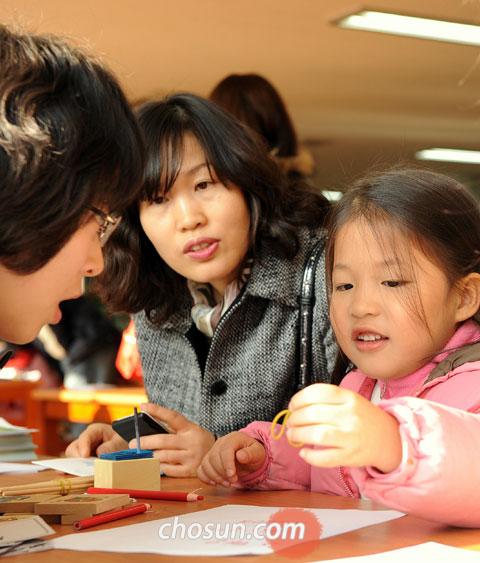
Never too early for tests.

"A prospective elementary school girl is being interviewed at a school in Gwangju on Wednesday" says the English-language Chosun Ilbo. A short video of the proceedings at Gwangju's Sinchang Elementary School from the Korean-language version.
Tuesday, January 6, 2009
New immigration problems on the way?
I'm reporting from the beyond---well, from English Camp---to pass along what has already been posted by The Chosun Bimbo and Zen Kimchi. As per a press release from ATEK, a fledgling teachers' union here, the government is mulling more requirements for immigrants looking to work in South Korea. According to the release:
Interesting, but we've already been subjected to this for a while. The reasoning for this latest activity?
Christ Almighty. Commentary here from The Chosun Bimbo, The Metropolitician, and kimchi-icecream.
It remains to been what implications this will have for teachers, or for those on E-2 visas, especially since we've been subject to these measures since December, 2007. After all English teachers comprise a small percentage of foreigners in Korea, and in spite of the ugly rhetoric thrown our way, we're not the first demographic to come to mind when talking about AIDS and drugs. Likewise, it is the right of a country to screen its visitors however it sees fit, and trying to curtail drugs and crime isn't a bad aim. Drugs and crime are, after all, a threat to public order and health, and if some foreigners are engaging in these and other harmful activities, they must of course be stopped.
That said, there has been a long history of hate-mongering against and scapegoating of foreign English teachers here, and it has been pretty well demonstrated that foreigner drug- and crime-rates are greatly sensationalized. And you'll remember the moral panic of late-2007 was directed exclusively at teachers on E-2 visas, for no reason in particular. The man who triggered the scare was on an E-7 visa, after all, and you'd think that in spite of such vigilant citizens' groups and columnists that there'd be reports of E-2 teachers actually, like, doing the harmful things they're always accussed of. We read a lot about running drugs, committing sex crimes, falsifying academic records, and harming students, but those areas have heretofore been the specialty of Korean or ethnic Korean teachers.
The language above is similar to that in of 2007 when the latest moral panic started after the arrest of Christopher Paul Neil. Immigration said in December of that year:
In response to this latest activity, ATEK has said in the above-mentioned release:
While ATEK has been getting some exposure, let's be honest and say they don't have the teeth to really do anything. Nor do they have the popularity, the trust, or the confidence to get anything from the foreign teaching community. Hence the need to post something here, and to direct you to other commentary from other teachers, because the most effective things we can do now is just raise awareness about things like this and the ridiculously insulting comments by the education Ministry official in charge of native teachers, for example, and negatively influencing not only the way we do our jobs, but they way we're perceived in society. Not as if those two things are unrelated, either.
Perhaps there's nothing bloggers or readers themselves can do, either, except inform themselves and their handlers about the facts, and refuse to submit to repeated, redundant checks. I would love for the men upstairs to produce evidence of this "good many" foreigners who are damaging Korea, just like I want to find a solid definition of "unqualified" as it's used to slam teachers, or an honest appraisal of Korean English teachers, but I know none of those things are coming. But repeated accusations---that we're unqualified, or criminals, or drug smugglers, or sexual predators---does nothing but reveal a xenophobia that apparently needs little to bring it to the fore. It also speaks volumes about the faith in "the system": after all we've been vetted by our embassies and by their immigration---all numerous times---yet we still have to counter these charges every few months.
For those keeping score at home, immigration has changed its policies repeatedly since implementing them in late-2007, in spite of the dangers posed by foreign teachers and interracial daters. The story has been how the Korean government has been imposing things willy-nilly without checking on the practicality of these moves. In December, 2007, Korea wanted the embassies in Seoul to provide criminal background checks for its citizens, even though the embassies neither performed those functions nor agreed to do so before the requirement was announced. In response to being told to fuck off, one Ministry of Justice spokesperson said of the embassies
The US Embassy even sent out an email to those on its mailing list in response to these unmeetable demands. An excerpt:
You'll remember this summer I made a three-hour visit to Seoul to get an apostile for my criminal background check at the US Embassy, only to be told by Yeosu Immigration---in contradiction of what I'd been hearing from my supervisor for months---that I didn't need it. The costly and time-consuming in-person Embassy interview has been the target of much criticism and many jokes. In October we saw reported what we already could guess: immigration regulations were favoring ethnic Koreans, an article in which an immigration official said
Most recently it announced it required Vulnerable Sector Screenings of Canadians, although it made this decision without alerting the Canadian Embassy, thus resulting in chaos for its applicants and in a lot of misinformation. Turns out some of the services the Korean government was requiring of the embassy were not in fact available, and that according to an embassy email the VSS was not even approved for overseas use anyway. As I said in a Korea Times column on the topic, the constant changes reveal not only gross disorganization but a lack of focus which in turn tells us that the goals are far less important than the process.
Without even taking into account the poor exchange rate, all of this of course makes you wonder how Korea will attract foreign teachers to meet its demand. It's amusing that while you're reading about unqualified-this, unqualified-that, you also read about how districts plan to bring in loads more foreign teachers, apparently oblivious to what's going on elsewhere. But I'm not so sure the demand will be there for much longer. They're already going to import teachers from India and other countries that have English as a nominal official language. More telling is their planned introduction of a domestic-made English test to supplant the TOEFL and SAT, two tests they generally suck at. I wonder how much longer until the jig is up, until they realize that this just isn't working. I don't think they will ever come to that conclusion, though, and contradictory to the aims of foreign-language study, they'll look inward and come to blame foreign teachers for all the failures of English-language education, rather than looking at the issues with implementation. That's a pessimistic outlook anyway. Perhaps this is just one more step toward an idea I've been playing with the last month or two: just give up, make Japanese the required second language, and keep English as an elective for the students who want it.
The bill seeks to establish the "legal basis to require foreigners applying for an employment visa to submit a criminal background check and health certificate."
Interesting, but we've already been subjected to this for a while. The reasoning for this latest activity?
"Nowadays, the number of foreigners working in Korea is increasing, but a good many [Korean: 상당수] have previous convictions for drug and sexual crimes or carry infectious diseases. As we require measures to deal with the threat they pose to our society's public order and our people's health, we herein prepare the legal basis to require that foreigners applying for an employment visa submit a criminal background check and a health certificate."
Christ Almighty. Commentary here from The Chosun Bimbo, The Metropolitician, and kimchi-icecream.
It remains to been what implications this will have for teachers, or for those on E-2 visas, especially since we've been subject to these measures since December, 2007. After all English teachers comprise a small percentage of foreigners in Korea, and in spite of the ugly rhetoric thrown our way, we're not the first demographic to come to mind when talking about AIDS and drugs. Likewise, it is the right of a country to screen its visitors however it sees fit, and trying to curtail drugs and crime isn't a bad aim. Drugs and crime are, after all, a threat to public order and health, and if some foreigners are engaging in these and other harmful activities, they must of course be stopped.
That said, there has been a long history of hate-mongering against and scapegoating of foreign English teachers here, and it has been pretty well demonstrated that foreigner drug- and crime-rates are greatly sensationalized. And you'll remember the moral panic of late-2007 was directed exclusively at teachers on E-2 visas, for no reason in particular. The man who triggered the scare was on an E-7 visa, after all, and you'd think that in spite of such vigilant citizens' groups and columnists that there'd be reports of E-2 teachers actually, like, doing the harmful things they're always accussed of. We read a lot about running drugs, committing sex crimes, falsifying academic records, and harming students, but those areas have heretofore been the specialty of Korean or ethnic Korean teachers.
The language above is similar to that in of 2007 when the latest moral panic started after the arrest of Christopher Paul Neil. Immigration said in December of that year:
The Korean Government will prevent illegal activities by verifying requirements of native English teacher and tighten their non-immigrant status [...] [and will] eradicate illegal activities of native English teachers who are causing social problems such as ineligible lectures, taking drugs and sex crimes. English teachers, who disturb social order during their staying in Korea such as illegal teaching, taking drugs and sex crimes, will be banned from entering South Korea.[...] [They will] prevent illegal English teaching activities and the taking of drugs and sexual harassment of English teachers, [...] teachers who disrupt the social order by taking drugs, committing sexual harassment and alcohol intoxication.
In response to this latest activity, ATEK has said in the above-mentioned release:
The Association for Teachers of English in Korea (ATEK) calls on the author(s) of this bill to provide their evidence that "a good many" (상당수) foreigners working in Korea have previous convictions for drug and sexual crimes or carry infectious diseases. Obviously, with the stringent checks being done on E-2 visa holders, they are not part of the "good many" foreigners mentioned. How many E-1, E-6, E-7, and/or C-4 visa holders have been discovered to have criminal convictions or infectious diseases? This evidence cannot be produced because it does not exist.
While ATEK has been getting some exposure, let's be honest and say they don't have the teeth to really do anything. Nor do they have the popularity, the trust, or the confidence to get anything from the foreign teaching community. Hence the need to post something here, and to direct you to other commentary from other teachers, because the most effective things we can do now is just raise awareness about things like this and the ridiculously insulting comments by the education Ministry official in charge of native teachers, for example, and negatively influencing not only the way we do our jobs, but they way we're perceived in society. Not as if those two things are unrelated, either.
Perhaps there's nothing bloggers or readers themselves can do, either, except inform themselves and their handlers about the facts, and refuse to submit to repeated, redundant checks. I would love for the men upstairs to produce evidence of this "good many" foreigners who are damaging Korea, just like I want to find a solid definition of "unqualified" as it's used to slam teachers, or an honest appraisal of Korean English teachers, but I know none of those things are coming. But repeated accusations---that we're unqualified, or criminals, or drug smugglers, or sexual predators---does nothing but reveal a xenophobia that apparently needs little to bring it to the fore. It also speaks volumes about the faith in "the system": after all we've been vetted by our embassies and by their immigration---all numerous times---yet we still have to counter these charges every few months.
For those keeping score at home, immigration has changed its policies repeatedly since implementing them in late-2007, in spite of the dangers posed by foreign teachers and interracial daters. The story has been how the Korean government has been imposing things willy-nilly without checking on the practicality of these moves. In December, 2007, Korea wanted the embassies in Seoul to provide criminal background checks for its citizens, even though the embassies neither performed those functions nor agreed to do so before the requirement was announced. In response to being told to fuck off, one Ministry of Justice spokesperson said of the embassies
I just don’t understand why they cannot make some exceptions to accommodate the needs of their own nationals. In Korea, criminal records can be easily obtained online. But they don’t have a centralized system.
The US Embassy even sent out an email to those on its mailing list in response to these unmeetable demands. An excerpt:
The U.S. Embassy website will also continue to be the best source of information about the services that we are able to provide under U.S. law and regulation.
You'll remember this summer I made a three-hour visit to Seoul to get an apostile for my criminal background check at the US Embassy, only to be told by Yeosu Immigration---in contradiction of what I'd been hearing from my supervisor for months---that I didn't need it. The costly and time-consuming in-person Embassy interview has been the target of much criticism and many jokes. In October we saw reported what we already could guess: immigration regulations were favoring ethnic Koreans, an article in which an immigration official said
We know there might be unqualified ethnic Koreans teaching English here, but you also need to understand there is no 100 percent perfect system.
Most recently it announced it required Vulnerable Sector Screenings of Canadians, although it made this decision without alerting the Canadian Embassy, thus resulting in chaos for its applicants and in a lot of misinformation. Turns out some of the services the Korean government was requiring of the embassy were not in fact available, and that according to an embassy email the VSS was not even approved for overseas use anyway. As I said in a Korea Times column on the topic, the constant changes reveal not only gross disorganization but a lack of focus which in turn tells us that the goals are far less important than the process.
Without even taking into account the poor exchange rate, all of this of course makes you wonder how Korea will attract foreign teachers to meet its demand. It's amusing that while you're reading about unqualified-this, unqualified-that, you also read about how districts plan to bring in loads more foreign teachers, apparently oblivious to what's going on elsewhere. But I'm not so sure the demand will be there for much longer. They're already going to import teachers from India and other countries that have English as a nominal official language. More telling is their planned introduction of a domestic-made English test to supplant the TOEFL and SAT, two tests they generally suck at. I wonder how much longer until the jig is up, until they realize that this just isn't working. I don't think they will ever come to that conclusion, though, and contradictory to the aims of foreign-language study, they'll look inward and come to blame foreign teachers for all the failures of English-language education, rather than looking at the issues with implementation. That's a pessimistic outlook anyway. Perhaps this is just one more step toward an idea I've been playing with the last month or two: just give up, make Japanese the required second language, and keep English as an elective for the students who want it.
Sunday, January 4, 2009
Taking you back like a rocking chair.
For the next week I'll be sequestered at Suncheon's English Town for my winter camp. Following that I'll be out of the country for most of January and a big part of February, so I'll likely have no new entries for a while. However, I know that going two months without posting is blogger suicide, so I've got some posts in the can, scheduled to come out later this month and next.
To hold you over for a while I've compiled a list of some posts I like but that either came out when nobody read my blog or were buried behind bigger stories or behind the wall-to-wall Mad Bull Shit coverage. Give them a read-through, and hell, since I won't have anything new for about a week, why not just start with September, 2007, and read through every entry? *cough*
* "이번역은 율촌, 율촌역 입니다 ~ Yulchon Station." - A small write-up on an old train station in Yeosu, a post that contains the best one-liner in Brian in Jeollanam-do history.
* "GEPIK offers culture tips." You know this isn't going to turn out well.
* "Nazi mural in Gyeongju." – A not-so-subtle display in downtown Gyeongju.
* "You look nervous." - Perhaps the most awesomely bad 71 seconds of consecutive English in a Korean drama.
* "Korea Times: Tips are no longer strange here." - The one where we debate the merits of tipping. It was a short discussion because there are no merits of tipping.
* "Okay, I know I really shouldn't be laughing at this." - A taste of home.
* "A Reaction to Kang Eun-hee's 'Korean English Teachers.'" - The first of what would be many rants on the topic of English education.
* "Cheonghak-dong and Samseong-gung: Excellent with a capital E through T." - One of the most beautiful areas of Korea I've ever seen.
*“’Sexy Mong’ battles drunk foreigners, interracial relationships.” It’s bad enough that a softcore porn episode was dealing with the “social issue” of sexual predator English teachers. What’s worse is that they actually recruited some piece of shit white people to play these date rapists. Way to go, you got to rub a Korean woman’s groin on television. Now eat shit and die.
*“No hummingbirds in Jeollanam-do :(“ – No hummingbirds in Korea for that matter, but we do have some beautiful moths.
*“Remembering.” – A visit to Gwangju on May 18th, and a look at how anti-American, anti-beef displays were the theme of the anniversary of the Gwangju Massacre.
*“Cultural Guidebook for Foreigners warns of killer fans.” – Actually, LMFAO, so does the Korean Consumer Agency.
*“Foreigners Expose Abusive Daycare.” – Some English teachers helped bring to justice a preschool that was punishing its children by leaving them outside naked in the middle of winter.
*“Korea Times: What do English Teachers Think?” – Another rant brought upon by a column in the Korea Times.
*“pyew pyew pyew, the sound of bad taste.” – A distasteful Hummer commercial from a few years ago.
* "Forbes ranks South Korea as hardest-working country." - What does that mean?
* “You’re not their friend, you’re their teacher.” – Sometimes it’s difficult to leave the house, knowing how ridiculous you’re made to look as a foreigner. If you haven’t figured it out yet, when they scream “HEllo, hellloooo, HELLOOOO” they’re not being friendly, or curious, or eager to speak to foreigners.
* "Some stuff about Korean love motels, so pay attention." - I'm a big fan of love motels. Less so when people commit suicide in them, but still. They're much better than ordinary tourist hotels in every conceivable---PUN!---way. That one room has a telescope.
To hold you over for a while I've compiled a list of some posts I like but that either came out when nobody read my blog or were buried behind bigger stories or behind the wall-to-wall Mad Bull Shit coverage. Give them a read-through, and hell, since I won't have anything new for about a week, why not just start with September, 2007, and read through every entry? *cough*
* "이번역은 율촌, 율촌역 입니다 ~ Yulchon Station." - A small write-up on an old train station in Yeosu, a post that contains the best one-liner in Brian in Jeollanam-do history.
* "GEPIK offers culture tips." You know this isn't going to turn out well.
* "Nazi mural in Gyeongju." – A not-so-subtle display in downtown Gyeongju.
* "You look nervous." - Perhaps the most awesomely bad 71 seconds of consecutive English in a Korean drama.
* "Korea Times: Tips are no longer strange here." - The one where we debate the merits of tipping. It was a short discussion because there are no merits of tipping.
* "Okay, I know I really shouldn't be laughing at this." - A taste of home.
* "A Reaction to Kang Eun-hee's 'Korean English Teachers.'" - The first of what would be many rants on the topic of English education.
* "Cheonghak-dong and Samseong-gung: Excellent with a capital E through T." - One of the most beautiful areas of Korea I've ever seen.
*“’Sexy Mong’ battles drunk foreigners, interracial relationships.” It’s bad enough that a softcore porn episode was dealing with the “social issue” of sexual predator English teachers. What’s worse is that they actually recruited some piece of shit white people to play these date rapists. Way to go, you got to rub a Korean woman’s groin on television. Now eat shit and die.
*“No hummingbirds in Jeollanam-do :(“ – No hummingbirds in Korea for that matter, but we do have some beautiful moths.
*“Remembering.” – A visit to Gwangju on May 18th, and a look at how anti-American, anti-beef displays were the theme of the anniversary of the Gwangju Massacre.
*“Cultural Guidebook for Foreigners warns of killer fans.” – Actually, LMFAO, so does the Korean Consumer Agency.
*“Foreigners Expose Abusive Daycare.” – Some English teachers helped bring to justice a preschool that was punishing its children by leaving them outside naked in the middle of winter.
*“Korea Times: What do English Teachers Think?” – Another rant brought upon by a column in the Korea Times.
*“pyew pyew pyew, the sound of bad taste.” – A distasteful Hummer commercial from a few years ago.
* "Forbes ranks South Korea as hardest-working country." - What does that mean?
* “You’re not their friend, you’re their teacher.” – Sometimes it’s difficult to leave the house, knowing how ridiculous you’re made to look as a foreigner. If you haven’t figured it out yet, when they scream “HEllo, hellloooo, HELLOOOO” they’re not being friendly, or curious, or eager to speak to foreigners.
* "Some stuff about Korean love motels, so pay attention." - I'm a big fan of love motels. Less so when people commit suicide in them, but still. They're much better than ordinary tourist hotels in every conceivable---PUN!---way. That one room has a telescope.
Artificial ice climbing in Yeongdong.
The Korea Times has a picture of an artificial ice cliff in Yeongdong county, Chungcheongbuk-do---and lets readers know of course that county officials hope it will become a tourist attraction. Here are a few more from around the internet:


And here's a gallery from the Chosun Ilbo.


And here's a gallery from the Chosun Ilbo.
Michael White's mother sues.

An update to one of the most outrageous news items of 2008.
An American mother sued the Korean government Friday for 450 million won in compensation over her son's alleged drowning in a sauna in a southern city. The bereaved mother claimed that Korean paramedic management was poor and the legal system prevents people from helping others in emergency situations.
According to the Daegu District Court, Stephannie White, 41, has filed a compensation suit against the central government and local South Gyeongsang Provincial government for having ``let her son die due to poor emergency measures.''
The accident took place on May 10 last year, when White and her 14-year-old son Michael visited the Royal Hawaii Sauna in Gyeongsang, near Daegu. He was found unconscious in a pool soon after arriving. Emergency staff rushed him to a nearby hospital and tried to resuscitate him via cardiopulmonary resuscitation (CPR), but the boy was declared dead a few minutes later.
Best of luck to Ms. White, who deserves credit for continuing to pursue the matter. However, I would be very surprised if anything came of this.
You can read more about Michael and this story on the website his mother created, Mightie Mike. Give a listen to the two podcasts done with Seoul Podcast, too, here and here, or give the transcripts a read (a few choice excerpts here). They'll leave you speechless. And really really mad.
A few earlier posts on the topic:
** "Michael White's autopsy report released to press before family."
** "Vigils for Michael White hitting snares."
** "But at this point, the difference in law and culture at bathing places is what is likely to be at fault."
** "The suspicious death of 14-year-old Michael White."


Subscribe to:
Posts (Atom)