
Saturday, November 12, 2011

수능 문제지와 답안지: College entrance examination questions and answers online.

A few hours after the 2012 College Entrance Examination (2012 대학수학능력시험), the questions and answers are online. Naver has a list of twelve places to find them.

Part three, the English section, will probably be of most interest to readers. Finding the main idea of the passage, via the 서울신문:
[34~35] 다음 글의 주제로 가장 적절한 것을 고르시오.

34. Living things naturally return to a state of balance.
When we are disturbed by forces acting on us, our inner
machinery kicks in and returns us to a balanced state of
equilibrium. Homeostasis is the word we use to describe
the ability of an organism to maintain internal equilibrium
by adjusting its physiological processes. Most of the
systems in animal and human physiology are controlled
by homeostasis. We don’t like to be off balance. We tend
to keep things in a stable condition. This system operates
at all levels. Our blood stays the same temperature.
Except for extraordinary exceptions, when people find
ways to intervene using methods more powerful than our
tendency to equilibrium, our habits, behaviors, thoughts,
and our quality of life stay pretty much the same too.
① physical balance needed for mental equilibrium
② inner mechanisms to enhance the quality of life
③ general tendency of organisms to keep equilibrium
④ major differences in animal and human physiology
⑤ biological processes resulting from habitual behaviors
Um, I’m fine, thank you, and you?

The last section is an optional additional foreign-language section: German, French, Spanish, Chinese, Japanese, Russian, Arabic, and Chinese characters. Arabic is consistently the most “popular” choice.

Students say, according to the JoongAng Daily, this year's "mother of all tests" was easier than last year's. Here's last November's exam, if you'd like to compare.

Here's a post from 2009 about walking to class and watching the pre-exam festivities on test day in a Gwangju neighborhood.
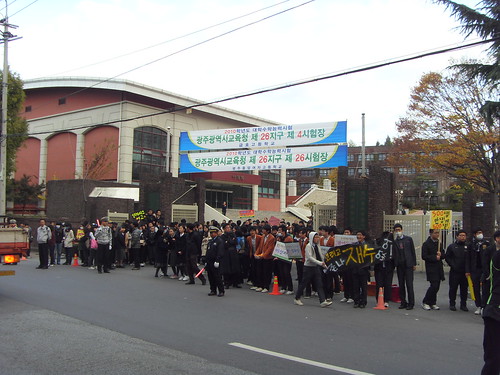
SDC19794

Unsurprisingly, Reuters has filed its story on the country's exam preparations under "Oddly Enough", so I won't bother linking to it.

Sunday, November 6, 2011

Mudeung Stadium, then and now.

Here's a look at Gwangju's two stadiums in Im-dong in 1965:

Mudeung Stadium 1965

And here's how the area looked in March, 2009 via Naver's map system:

Gwangju Sinan-dong
According to the Gwangju city webpage, the population in 1965 was 365,611, and in 2010 it was 1,467,996. The old track stadium---opened in 1965---is being replaced with a new baseball stadium for the Kia Tigers' 2014 season.

South Korean education makes "News of the Weird".


Korean kids talking with the Obama children, from the Chosun Ilbo, March 11, 2009.

Coverage of Korea in western outlets usually amounts to "news" that's lazily reported several months later, or something that fits into the "news of the weird" category that aligns with western stereotypes of Asians. I've written that before about the persistent, and untimely, reporting on Korea's English-teaching robots that turns up in "news" stories every few months. This week, the syndicated, low-brow column "News of the Weird" covers those "Inscrutable Asians" in South Korea:
Though South Korean children score among the highest in the world on standardized reading and math tests, their success comes at a price, according to an October Time magazine dispatch. They supposedly suffer "educational masochism" -- punishing themselves by overstudy, especially in high school preparing for university admissions tests (a process so competitive that even test-coaching schools are picky about accepting students). Earlier this year, to curb the "masochism," the government began enforcing a 10 p.m. curfew on coaching-school activities, and in Seoul, a six-man team conducts nightly after-hours raids on classes that run late-night sessions behind shuttered windows. (Ironically, Time acknowledged, American educational reformers want U.S. students to study harder, like Asians do, but Asian reformers want their students to relax, like American students.)

Friday, November 4, 2011

November 3rd, Students' Day.


Gwangju politicians at the memorial tower on the campus of Gwangju Jeil High School mark Students' Day (학생의날) , which was designated to commemorate the start of the Gwangju Students' Independence Movement (광주학생항일운동) of 1929. It was, says a now-defunct page on the Gwangju Student Independence Movement Memorial Hall website:
a typical national resistance movement against the cruel rule of Japanese colonialism. Its size, the influence it exerted and its historical significance were comparable with that of the huge "Samil Independence Movement".
Gwangju's tourism webpage said in 2009:
In 1953, the government designated Nov. 3rd as "Student Day"in commemoration of the Gwangju Students'Independence Movement and a memorial monument was established in Gwangju Seo Middle School and Il High School in 1954. The day was at one point abolished by the autocratic government before finally being named as "Students'Independence Memorial Day"and elevated to a nationwide memorial day in 2006.
From the 1954 dedication ceremony, via this site.

Saturday, October 29, 2011

"Slow city" Jeung-do in transition.

Naver's looking out from above Eldorado Resort.

Claire Lee in the Korea Herald looks at Shinan county's Jeung-do nearly four years after it was one of four areas in South Korea designated as "Slow Cities" in December 2007.
Being the first slow city of Asia, along with the completion of the bridge that connects the island to the peninsula ― which opened last year ― brought many changes to Jeungdo. As the number of visitors increased dramatically, the island faced more demand for accommodations and tour packages. This had both positive and negative impacts on the island, placing Jeungdo somewhere in between further development and the expected “slowness.”

For more about Jeollanam-do's "slow cities"---actually two cities and two rural counties---over the years:
* February 15, 2008: Jeollanam-do's slow cities.
* March 24, 2009: Jeollanam-do is a little slow.
* December 28, 2009: "Slow City" in Shinan working hard to stay slow.
Nearly two years ago we read of Jeung-do in the JoongAng Daily that "A rare experiment to create an island free of cigarette smoking, cars and night lights has begun in Korea’s southern region." But in this month's Herald piece we see a conflicted Jeung-do:
Lee Jong-hwa, the representative of the local tour agency Gilbeot, on the other hand, has been receiving complaints from visitors and scholars, that Jeungdo isn’t “slow” enough. One of the scholars that contacted him pointed out that most buildings on Jeungdo are modern-day residential ones, carrying no particular aesthetic values. Unlike other slow cities in Korea, such as Changpyeong of South Jeolla Province or Yesan of South Chungcheong Province, Jeungdo doesn’t have any traditional Korean houses or ancient Buddhist temples. “He said we should in fact ‘create’ traditional homes, at least just to show the visitors, to serve the purpose of being a slow city,” Lee told The Korea Herald. “But we cannot live a lie for the sake of a slow city.”
Still interested in visiting? Search the Korea Tourism Organization's webpage for a couple of articles on it. There are a couple of big---well, um, slow city big---festivals: the Slow Salt Village Festival (SLOW 소금마을 축제) from May to July at the Salt Village, and a Mud Festival that hasn't yet been debauched (신안 섬갯벌 축제) in July.

Wednesday, October 26, 2011

Sunday, October 23, 2011

아이고, fire at Suncheon's Drama Set.


From No Cut News.

Earlier this month there was a fire at Suncheon's Drama Set (순천드라마세트장 or 드라마촬영장), used to film TV dramas like "Love and Ambition" (사랑과야망) and "East of Eden" (에덴의 동쪽). According to the latest update on October 7th, a few hours after the fire spread through the recreations of mid-century Korea the night before, three buildings were destroyed: one theater and two hanok houses.

CIMG5892
I think this is the theater they're talking about, but after a good bit of time comparing the fire footage with pictures of the theaters and the "town" layouts, I can't be sure. Just one disadvantage of blogging on Suncheon from half-a-world away.

CIMG5875
CIMG5887
CIMG5896
CIMG5869

The set is located in Jorye-dong and is a fairly well-kept secret I always enjoyed visiting. Even three buildings down it's worth a trip to see the mock-up of an anachronistically-named 60s-era Suncheon-eup (Suncheon was designated a city in the 40s), a 70s-era slum, and an 80s-era Seoul. Here's a September 2008 Korea Times article about it and the then-recent activity there, here's a Flickr gallery from 2007, and here's my second-ever blog post. Walk to it from New Downtown, take city bus #777, or catch it on the Suncheon City Tour. If you're interested in these sorts of displays and artifacts there are a couple other drama sets throughout the country that cover similar time periods. There's also a Daldongnae Museum (수도국산 달동네박물관, Sudoguksan Museum of Living and Housing) in Incheon.

Friday, October 21, 2011

Hyundai to build new Gwangju baseball stadium.


Artist's rendition of the new ballpark in Gwangju, from the 전남일보.

On October 20th it was announced that Hyundai Engineering & Construction will build Gwangju's new baseball stadium, home of the Kia Tigers. The site of a future "Culture Park" in Im-dong, it's expected to be done in December 2013 in time for the 2014 season. The new one will sit next to the old one, for now, but will replace and mean the end of Mudeung Stadium (무등경기장 주경기장), built in 1965.

Gwangju and Mudeung Stadium hosted the 46th annual National Sports Festival in 1965, where unfortunately 16 people died in a stampede
on opening day.

Tuesday, October 18, 2011

Yŏsu-Sunchŏn Incident (여순반란사건), October 1948.


By Carl Mydans, for Life magazine.

Wednesday, October 19th, marks the anniversary of the "Yŏsu Rebellion," written in English also as the "Yŏsu-Sunchŏn Incident" or the "Yŏsu-Sunchŏn Rebellion," one of several bloody exchanges in Jeollanam-do last century, and one whose background serves to foreshadow the violence of the Korean War two years later. The 여순반란사건 was a crackdown against suspected communists in South Jeolla province, specifically the cities written now as Yeosu and Suncheon, that resulted in hundreds or thousands of deaths, depending on the source.

Smooth.

One of my biggest weaknesses continues to be clicking on the ads on the Korea Times website. Today they led me to Flyday.co.kr and to


Only 14,000 won. Goes nicely with the G-ma$ta classic: