

Monday, October 17, 2011


Saturday, October 15, 2011
US announces participation in 2012 Yeosu Expo.
On the 13th the US State Department officially announced its participation in the Yeosu Expo, scheduled for May 12th through August 12th, 2012.

I'm sorry to see the theme will incorporate my least-favorite buzzword, the s-word:
Official site of the USA pavillion here, brochure for University of Virginia Student Ambassador Program here. Canada, we learned in August, will not participate.

The International Pavilion (국제관).
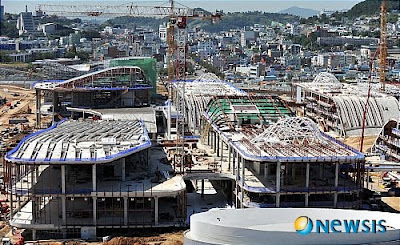
Under construction in September.

Joining more than 108 countries and international organizations, USA Pavilion 2012 will build on the Expo’s overall theme of “The Living Ocean and Coast,” and showcase the diversity, spirit of entrepreneurship, innovation, and commitment to sustainable development of the American people. U.S. participation in Expo 2012 Yeosu Korea demonstrates U.S. commitment to deepening our friendly ties and strengthening U.S. – Republic of Korea (ROK) relations and engagement in the Asia-Pacific region.
I'm sorry to see the theme will incorporate my least-favorite buzzword, the s-word:
Focusing on the themes of Diversity, Wonder, and Solutions, the USA Pavilion 2012 is expected to reach millions of visitors through a host of exciting technologies and storytelling. A highlight of the USA Pavilion experience for visitors will be their interactions with Student Ambassadors. In partnership with the University of Virginia, 40 college-aged American Student Ambassadors proficient in Korean will be selected to serve as representatives of the United States, engaging directly with USA Pavilion visitors and supporting the USA Pavilion operation.
Official site of the USA pavillion here, brochure for University of Virginia Student Ambassador Program here. Canada, we learned in August, will not participate.

The International Pavilion (국제관).

Under construction in September.
Monday, September 12, 2011
Gangjin's Sunghwa College, Suncheon's Myungshin University "lousy schools", may close this fall.
Last month we learned about corruption and embezzlement at two small post-secondary schools in Jeollanam-do, Sunghwa College and Myungshin University. This month we read in the Korea JoongAng Daily that they're likely to close.
The Korea Times writes that government subsidies to these 43 "lousy" schools will end "as part of a set of measures to weed out poorly-managed higher education establishments."

At least Sunghwa College has a neat campus.
The Korea JoongAng Daily embedded a list of the 43 "lousy" schools, typed after the jump:
In line with its no-tolerance policy for lousy schools, the Ministry of Education, Science and Technology ordered two universities in South Jeolla to shut down if they don’t make immediate changes the ministry has demanded.Myungshin University has until September 27th to repay the embezzled funds, while Sunghwa College's deadline is October 1st.
The two schools, Myungshin University and Sunghwa College, are expected to close as both of the schools have been accused of corrupt practices such as giving grades and attendance records to thousands of students who never bothered going to classes, trying to boost their reputations.
“We expect the schools’ closings to be finished by early next year,” said Kim Dae-sung, an official at the Education Ministry.
The Korea Times writes that government subsidies to these 43 "lousy" schools will end "as part of a set of measures to weed out poorly-managed higher education establishments."
The government will also restrict loans for students attending 17 of the 43 schools. Loans to students at the worst four schools — Kundong University in Andong, North Gyeongsang Province; Myungshin University in Suncheon, South Jeolla Province; Holy People University in Cheonan, South Chungcheong Province; and Sunghwa College in Gangjin, South Jeolla Province — will be limited to only 30 percent of tuition fees next year.

At least Sunghwa College has a neat campus.
The Korea JoongAng Daily embedded a list of the 43 "lousy" schools, typed after the jump:
Tuesday, August 30, 2011
Teach Korean, get white women.

Of course news sites like the Korea Times aren't known for the subtlety or classiness of their advertisements (more here and here, for example). This particular article, "Foreigner attacks old person on a bus," is surrounded by ads for a plastic surgeon, a dating quiz, two male enhancement clinics, two online shopping sites, and a wristwatch camcorder convenient for secretly taking pictures of women on the street.

This school's ad speaks to the increasing need for qualified Korean-language teachers during the swell of the Korean Wave, and unsurprisingly uses the appeal of white women---who are often fetishized and sexualized in Korean media and ads---to do it.
I'm reminded of what I dug up a couple years ago for a post I never got around to finishing, about the big language-exchange clubs in Seoul that used flirtatious white girls as their draw (inspired in turn by material found for this post about pestering foreigners to learn English).

Take a look at the "traditional" American dress used to promote the English Conversation Club.
Hana Republic is one of the best-known of these "international party" groups, and probably the most widely-advertised on Korean-language sites, and has images like this on its site to promote its language e

It has, um, "evolved" to include pictures of white men hanging out with Korean women as well. But nevertheless the drunk white girl angle is somewhat notable considering the reception a language-exchange site, or a Korean-language school, would get were its main aim to hook up white guys with Korean women. There's no need to spend too long imagining.
Wednesday, August 24, 2011
World Roller Speed Skating Championship coming to Yeosu.

The 2011 Yeosu World Roller Speed Skating Championship (2011여수세계롤러스피드스케이팅선수권대회) will be held August 29th through September 5th in Yeosu, Jeollanam-do. Information is characteristically sparse on the official website, though you can find a time-table of events for the week in English. A news article from last week estimates 700-some athletes from 50-some countries will compete.
Tuesday, August 2, 2011
Big trouble at small Gangjin college.
A good edition of "Korea Finder" might start with this:

A better edition wouldn't give it away in the title, though.
The JoongAng Daily writes of the troubles surrounding Gangjin county's Sunghwa College (성화대학), located in a small village northwest of the county seat:
On a similar topic in the neighborhood, two weeks ago the JoongAng Daily also wrote that Myungshin University (명신대학교), between Boseong county and Suncheon,
The paper called it, in an editorial the same day,
 Satellite view from Naver Maps. The big green thing on the left is a driving range on campus.
Daum's Road View gives us a look at smaller model by the entrance:
 From May 16, 2010.
Taken March 29, 2007, outside the school's main building:

From Road View:
For more pictures, click the first blog link---a bike trip from Mokpo to Seongjeon-myeon--- from this Naver search. As is often the case with Naver Cafe posts, I can't link to it directly, because for many, making entries inaccessible is just as much fun as writing them.
A better edition wouldn't give it away in the title, though.
The JoongAng Daily writes of the troubles surrounding Gangjin county's Sunghwa College (성화대학), located in a small village northwest of the county seat:
Education authorities said the former president of Sunghwa College in South Jeolla embezzled billions of won from the school, explaining why the college paid just 130,000 won ($124) a month to its professors.. . .
The Ministry of Education, Science and Technology announced yesterday that the former president and school founder, surnamed Lee, embezzled a total of 6.5 billion won since 2005, including 5.2 billion won that he transferred from the college’s coffers to a company that he owns.
According to the ministry, Lee appointed his wife, high school classmates and hometown friends to the college’s board as well as naming his 31-year-old daughter as his executive assistant.
Lee’s second daughter, 27, was appointed as the head of the accounting unit.
On a similar topic in the neighborhood, two weeks ago the JoongAng Daily also wrote that Myungshin University (명신대학교), between Boseong county and Suncheon,
was dealt a heavy blow by the educational authorities who cited it for corrupt management, including embezzling 6.5 billion won ($6.1 million).
The paper called it, in an editorial the same day,
a typical example of the mismanaged private universities that have degenerated into a profitable business by selling diplomas.It's been a slow news year for Jeollanam-do, and the reason this story caught my eye is not simply because it talks about an untenable business model close to "home", but because I've worked in the area and visited the school a couple times. When I worked in Gangjin county I taught in Seongjeon-myeon each Friday at a small elementary school a block from the college. Basically the only post-secondary institution in the county, its campus was distinctive for a couple reasons: for the caged deer it kept across from the administration building, and for the four airplanes it kept on campus.

Daum's Road View gives us a look at smaller model by the entrance:

Taken March 29, 2007, outside the school's main building:
From Road View:
For more pictures, click the first blog link---a bike trip from Mokpo to Seongjeon-myeon--- from this Naver search. As is often the case with Naver Cafe posts, I can't link to it directly, because for many, making entries inaccessible is just as much fun as writing them.
Monday, July 25, 2011
Smaller mud festivals in Yeonggwang, Gochang counties this July and August.
If you'd like to try out a mud festival in Korea but don't want to deal with the overcrowding, the drunks, and the pervy photographers that are associated the famous one in Boryeong, there are a couple other options in the Jeolla provinces.

Yeonggwang county will be holding its 3rd annual Mud Marathon Festival (머드마라톤대회축제) on July 30th and 31st. The actual "mud runs" will take place the morning of Sunday the 31st (registration closed July 15th, but hey I gave you plenty of advance notice), though other performances and activities are scheduled, including a mud slide, mud sleds, and tug-of-war. A Korean-language program is available on the website. County buses run from the bus terminal in Yeonggwang-eup to Yeomsan-myeon and Baekbaui Beach (백바위해수욕장).
And check out Jeollabuk-do's Gochang county the next weekend for a similar set of events (전국갯벌스포츠축제). Hat tip to the Gwangju News editor for that one.
Saturday, July 9, 2011
Ferry to run between Fukuoka, Yeosu during 2012 Expo.

Test run from Fukuoka to Yeosu. (Yachtpia)
The Beetle Ferry, which currently operates between Busan and the Japanese city of Fukuoka, will make daily trips from Japan to Yeosu next year while the Jeollanam-do city hosts the 2012 World Expo. From the Korea Herald last week:
The state-run Korea Tourism Organization said Wednesday that it has secured a sea route linking the southern port city of Yeosu to Fukuoka, southwestern Japan, in preparation of next year’s Yeosu World Expo.
The organization, together with the South Jeolla provincial government and the Yeosu city government, has arranged for a chartered ferry service by Japan’s Kyushu Railway Co. (JR Kyushu) over the route.
The high-speed ferry “Beatle” [sic] will travel once a day between Yeosu port and Fukuoka’s Hakata port during the 2012 Yeosu Expo, scheduled to run May through August next year.
Beatle is capable of accommodating 200 people and takes three hours and 45 minutes for a one-way trip, with the ferry service estimated to cost about 200,000 won ($185.36) per passenger.
Fukuoka is probably best known to foreign teachers in Korea as a nearby visa-run destination, but as I learned in late-2009 it's fine for a short vacation, too.
Saturday, June 4, 2011
2011 Muju Firefly Festival (무주반딧불축제): June 3rd - 11th.

Got some hits recently from people looking for information about Muju's annual firefly festival (무주반딧불축제). This year it opened on June 3rd and will run from June 11th, in Jeollabuk-do's Muju county.

Both posters taken from the official festival website, making a strong push to win the award for "Most pop-ups on a website in 2011."
I've written about it several times in the past
* June 4, 2008: 2008 Muju Firefly Festival: June 7th - June 15th.
* June 16, 2008: 2008 Muju Festival
* June 2, 2009: 2009 Muju Firefly Festival (2009 무주반딧불축제)
and said that although it's special to me because it's where I went with my wife on our first date (awww), I didn't see a single firefly. Though one obscure poet wrote that it was the Japanese who exterminated the fireflies---a poem known only because it turned up deep in the Google search results---the scarcity is actually due to climate change, as Kim Jong-Gill at the National Institute of Agricultural Science & Technology wrote in a 2002 issue of Koreana (.pdf file)
Only 20 to 30 years ago fireflies were a common sight, but now they have become a nostaligic rarity, highlighted on television shows. In recent years, their natural habitats have been increasingly destroyed and disturbed through environmental damage resulting from the modernization of rural areas and changes in agricultural methods involving excessive reliance on pesticides and chemical fertilizers, as well as street lights that interfere with the ability of fireflies to communicate with each other. Indeed, with all these challenges to its survivability, it is no wonder that firefly sightings are so infrequent nowadays.
Commenters have also written on this site that the appearances are hit-or-miss depending on the weather.
The festival is held in the county seat, Muju-eup, accessible from Jeollanam-do by buses that run to Muju by way of Namwon, Jangsu, and other smaller towns along the way. There are seven buses a day from Gwangju, with three leaving in the afternoon: 13:20, 15:00, and 17:00. One big improvement festival organizers could make, besides getting more fireflies, would be to operate shuttles between Muju-eup and neighboring cities. Going to and from the festival is a challenge without your own transportation, since the last bus leaves Muju rather early, and the few motels in town aren't enough to accommodate the thousands of visitors.
Sunday, May 1, 2011
May 2011 festivals in Jeollanam-do.
Spring and fall are two excellent times for travelling around Jeollanam-do because of the dozens of festivals large and small taking place in its cities, towns, and villages. Here's a brief look at some of the bigger ones; a Naver search and a look around local websites will be your friend for more boring ones others.

Hampyeong Butterfly Festival (함평나비대축제) in Hampyeong country through May 10th. One of the region's better-known festivals, it's essentially a nice walk through a big park, I concluded during a 2009 visit it's somewhat lacking in butterflies in a natural setting (at least for those who come from places with abundant nature). A short walk from the bus terminal in Hampyeong-eup, in turn accessible by regular buses from Gwangju. Times available from the Gwangju U-Square terminal website, in Korean.

Damyang Bamboo Festival (담양대나무축제) in Damyang county from May 3rd through May 8th. One of the province's representative sites, it's a short bus ride from Gwangju. Worth a visit anytime during the spring and summer months, the festival offers the usual, um, festivities.

Shinan Heuksan Skate Festival (산안흑산홍어축제) on May 6th and 7th. One of the two big hongeo festivals in Jeollanam-do celebrating the region's affinity for the acquired taste of fermented skate. Somewhat out of the way on Heuksan-do, one of the 1,004 islands that comprise Shinan county, those with time and an interest in seeing an even more remote part of Jeollanam-do would probably enjoy the trip.
Jeamsan Azalea Festival (제암산철쭉제) on Mt. Jeam in Jangheung county on May 8th.
Seomjin River Azalea Festival (섬진강 철길 철쭉축제) in Gokseong county on May 7th and 8th.

Boseong Green Tea Festival (보성녹차대축제) in Boseong county from May 4th through the 8th. The tea fields in Boseong have provided this blog's header for years, and the area is worth a visit for anyone living, um, in the area. It offers the usual stuff, plus green tea samgyeopsal, green tea noodles, green tea ice cream, and green tea green tea. Buses run regularly to the main field from the terminal in Boseong-eup, and there is a small entrance fee.

Suncheon Nagan Folk Culture Festival (순천낙안민속문화축제) in Suncheon's Nagan Folk Village from May 13th through the 15th. In one of my favorite places in Jeollanam-do, here are some posts and pictures from previous years: from May 2008, October 2008, and an unblogged set from May 2009. The folk village is accessible from downtown Suncheon via city buses 61 and 63 (timetable, in Korean), and when you get off at the village you'll find a timetable for buses returning to town.
Subscribe to:
Posts (Atom)