I'm in the process of profiling some of Gangjin's notable people and places. The first entry on this topic is "Gangjin: Its people and its places," on three of the county's most notable residents. For the sake of readability, I have decided to break up the huge entry on Gangjin's temples into several smaller sections. Part 1 will profile the three temples on Mandeoksan mountain: Baekryeonsa, Okryeonsa, and Yongmunsa.Mandeoksan
(만덕산), or Mt. Mandeok (산 means mountain), is located in
Gangjin county's Doam-myeon, just west of Gangjin Bay, and rises 408 meters. A bunch of Gangjin's most well-known assets are located here, including Baekryeonsa temple, Dasan Chodang (다산초당, Dasan's house of exile), and Dasan's Relic Exhibition Hall.
 Baekryeonsa, overlooking Gangjin Bay.Baekryeonsa
(백련사, 白蓮寺) is arguably the most "famous"---in the Korean sense of every square inch of the country being famous for something---temple in the Gangjin. But in my humble opinion it's not the most interesting, is quite small and is certainly nothing you've never seen at any other temple in South Korea. What is nice, though, is the series of trails that criss-cross Mandeoksan and connect the three temples to Dasan Chodang. The trail from Baekryeonsa to Dasan Chodang is roughly 0.8 kilometers long, is wide and pleasant with a gentle slope in most places, and has stairs built into the hill in steeper places. The pavillion at Dasan Chodang, called 천일각, offers nice views of Gangjin Bay and the uninhabited Juk-do island.
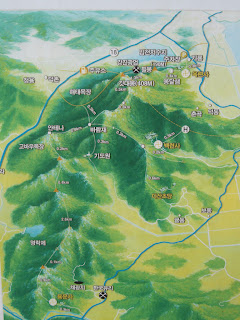 Map of Mandeoksan (click for a readable version)
 Chunilgak Pavillion at Dasan Chodang, just over a half-kilometer from Baekryeonsa.
Once known as Mandeoksa, after the mountain, Baekryeonsa means "White Lotus Temple," and you'll see the name spelled Baegnyeonsa, Baekyeonsa, Paengryonsa, and other similar variations. According to the
official website, the temple originally dates to 747 and was founded by the priest Chinpyo (진표), though
Naver gives the date 839. Regardless, the structures on the site have been rebuilt many times. The main hall (대웅전), for instance, is said to have been rebuilt in the 18th century.
Dr. Kim Byung-kuk, a native of Gangjin, has written on the relationship between Dasan and Gangjin, and in this passage he writes, maybe a little overenthusiastically,
"Collecting abundant young tea leaves, in early spring, he indulged in drinking tea, the redolent fragrance of which has been identified with the lofty ideals of his thought."
In his collection of articles on Gangjin, which I talked about at the end of my
earlier post on Gangjin, Kim mentions that some have suggested a relationship between Dasan's time near temples in Gangjin and his attitudes toward Buddhism. On page 13 of the particular journal I have, Kim writes:
Buddhism had an important place in the thought and historical reflections of Ta-san. There are many references to and expositions of Buddhist doctrine in his voluminous works. Ta-san compiled, among other volumes, "Manduk-sa Ji" (History of Manduk Temple), "Taehung-sa Ji" (History of Taehung Temple) [in Haenam county], and "Taedong Sonkyo Ko" (A Study of Eastern Zen Buddhism). The "History of Manduk Temple" recorded important events related to Buddhism in the latter period of the Koryo Dynasty with emphasis on the Paekryon (White Lotus) movement, a popular Buddhist reform movement initiated in 1236. The "History of Taehung Temple" described the development of Korean Buddhism in the latter period of the Yi Dynasty after the demise of Saint Sur-san who played a leading role in the popular resistance movement during the Hideyoshi invasion (1592 - 1599). The "A Study of Eastern Zen Buddhism" was a systematic compilation of the highlights of the development of Buddhism from the Three Kingdoms till the Silla Kingdom. However, Ta-san did not leave behind any systematic treatise on his personal view of Buddhism. it is therefore intriguing to contemplate Ta-san's views of Buddhism and his understanding of the history of Korean Buddhism.
On the next page, Kim gives some background on Manduk-sa (a different spelling of Mandeoksa):
Manduk-sa is located some 12km south of the town [today's Gangjin-eup] on the hill looking down on picturesque Kangjin Bay. The temple was originally built in the Shilla period. It was reconstructed first in the Koryo period and gain during the reign of King Sejong (1418-1450) and lastly during the reign of King Hyojong (1649-1659). Manduk-sa has produced eight holy preceptors and was one of the two pillars of theoretical Buddhist learning in the south during the latter part of the Yi Dynasty. A forest consisting of some 1,500 camellia trees surrounding the compound of Manduk-sa is unique and may not exist anywhere else in the world. Tea plants grow on the forest floor.
Beside the temple is a grove of camellia trees, which Kim mentions above, and a few small stupas. According to a placard on site, the "Camelia Forest of Baengnyeonsa Temple" contains several thousand trees and was designated as Korea's Natural Monument no. 151 in 1962. One of the stupas inside the forest dates to the 14th century and has been Local Tangible Cultural Property no. 223 (전남유형문화재 제233호) since November 20, 1999. Because there are no markings on the stupa, it is unknown whose belongings are inside. Other cultural properties on site include the main hall, Local Tangible Cultural Property no. 136, and a stele
erroneously labeled as National Treasure no. 1396 (it is not a national treasure, and the number of treasures does not exceed 307 anyway). According to a placard nearby, it is actually "Treasure no. 507," which isn't any more helpful. It does say, though, that the turtle-shaped base on the stele reportedly came from a 13th-century stele at the temple.
 "Bell-shaped stupa of Baengnyeonsa," Jeollanam-do Tangible Cultural Property no. 223
A second temple,
Okryeonsa (옥련사, 玉蓮寺), is located two kilometers northeast of the mountain's peak, and roughly three-and-a-half kilometers from Baekryeonsa. Not that you would, but don't get this one confused with the more notable Okryeonsa in Euiseong county, Gyeongsangbuk-do. About the only thing worth mentioning about this rather small temple is the 77-cm-high wooden seated Buddha statue (목조석가여래좌상) in the main hall, which, according to the
Gangjin county site, came from Jangsusa temple in Gangjin's Daegu-myeon in 1951. Also from the Gangjin county website,
In May, 1991, clothing was introduced by the Gangjin Culture Office and students of Gangjin local history.
It continues in a less amusing manner:
In this Buddha style, several characteristics are shown, such as downward tilt of his head, lifted eyes, unseparated hair, and the physical appearance of the head, etc. The material of the Buddhist clothing is thick silk and the trail of clothing is down to the elbow. From these details, we are able to recognize that this style is from late Koryo to late Chosun dynasty. Also, it indicates that this is Sakyamuni Tathagata as Sakyamuni is written on the wrist of left hand.
In 1995 it was designated as Local Tangible Cultural Property no. 188. It's also worth pointing out that the Japanese invaded in 1592 and not, as the website tells us, in 1952.
 Picture of the Wooden Seated Buddha at Okryeonsa, stolen from here.
There is a third temple on Mandeoksan, called
Yongmunsa (용문사), located 5.3 kilometers south of the mountain's peak, 깃대봉. I haven't found much information about this temple, although I've included a photograph below, which looks east over the temple and toward Gangjin Bay. The complete photo album is available
here.
 Photograph of Yongmunsa, stolen from here.
Buses run to Dasan Chodang about once an hour from the brand new bus terminal in Gangjin. You can tell the bus driver to drop you off at Baekryeonsa, although the bus stop is roughly a mile away from the temple. After getting off at Dasan Chodang, you will have to walk for about fifteen to twenty minutes, but as long as you stay on the road, walk toward the mountain, and follow the signs, you can't miss it. Double-check the pick-up times at the bus terminal before you leave. Both times I've been in that area I had a hard time getting back. I recommend also writing down the number of one of the call taxi companies across from the bus station, just in case. You can call yourself or somebody at one of the tourist sites can arrange it for you.
If you go toward that area, especially if you have a car, I recommend stopping at
들꽃이야기 (Wild Flower Story), a nice little tea house in front of the relic exhibition hall. There is a garden with maple trees, totem poles, and of course wild flowers surrounding the small house. The interior is decorated with items made at the workshop attached to the house, and some of the woodcarvings cost upwards of two million won ($2,000). They are decorated with animals, plants, or Korean proverbs, and are made by a craftsman whose name completely escapes me. The tea house is accessible by the same driveway that reaches the exhibition hall. You can see photo galleries
here and
here. Should you need it, the phone number is (061) 432-9080.
In the near future I will write a little about
Nammireuksa (남미륵사) and
Omcheonsa (옴천사), the two most interesting temples in Gangjin, and Muwisa, which is also arguably the most "famous" temple in the county.