Showing posts with label History. Show all posts

Monday, December 19, 2011

Old photos of Jeollanam-do and Gwangju.

1941 Jeollanamdo Provincial Office
Taken in front of the Jeollanam-do Provincial Office, 1941.

Sajik Park
Sajik Park observatory in the foreground, Gwangju and Mudeungsan in the background.

Building Chosun University 1951
Chosun University under construction, 1951.

For a while I've been collecting old photos of Jeollanam-do and Gwangju---politically part of South Jeolla province since 1986---and recently started to put them in one place. Finding pictures of what southwestern Korea used to look like is generally much harder than finding old photographs of Seoul, and even Pyeongyang. Some local governments, schools, and charitable organizations have fortunately documented and preserved the photographic history of the region.

Suncheon English class.
English class in Suncheon under Japanese rule.

Suncheon fortress, South Gate
Suncheon Fortress's South Gate in the 1920s, at the present-day location of the entrance of the 중앙시장 in "Old Downtown".

1960s Suncheon
Aerial view of Suncheon, 1960s.

About 200 more, and growing, on the Old Jeollanam-do Flickr gallery. Sources have been cited when possible, though a lot of these have circulated on numerous blogs throughout the years and it's hard to pin down dates, details, and credits. Frequently Naver bloggers will take old photos, put big watermarks across them, and disable right clicks, leading visitors to believe the best way to preserve local history is to make it inaccessible to everyone else.

Bbong Bbong Bridge 1960
뽕뽕다리 across Gwangjucheon, 1960.

Chonnam University 1959
Chonnam National University campus, 1959.

Gwangju cherry blossoms 1955
Cherry blossoms in Gwangju, 1955.

Sunday, November 6, 2011

Mudeung Stadium, then and now.

Here's a look at Gwangju's two stadiums in Im-dong in 1965:

Mudeung Stadium 1965

And here's how the area looked in March, 2009 via Naver's map system:

Gwangju Sinan-dong
According to the Gwangju city webpage, the population in 1965 was 365,611, and in 2010 it was 1,467,996. The old track stadium---opened in 1965---is being replaced with a new baseball stadium for the Kia Tigers' 2014 season.

Friday, November 4, 2011

November 3rd, Students' Day.


Gwangju politicians at the memorial tower on the campus of Gwangju Jeil High School mark Students' Day (학생의날) , which was designated to commemorate the start of the Gwangju Students' Independence Movement (광주학생항일운동) of 1929. It was, says a now-defunct page on the Gwangju Student Independence Movement Memorial Hall website:
a typical national resistance movement against the cruel rule of Japanese colonialism. Its size, the influence it exerted and its historical significance were comparable with that of the huge "Samil Independence Movement".
Gwangju's tourism webpage said in 2009:
In 1953, the government designated Nov. 3rd as "Student Day"in commemoration of the Gwangju Students'Independence Movement and a memorial monument was established in Gwangju Seo Middle School and Il High School in 1954. The day was at one point abolished by the autocratic government before finally being named as "Students'Independence Memorial Day"and elevated to a nationwide memorial day in 2006.
From the 1954 dedication ceremony, via this site.

Tuesday, October 18, 2011

Yŏsu-Sunchŏn Incident (여순반란사건), October 1948.


By Carl Mydans, for Life magazine.

Wednesday, October 19th, marks the anniversary of the "Yŏsu Rebellion," written in English also as the "Yŏsu-Sunchŏn Incident" or the "Yŏsu-Sunchŏn Rebellion," one of several bloody exchanges in Jeollanam-do last century, and one whose background serves to foreshadow the violence of the Korean War two years later. The 여순반란사건 was a crackdown against suspected communists in South Jeolla province, specifically the cities written now as Yeosu and Suncheon, that resulted in hundreds or thousands of deaths, depending on the source.

Friday, January 7, 2011

"40 Years of Gangnam" at the Seoul Museum of History.


An exhibition on the dramatic growth of Gangnam the past 40 years is at the Seoul Museum of History through February 27th.
Forty years have passed since radical changes began in Gangnam area. It was then called "Yeongdong", indicating the cabbage fields and pear orchards to the east of Yeongdeungpo area. This exhibition is a visual representation of the process of its creation, its profile seen from above and also on the streets. It is not only a part of our urban history but a significant part of history of our generation.

The museum is open from 9 to 9 during the week and to 6 on the weekends, and is accessible by Gwanghwamun and Seodaemun subway stations.

Monday, December 13, 2010

Sisters of Charity mark 50 years of work in Korea, Jeollanam-do.


From the official 사랑의씨튼수녀회 site.

"News" from last month with a Gangjin and Pittsburgh connection, as several Sisters of Charity of Seton Hill (사랑의씨튼수녀회) returned to South Korea to celebrate the group's 50th anniversary of work there. The Sisters came to Jeollanam-do in 1960 from western Pennsylvania to found a girls' school, and with their domestic colleagues still operate community centers in Gwangju and St. Joseph's Girls' High School in Gangjin county. The official site has an overview of their work in Korea, and East Asia:
Today, 205 Sisters of Charity of Seton Hill serve in the Korean Province and in 11 dioceses there. Several American sisters are members of the Korean Province, but the majority of its members are native Korean women. Each year, at least one American Sister of Charity volunteers to serve in Korea teaching English as a second language to both sisters and students.

Our ministries in the Korean Province are varied and include a school for children who are blind, another school for children with physical disabilities, and a bakery that teaches vocational skills to young adults with physical disabilities.

The Pittsburgh Press has an article from June 25th, 1960 about the first mission.
When the freighter "California Bear" pulls out of San Francisco Sept. 22 and heads for the Far East, probably the most unusual cargo she ever carried will be stowed away in the hold.
It will be the makings of a foreign mission to the southwestern tip of Korea. In the ship's cabins will be four nuns who have been chosen to start the first foreign mission of the Sisters of Charity at Seton Hill Greensburg.

. . .
Out of the community of more than 800 religious, these four were selected from the many who volunteered when Bishop Harold W. Henry invited the sisters to open a school in the Vicariate of Kwangju, Korea.

The Press has another article four years later when one woman's mother visited the mission in Jeollanam-do. Several articles and mentions appeared in Pittsburgh papers after that---in 1970, 1972, and 1983---interestingly repeating a typographical error in 1964: "Kang Tjin."


Sisters in Gangjin, from the Catholic Bishops' Conference of Korea messageboard.


An early English class.

I was lucky enough to meet one of these women in 2006 through a mutual friend, one of several expatriates in South Korea with a western Pennsylvania connection. And, in an interesting coincidence, I learned last Easter that my mother's aunt's cousin, one of the women who attended the commemoration, lived and taught in Gangjin a couple of years before I arrived.

Monday, November 1, 2010

The 1924 광주고보야구사건 and the Kwangju Students' Independence Movement.

November 3rd is the anniversary of the Kwangju Students' Independence Movement (광주학생항일운동), an that is said to have been set in motion in 1929 when students were apprehended for fighting with Japanese schoolchildren on a train from Naju to Gwangju.

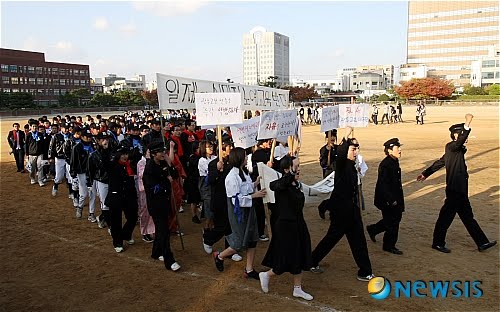
Last November, while looking for information related to this, I came across some captivating pictures out of Gwangju's Jeil High School, a reenactment of what I'll translate as the Gwangju High School Baseball Incident (광주보고야구사건, after 광주고등보통학교, the former name of 광주제일고등학교).


No English-language information exists to give background, though November 1, 2009 Newsis articles briefly summarize:
'광주고보 야구사건'은 일제강점기 시절인 1924년 6월 중순 두 팀이 광주고보 운동장에서 친선경기를 벌이던 중 심판 판정에 불만을 품은 일본팀 단장이 광주고보 투수를 폭행하자 선수들과 학생, 시민 등 400여명이 경기장으로 뛰어들어 항거했던 사건이다.

According to a lengthier article, a June 1924 baseball game between the Gwangju high school and a Japanese student all-star team ended with a play at the plate and a 1-0 upset, leading to a brawl at the mound among the teams and their fans. The nine Gwangju athletes were arrested and imprisoned for three months, a game and an outcome that would remain influential five years later.

Newsis photographers were on hand last year for a reenactment to coincide with the anniversary of the 1929 uprising.


Tuesday, October 19, 2010

October 19th, anniversary of the Yŏsu-Sunchŏn Incident (여순반란사건).


By Carl Mydans, for Life magazine.

Tuesday, October 19th, marks the anniversary of the "Yŏsu Rebellion," written in English also as the "Yŏsu-Sunchŏn Incident" or the "Yŏsu-Sunchŏn Rebellion," one of several bloody exchanges in Jeollanam-do last century, and one whose background serves to foreshadow the violence of the Korean War two years later. The 여순반란사건 was a crackdown against suspected communists in South Jeolla province, specifically the cities written now as Yeosu and Suncheon, that resulted in hundreds or thousands of deaths, depending on the source.

English-language information is limited, though the placards around Suncheon provide some background. From the placard that stood in front of Suncheon Station until it was razed and rebuilt in 2009:
The Yosun Incident broke out on Oct. 19, 1948, when the 14th Regiment of the National Defense Guard of South Korea refused to move to Jeju Island on a mission to put down an armed uprising protesting against the estasblishment of the government by South Korea alone. When about 2,000 soldiers marched into downtown Yeosu, the civilians,students and local leftists, who were suffering from economic distress after the establishment of the new government, joined the soldiers. The insurgent forces instantly occupied eastern areas of Jeonnam Province, i.e., Suncheon, Gwangyang, Gurye, Boseong, Goheung, and Gokseong. The government established the quell force headquarter in Gwangju and defeated the insurgent forces in Suncheon on Oct. 23 and in Yeosu on Oct. 27. During the search operation against the civilian collaborators, many innocent civilians were executed without trial. The number of victims of the Yosun Incident is estimated to be about 10,000 including policement, soldiers, and civilians, though the exact number is not known.
The Yosun Incident served as a momentum for establishing 'anti-communism' as the national idiology for South Korea and fixation of the partition of the Korean peninsula.


An excerpt from the book The Korean War 1945 to 1953, available from Google Books, reminding us there was brutality on all sides:
The civilian rebels included at least 70 teachers. The head of the Yosu's People's Committee was Song Uk, prinicipal of the Yosu Girls' Middle School---the girls were described as "redder than the inside of a watermelon" and proved it when, armed with Japanese rifles, they fought in the vain defense of the city.

In Sunchon some people were summarily executed, but others were tried by a People's Court. While some were found innocent or merely castigated, most were beaten and then executed. The police chief got the worst of it. His eyes were plucked out and he was dragged by car along the streets. Shot, his gas-drenched body was tied to a pole and set on fire. Some 900 people, among them 400 police, were killed in Sunchon by the rebels.

Here's an excerpt from a 1948 report by Carl Mydans---the man who took some of those photographs for Life---that appeared in Time magazine:
When darkness came, Communist execution squads went from house to house, shooting "rightists" in their beds or marching them to collection points where they were mowed down. In 2-3-days, 500 civilians were slaughtered. U.S. Lieuts. Stewart M. Greenbaum and Gordon Mohr, Army observers in Sunchon, narrowly escaped death. The rebel sergeant assigned to kill them was an old friend, who had drunk beer with them in their billet many times. He took the two officers into a field, fired into the ground and then led them to the Presbyterian Mission of Dr. John Curtis Crane, who was barricaded in with his wife and four other missionaries.

From one of the doctor's shirts and a few colored rags the ladies made a 16-star, eleven-stripe U.S. flag and put it up. The rebels began pounding at the compound gate, yelling: "Let's kill the Americans!" Suddenly one shouted: "No, no, not them; they are my friends." It was the lieutenants' friend, the sergeant. The rebels went away.

For the first few hours the loyal troops who retook Sunchon were as savage as the Communists had been. On the big compound of the Sunchon Agricultural and Forestry School we found what was left of the entire population of Sunchon. Women with babies on their backs watched without expression as their husbands and sons were beaten with clubs, rifle butts and steel helmets. They saw 22 of them marched away to the primary school nearby, and heard the volley of rifles which killed them.


By Carl Mydans, for Life magazine.

A placard on the Suncheon National University campus reads:
At the time of the Yosun Incident, the quell force, made up of police and defense guard troops, used the Suncheon Middle School of Farming and Forestry (the predecessor of the present Sunchon National University) as their camp and
headquarter when they attacked the insurgent forces in downtown Suncheon on Oct. 22th. The nearby Suncheon Northern Elementary School was the site of questioning and executing of civilians who were suspected of taking sides with the insurgents. The victims were executed without trial on the levee of a rice paddy behind the school's auditorium.

A few other posts in the "1948 Yosu-Sunchon Incident" category provide a little more information and sources. In November 2008 Life magazine opened its archives to Google Image searches, providing over 100 pictures of violence in Yeosu and Suncheon in the 1940s, and in the Jeolla provinces in the 1950s. Be warned, the photographs are understandably graphic. Since my first posts in 2007 and 2008, more contemporary AP reports have trickled out via a Google News archive search, providing at least one-sided coverage of the violence and additional information about the area. From a report by Tom Lambert available in the Spokane Daily Chronicle on October 25, 1948:
Golden rice fields, streets, and the police compound are strewn with the bodies of an estimated 600 bodies killed in last week's revolt here.

The article continues, mentioning two of the "yanks" who saw action (named in the aforementioned Time piece by Mydans as well):
Lieutenant Greenbaum said anti-American epithets were hurled at him by the rebels. Lieutenant Mohr's boot heel had a hole shot in it by police, who, he said, "were shooting at everything."

When they were through executing bound antileftists and police, the rebels armed high school aged youths with Japanese rifles. Ten of those were slaughtered yesterday when they tried to storm the postoffice, then held by loyalists.

Col. Won Yong Duk, who took part in the loyalist assault on Sunchon, said 180 rebels were captured by his forces.

When Suncheon was retaken, every man in each house was taken to the grounds of a Japanese-built school for questioning. Police kicked and clubbed them. One policeman wearing an old Japanese helmet butted the suspects he was interrogatig.

Along the road flanking the school grounds an estimated 500 women awaited the outcome of the questioning. They could see some of the suspects mauled and beaten. Only the women's eyes betrayed their anxiety.

Further down the road, at a plaza, the bodies of the 22 newly executed men were strewn. On their bodies were small squares of white canvas on which were painted in indelible ink the hammer and sickle over a pair of clasped hands.


By Carl Mydans, for Life magazine. See also here.


Bodies of the 22 executed at the school, by Carl Mydans for Life magazine.

Monday, June 14, 2010

Great-grandson of Korean War hero teaching in Mokpo.

Last week Yonhap and the Chosun Ilbo profiled Ben Forney, a Fullbright Scholar and native speaker English teacher at a middle school in Mokpo, most notable perhaps for being the great-grandson of General Edward Forney, one of the men who helped hundreds of thousands of UN troops and Korean refugees escape from North Korea during the Hungnam Evacuation (흥남부두 철수) in 1950.

Ben arrived in Mokpo last summer and has written about his time in Korea for his alma mater and on his blog, the latter including an anecdote from his trip to Geoje island and the statue of his great-grandfather:
[T]hanks to the excellent Korean skills of my friends, we talked to a lady at the information booth and explained who I was. She made some calls, and thirty minutes later, two old men walked up and began talking to us. Survivors of the Hungnam Evacuation. They were awesome. Surprisingly, they spoke a little English, and with the help of our collective Korean knowledge, we heard their stories, and somehow arranged for a quick piggy-back ride. It was a pretty typical wacky exchange with Koreans. Don't bother asking me why he gave me a piggy-back ride. The world will probably never know.

Monday, May 31, 2010

Students commemorate anniversary of Gwangju Uprising with guardhouse experience tours.

A little while ago a teacher and blogger in Gwangju, Wanderlust: Korea, shared some pictures from the field trip her middle school took on Monday, May 17th to commemorate the Gwangju Uprising that began on May 18th, 1980. The students toured a few sites associated with the uprising and made the news posing with politician and Jeolla favorite Chung Dong-young, all in all a busy day.


Anyway, here are a few of my favorites, reposted with permission. The students had a tour guide to show them around the National Cemetery in Gwangju (which was also captured by Newsis):


An interesting placard at the museum:


The series that interested me most was at an old guardhouse, a site I didn't even know was still in existence and open to the public:


The students were yelled at by guards and then led across the grounds into holding cells.


Beyond the white buildings is a brick semicircle building "used as a detainment facility" a placard explains
where those who struggled against the military dictatorship during the May 18 Democratic Uprising were held in custody. In this fan-shaped guardhouse consisting of 6 chambers detainees could easily be monitored with a single glance. Detainees had to sit up straight for 16 hours a day and were beaten with a club regardless of age if they moved an inch. In one chamber as many as 150 were imprisoned, which made it almost impossible to sleep. Detainees often suffered from rashes and skin disease in the scorching heat. They were served two portions of food in one tray and were given only three spoonfuls of rice. The captives were under a constant threat of violence from the military police. Yet, they never caved in to such atrocities having the firm belief that truth always prevails in the end.


There are mannequins demonstrating how prisoners had to sit:


And, as in this Newsis photograph, how they were interrogated:


A Naver search turns up videos of these guardhouse experience tours (영창체험) for students, such as one with a local elementary school from 2006---with inappropriately-pleasant background music---and this one with Honam University students and Japanese yuhaksaeng from 2007.

The facility is located in the 518 Freedom Park (518자유공원) in Chipyeong-dong, behind the Kim Daejung Convention Center. It's accessible via a number of buses and by the Kim Daejung Convention Center subway station. The National Cemetary is accessible by the aptly-numbered city bus 518.

Tuesday, May 18, 2010

Gwangju Uprising anniversary.


A parade downtown to the Old Provincial Hall, on May 17th.

May 18th is the 30th anniversary of the start of the Gwangju Uprising (5.18 광주민주화운동), an occasion marked each year with a parade and speeches. Coverage of Tuesdays events is provided by English-language papers the JoongAng Daily and the Korea Herald:
About 2,500 people, including Prime Minister Chung Un-chan and leaders of political parties, attended the ceremony at the national cemetery in Gwangju.

More than 300,000 people have visited the national cemetery this month ahead of the ceremony, according to city officials.

Ceremonies were also held elsewhere in the nation including Seoul, Busan, Ulsan and Daegu.

About 600 people gathered at a plaza in front of the Seoul City Hall earlier Tuesday, offering a prayer for the victims of the May 18 uprising.

The president did not visit Gwangju on Monday, unsurprisingly inviting criticism; from the JoongAng Daily:
President Lee Myung-bak will not attend the anniversary ceremony, prompting complaints from the commemorative groups. The May 18 groups issued a joint statement, urging the president to reconsider his decision.

. . .
“When he was a presidential candidate, President Lee had spoke carelessly about the May 18 democracy movement,” said Democratic Party Chairman Chung Sye-kyun. “For the second year in a row, he is skipping the anniversary ceremony. The May 18 anniversary is designated as a national observation day, but concerns grow that Lee is treating it coldly.”

There is also an index of Korean-language articles available via Naver and a Daum search, and the local English-language magazine Gwangju News has a few articles in its May issue.

An excellent source of insight and information in English is the blog Gusts of Popular Feeling, which provided a summary of its writing in a post yesterday.

If you're ever in Gwangju you can visit the National Cemetery (5.18 국립묘지) and other historical sites associated with the uprising via the aptly-numbered city bus 518. In 2008 the calendar was more cooperative and the 17th and 18th fell on a weekend, so I could witness some of the proceedings downtown and at the cemetary on both days. In the middle of the Mad Bull Shit protests against President Lee Myung-bak and American beef, though, the struggle for democracy 28 years earlier was updated in a rather bizarre way.


Downtown Gwangju on May 17th, 2008 was less about the battles in 1980 and more about the perceived dangers of big, bad American beef.


Some still make the connection.

About the only other time I wrote about the uprising was a week later when I looked at placards set up in Gangjin county, south of Gwangju, one of the several outlying rural areas where violence spread in 1980. An excerpt from the placard in front of the county office:
The Demonstration Movement in Kangjin area has been ignited by demonstrators arrived in Kangjin from Kwangju City by eight buses on May 21, 1980.

As the demonstrators entered the Kangjin, the police forces voluntarily withdrew their forces avoiding physical clash. Citizens being already aware of the Kwangju massacre welcomed the student demonstrators and joined with them.

Having set up their headquarter at the Kangjin church, the students and citizens made an organized demonstration in several places such as County Hall and Bus Terminal. At night, they stayed at the church or the inns nearby and the sisters from the church offered foods to them.

On May 23, 1980, about 500 students from Kangjin Agricultural High School gathered together and joined in the demonstration screaming "Lift the Martial Law", "Recover the democracy", and "Free Kim Dae Jung". The demonstration reached its climax as the members from the Regional Young Man's Association and Young Man's Counsel add to the demonstration group. On May 23rd, there were two bullet wounded people and many other wounded ones from Haenam Wooseljae clash against the Martial Law Command and they were hospitalized and cared for in the provincial hospital, the current Kangjin clinic.


Photographed in 2006.

Further research into the events in rural Jeollanam-do in May 1980 would be an interesting academic hobby to try before the 31st anniversary.