Tuesday, December 11, 2007

Michelle Wie and Jangheung.


I rediscovered an article from February, 2006, on Michelle Wie that I posted to Dave's before I even heard of Jangheung county. The article talks about an upcoming tournament, and contains this interesting paragraph:
Wie's parents are from South Korea. Her grandfather Wie Sang-kyu lives in Jangheung, a remote South Korean city where a few locals used to pass the hat to support his granddaughter in her earlier days playing as an amateur in Hawaii.
I saw another article that said there were plans to build a Michelle Wie golf course in Jangheung, incorrectly listed as her hometown, but apparently those ideas were the work of an imposter. From the Donga Ilbo, November 15, 2005:

Police have arrested a Mr. Wie (46) on November 14 for posing as 16-year-old American professional golfer Michelle Wie’s close relative and swindling hundreds of millions of won.

According to police, Wie courted investors beginning in late 2004, saying, “a ‘Michelle Wie golf course’ will be constructed in her hometown of Jangheung, Jeonnam, and we will build a shoe sterilizing factory there, which will give a 940 percent rate of return in just four months.”

He is suspected of gleaning 14.7 billion won from some 970 investors by promising principal and interest, and embezzling 300 million won outright.

Police reported, “Wie introduced himself as Michelle Wie’s relative and printed pictures of him and Michelle Wie taken together on advertising fliers.” Police noted that Mr. Wie was an unacquainted remote relative of Michelle Wie’s.

Sunchon Tunnel Massacre - October 30, 1950


Suncheon is also the name of a city in North Korea, something I was reminded of while googling "Sunchon" in order to find older mentions of the South Korean city. The North Korean city has a population of 437,000, and though it is spelled the same in Hangeul, it, along with the rest of the DPRK, uses the McCune-Reischauer spelling of Sunch'ŏn. Anyway, I bring it up because while I was googling I came across a few sites talking about the Sunchon Tunnel Massacre, which I had never heard of before. According to U.S. Senate Report no. 848 on Atrocities of January, 1954:
In October of 1950, at Pyongyang, when the fall of that city appeared imminent, the Communists loaded approximately 180 American war prisoners into open railroad cars for transport northward. These men were survivors of the Seoul-Pyongyang death march and were weak from lack of food, water, and medical care. They rode unprotected in the raw climate for 4 or 5 days, arriving at the Sunchon tunnel on October 30, 1950. Late in the afternoon, the prisoners were taken from the railroad cars in alternate groups of approximately 40 to nearby ravines, ostensibly to receive their first food in several days. There they were ruthlessly shot by North Korean soldiers, using Russian burp guns. One hundred and thirty-eight American soldiers lost their lives in this atrocity; 68 were murdered at the tunnel, 7 died of malnutrition while in the tunnel, and the remainder died of pneumonia, dysentery, and malnutrition while in the tunnel, and the remainder died of pneumonia, dysentery, and malnutrition on the horror trip from Pyongyang.

You can also find the above report here, in .pdf form. According to another report, almost two-thirds of American prisoners of war who died in Korea died of war crimes. I found that report through a link from Wikipedia's Korean War page which, to me, seems a bit biased against the US.

Anyway, it's fairly timely because apparently a book was just released which documents the accounts of eight survivors. It is called They Came Home - Sunchon Tunnel Massacre Survivors.

MIssionary Wilson's House, Gwangju

I'm in the process of writing a longer entry on missionary work carried out in Suncheon during the early-20th century, but as a little introduction I wanted to write-up Missionary Wilson's House (우일선선교사사택), located in Gwangju. Built in 1920, it is the oldest example of Western architecture in Gwangju, and was designated as Gwangju Monument no. 15 in 1989. Galbijim ate my pictures, so instead here are a couple stolen from Naver's encyclopedia entry:


It was home to the American missionary Robert A. Wilson, about whom I've been able to find no further information. It is located on the campus of the Honam Theological University and Seminary, on the other side of Sajik Park. On the site of present-day HTUS, the Honam Bible School was established in 1955 by American Presbyterians. In the early 1960s, the Honam Bible School merged with the Gwangju Night School and the Suncheon Maesan Seminary to form the Honam Theology Institution.

According to the HTUS site, the Reverend Thomas Dwight Linton served as principal of the Honam Theological Seminary from 1973 to 1978. The Linton family, it turns out, has an interesting history in Korea, especially in Suncheon, that continues to this day.

The above-mentioned timeline also tells us that George Thompson Brown was the first principal of the Honam Theology Institution, from 1961 to 1967. I don't know anything about him either, but google says he published a 30-page pamphlet titled "Not by Might: A Century of Presbyterians in Korea" in 1984. While stalking googling around I found mention of the Kwangju Christian Hospital, established by Presbyterian missionaries in 1905, and whose first building was erected in 1909 as the Ella Lavine Graham Memorial Hospital (not sure how that works). Further stalking googling led me to the mention of a book titled Kwangju Christian Hospital, the Missionary Years: 1905-1976, by Ron Dietrick who, according to his Amazon.com bio, went to Gwangju in 1958 and stayed there long enough for his children to be raised there. Oh, and according to the Kwangju Christian Hospital timeline, the missionary Dr. Robert M. Wilson became the hospital's second director in 1908.

Wilson's house is on the campus of HTUS. It is on the left side of this map, although I don't recall if it's the "Missionary Compounds" labeled 17. If I remember correctly it is located further down the path, beside a cafe, and is really quite isolated. It is not open to the public and, in spite of being a monument and historical site, is in pretty bad shape, with broken windows and litter inside the first-floor rooms. The basement door was wide open when I was last there, though it was empty of anything besides spiders and trash.

Monday, December 10, 2007

TIME magazine on the 1948 Yosu-Sunchon Incident.

The TIME magazine website has two little articles about the Yosu-Sunchon Incident, both from November, 1948.

First is an article from November 1, 1948, titled "From One Source."
One day last week, Radio Moscow announced that Russian troops had begun to pull out of North Korea. On the same day, a Communist-inspired revolt broke out in Korea's southern tip.

The Russian withdrawal in the north worried South Koreans more than did the vest-pocket southern uprising. The Russians were leaving behind them a firmly installed Communist regime with a well-trained army of 150,000. The departure of the Red army was intended to bring pressure on the U.S. to withdraw its troops, leaving a South Korean constabulary and militia totaling about 60,000 to face the far stronger northern force.

Dr. Syngman Rhee, President of the two-month-old South Korean Republic, was in Tokyo visiting Douglas MacArthur at the time. Said MacArthur: "I will defend Korea as I would my own country—just as I would California."

With MacArthur's words to encourage them, the South Korean army energetically set about crushing the revolt. It had begun one morning before dawn, when 40 Communist members of a brigade stationed in the far southern port of Yosu shot their officers and bullied their sleepy comrades into attacking the city police station. They took over all of Yosu, then headed north, picking up confused recruits along the way. By the time they reached Sunchon, a city of 75,000, their force had grown to
around 2,000.

Brigadier General Song Ho's loyal troops quickly drove the rebels out of Sunchon, and chased them back into the rough, hilly country to the south. It was hard to tell friend from foe. Both loyal and rebel troops wore U.S. uniforms and carried U.S. weapons. Loyal troops finally put on white armbands. Said young Lieut. Colonel Kang Yung Noon: "What sadness that we had to fire our first bullets against our own brothers."

At week's end government forces had retaken most of the territory won by the rebels; they expected to recover Yosu soon. Asked who was responsible for the revolt, President Rhee said: "We really do not know." Then he pointed a finger to the north and added: "But all of our troubles come from one source."
Next is a report from November 8, 1948, filed by Carl Mydans, who was accompanying the government troops.

The pretty little valley of Sunchon ("Peaceful Heaven") rests neatly at the bottom of the rugged Chiri Mountains, twelve miles north of the port of Yosu. On the morning of Oct. 20, Sunchon's farmers were harvesting their rice, when they heard a siren and the rattle of small arms from the railroad station. They looked up to see 2,000 rebel soldiers and 400 civilians swarming off a train from Yosu.

The rebels approached Sunchon city peacefully; but as soon as they entered the city, police opened fire. Joined by a company of soldiers guarding the city bridge, the rebels fired back. After a short, sharp battle they were in full control. The hundred or so cops who surrendered were lined up against the wall of the police compound and riddled. Then the rebels, joined by part of the citizenry, paraded through the city under North Korea's Communist banner, singing "Ten thousand years to the North Korean People's Republic!"

Star-Spangled Shirt. When darkness came, Communist execution squads went from house to house, shooting "rightists" in their beds or marching them to collection points where they were mowed down. In 2-3-days, 500 civilians were slaughtered. U.S. Lieuts. Stewart M. Greenbaum and Gordon Mohr, Army observers in Sunchon, narrowly escaped death. The rebel sergeant assigned to kill them was an old friend, who had drunk beer with them in their billet many times. He took the two officers into a field, fired into the ground and then led them to the Presbyterian Mission of Dr. John Curtis Crane, who was barricaded in with his wife and four other missionaries.

From one of the doctor's shirts and a few colored rags the ladies made a 16-star, eleven-stripe U.S. flag and put it up. The rebels began pounding at the compound gate, yelling: "Let's kill the Americans!" Suddenly one shouted: "No, no, not them; they are my friends." It was the lieutenants' friend, the sergeant. The rebels went away.

For the first few hours the loyal troops who retook Sunchon were as savage as the Communists had been. On the big compound of the Sunchon Agricultural and Forestry School we found what was left of the entire population of Sunchon. Women with babies on their backs watched without expression as their husbands and sons were beaten with clubs, rifle butts and steel helmets. They saw 22 of them marched away to the primary school nearby, and heard the volley of rifles which killed them.

"Get the Americans Out." Two days later, entering Yosu, the town where the revolt began, the government troops were much better behaved. The Communists' occupation of Yosu revealed the pattern they would like to impose on all South Korea. After arrest and murder of police and loyal leaders, the rebels took over all communications, banks, schools and food distribution. They established a "People's Committee" as the new government. The "People's Committee" announced: "Our two-point program: 1) to oppose, to the death the killing of our brothers, and 2) to get the Americans out of here."

Though the recapture of Yosu has temporarily stalled the revolt, most of the rebel troops have, melted off into the countryside and mountains with their weapons. Yosu's fall was not the end of a war; it was only the beginning. The general civilian point of view was expressed by one woman we found squatting in a shack on the outskirts of Yosu just after the fight had gone by her door. When we asked her whom she was for she replied: "I'm for you. You are the strongest."


The Suncheon Agricultural and Forestry School is present-day Suncheon National University. A few days ago I posted about the placards around Suncheon that mark notable sites during the rebellion. The one on the campus reads:
At the time of the Yosun Incident, the quell force, made up of police and defense guard troops, used the Suncheon Middle School of Farming and Forestry (the predecessor of the present Sunchon National University) as their camp and headquarter when they attacked the insurgent forces in downtown Suncheon on Oct. 22th. The nearby Suncheon Northern Elementary School was the site of questioning and executing of civilians who were suspected of taking sides with the insurgents. The victims were executed without trial on the levee of a rice paddy behind the school's auditorium.

There are a few articles on the rebellion from the New York Times. I thought their archives were free, but since they're not, I can't get to them. Anyone interested can comb through these search results.

Sunday, December 9, 2007

Gangjin's temples, part 2: Nammireuksa

Update, February 19, 2008:

I finally made a trip out to the temple yesterday. The site is fairly large, and is definitely worth a visit if you're in the area. I copied some of my original write-up and paired it with a small profile on Omcheonsa, another temple in Gangjin that I'll be blogging about shortly, for the upcoming issue of Gwangju News.


Nammireuksa is out in the middle of nowhere. Here's the street leading up to it (facing the other way). There is a small village next to the temple, but I didn't wander through it.

Buses do go toward Nammireuksa from the terminal in Gangjin-eup. They are bound for some of the tiny villages in eastern Gangjin county and will drop you off at an intersection 700 meters away from the temple. The site is kind of split into two sections: there's the half with the huge statue and the two large pagodas, and then there's the half with the various prayer halls. After you pass the elephant statues at the gate, walk down the path and bear right to visit the various halls. There are hundreds of small stone deities along the way, and another few hundred elsewhere around the site. Practicially everything on the grounds is brand new, which gives it a kind of tacky look, as if they went out to one of the stone masons you'll see out in the country and just bought one of everything. The stupa and statues are shiny and white, and the paint on the halls is colorful and vibrant. Inside the halls the decorations are a bit gaudy compared to what you typically find in Korean temples. There are tons of gilded dieties, and the main hall (대웅전) has a fairly large (gilded) reclining Buddha, a (gilded) multi-headed deity, and a (gilded) mural along one wall. There are also protuding dragon heads along the ceiling. So it does look a bit . . . much, and defies the Western stereotype we have of the unassuming, self-sacrificing Buddhist. As if any temple that builds a 36-meter-high Buddha would be confused with austere. But, hey, foreigners who visit temples in Asia aren't really looking for austere, and it should be said that at least the stuff at Nammireuksa is sort of unique, and doesn't resemble every other temple in the country.


The area leading up to the statue.

I'm not just saying this to cover my inadequacies, but I don't think it's a site that photographs well. The placement of the trees, buildings, stupa, and statues means it's hard to get a decent shot. Trying to photograph an entire building or statue, for example, meant backing up into some immovable object or other.

The area between the two halves of the site was filled with crumbling bulidings, boulders, building materials, and . . . trash. It was very strange. The statue is huge, as 36-meter-high statues are wont to be, and is lined along the bottom with prayer wheels and reliefs. There are statues popping up all over the place, and there are mantras (I'm assuming) carved alongside the stairs. There are two giant pagodas in front of the statue.

They pipe Buddhist music into the gates and halls, but other than that I didn't see or hear any evidence of inhabitation until I was just about to leave. One of the residents chatted with me a little and gave me two free calendars. As I was leaving I did see another interesting site: two caged turkeys.


Original post:

I'm in the process of profiling some of Gangjin's notable people and places. Earlier entries were on "Gangjin: Its People and Their Places" and "Gangjin's temples, part 1: Baekryeonsa, Okcheonsa, Yongmunsa."


Seated Buddha at Nammireuksa, April 2007 (stolen from here).


One of the more interesting places is Nammireuksa (남미륵사, 南彌勒寺, map) in Gundong-myeon. It has what is among the largest sitting-Buddha statues in the world. At 36 meters high and weighing 670 kilograms, the statue is the largest Buddha in Korea. It is 3 meters taller than Beopjusa’s standing Buddha, and 6 meters taller than the figure of Jesus standing over Rio de Janeiro, though roughly half the size of the Leshan Buddha in China, and a mere toddler next to the 152-meter-high bronze Maitreya planned for Kushinagar, India. You’ll see Nammireuksa’s statue from the highway on your left if you head from Gangjin to points east, like Jangheung, Boseong, Suncheon, and Yeosu.


Brass Seated Buddha (stolen from here).

As the statue was finished in 2006, Nammireuksa is still off the beaten path. Few foreigners know about it, even fewer have been there, and it doesn’t even have an encyclopedia entry on Naver. The temple's head priest has high hopes for it, though, saying that the statue will make the temple one of the region's representative tourist spots, and will revitalize the area and its people. Others have told me, though, that people sneer at the expensive (10 billion won) and gaudy donation magnet.

The statue depicts Amitabha (아미타), "the principal buddha in the Pure Land sect, a branch of Buddhism practiced mainly in East Asia," according to Wikipedia.


(Stolen from here.)

Photos of the statue’s construction are available here, and there are a bunch of photo albums available through a Naver search, including this and this.

Other points of interest at the temple are prayer wheels, pagodas, stone elephants, and springtime flowers.


Pagodas in front of the large seated Buddha (stolen from here).


Elephant statues at the gate (stolen from here).

It is, according to Naver, a little over 11 kilometers away from Gangjin-eup, the main town in the county, and a taxi there will cost a little over 8,000 won. The telephone number, should you need it, is 061-433-6460.

Friday, December 7, 2007

Korea Times: "About Foreign Teachers"

You know, unless you're a sports writer there's no need to paragraph every goddamn sentence.

I wrote a longer, more whiny entry about Kang Eun-hee's article here.

Placards about the Yosu-Sunchon Incident around Suncheon (여순사건관련지)


I've come across a few placards around Suncheon marking notable places during the Yosu-Sunchon Incident of 1948 (which also known as the Yosu Rebellion, the Yosu-Sunchon Rebellion, and other variations). I haven't found many internet sources in English on the internet, so I find these placards kind of useful. I'd also be interested to know what happened during this time---between World War II and the Korean War---in other areas of Jeollanam-do (specifically Gangjin). Anyway, for a little background on the incident, there are two articles here and here.

I've come across three placards so far: at Suncheon Station, at Dongcheon River, and at Suncheon National University. I originally assumed 관련지 meant "placard," but looking in the dictionary I see "관련" means "relation, connection, association." All three of the placards marking sites associated with the incident are two-sided, and all three contain the following text on one side:
The Yosun Incident broke out on Oct. 19, 1948, when the 14th Regiment of the National Defense Guard of South Korea refused to move to Jeju Island on a mission to put down an armed uprising protesting against the estasblishment of the government by South Korea alone. When about 2,000 soldiers marched into downtown Yeosu, the civilians,students and local leftists, who were suffering from economic distress after the establishment of the new government, joined the soldiers. The insurgent forces instantly occupied eastern areas of Jeonnam Province, i.e., Suncheon, Gwangyang, Gurye, Boseong, Goheung, and Gokseong. The government established the quell force headquarter in Gwangju and defeated the insurgent forces in Suncheon on Oct. 23 and in Yeosu on Oct. 27. During the search operation against the civilian collaborators, many innocent civilians were executed without trial. The number of victims of the Yosun Incident is estimated to be about 10,000 including policement, soldiers, and civilians, though the exact number is not known.
The Yosun Incident served as a momentum for establishing 'anti-communism' as the national idiology for South Korea and fixation of the partition of the Korean peninsula.
I didn't change any errors in spelling, punctuation, grammar, or spacing, and I didn't alter any of the romanization.

On the flip side of the placard in front of Suncheon Station is the following:
Suncheon Station bore witness to the early stages of the Yosun Incident. The insurgent forces used Suncheon Station as a base to attack downtown Suncheon while they were extending their influence outside Yeosu. At 8:39 Oct. 20, 1948, abotu two thousands of the insurgent forces left Yosu by train and other vehicles, and arrived at Suncheon Station at around 09:30 without facing any resistance. Two companies of the 14th Regiment, which had been dispatched to Suncheon, joined the insurgent forces under the command of 1st Lt. Hong Soonsuk. The joint forces were able to easily break through the resistance of the police troops who were defending Gwangyang Saguri (a three forked road) and the bank of Dongchun Stream, and advanced toward downtown Suncheon. The current building of the Suncheon Station was rebuilt in October, 1960.
The placard on the banks of Dongchun/Dongcheon is about 15 minutes away. From Suncheon Station, walk west toward the river. Follow the pedestrian on-ramp to your right and start walking north along the river. It is on the east side of the stream, along the walking path, tucked under Suncheon Bridge (순천교).


The placard reads:
The Suncheon Bridge (Jangdaedari) and the bank of Dongchun Stream witnessed the first fierce combat between the police and the insurgent forces at the time of the Yosun Incident. On October 20th, the Suncheon police and right-wing youths from adjacent regions established a defensive line at Gwangyang Samguri, but failed to keep the insurgent forces from advancing to downtown Suncheon because the 4th Regiment, a support troop from Gwangju, joined the insurgents. During the combat, most of the policement escaped from the spot, some were killed, and only about 50 retreated to the Suncheon Police Station.

The third placard I found is located on Suncheon National University, behind the graduate school / language center (대학원 / 어학원), number 2 on this map. If exiting the building, turn left and at the street turn left, and the placard will be visible a few meters on your left.

The placard says "여순사건관련지 - 순천농림중학교 (현 순천대학교), or Suncheon Middle School of Farming and Forestry (presently Suncheon National University). According to the Suncheon University site, the Farming and Forestry middle school was established in 1946, became a high school in 1951, a vocational high school in 1965, a technical college in 1973, a college in 1979, a four-year college in 1982, and finally Suncheon National University in 1991.

The placard reads:

At the time of the Yosun Incident, the quell force, made up of police and defense guard troops, used the Suncheon Middle School of Farming and Forestry (the predecessor of the present Sunchon National University) as their camp and
headquarter when they attacked the insurgent forces in downtown Suncheon on Oct. 22th. The nearby Suncheon Northern Elementary School was the site of questioning and executing of civilians who were suspected of taking sides with the insurgents. The victims were executed without trial on the levee of a rice paddy behind the school's auditorium.
Suncheon Northern Elementary School (presently 전남순천북초등학교) is located about a half-kilometer south of Suncheon University.

Thursday, December 6, 2007

Gangjin's temples, part 1: Baekryeonsa, Okryeonsa, Yongmunsa


I'm in the process of profiling some of Gangjin's notable people and places. The first entry on this topic is "Gangjin: Its people and its places," on three of the county's most notable residents. For the sake of readability, I have decided to break up the huge entry on Gangjin's temples into several smaller sections. Part 1 will profile the three temples on Mandeoksan mountain: Baekryeonsa, Okryeonsa, and Yongmunsa.

Mandeoksan (만덕산), or Mt. Mandeok (산 means mountain), is located in Gangjin county's Doam-myeon, just west of Gangjin Bay, and rises 408 meters. A bunch of Gangjin's most well-known assets are located here, including Baekryeonsa temple, Dasan Chodang (다산초당, Dasan's house of exile), and Dasan's Relic Exhibition Hall.


Baekryeonsa, overlooking Gangjin Bay.

Baekryeonsa (백련사, 白蓮寺) is arguably the most "famous"---in the Korean sense of every square inch of the country being famous for something---temple in the Gangjin. But in my humble opinion it's not the most interesting, is quite small and is certainly nothing you've never seen at any other temple in South Korea. What is nice, though, is the series of trails that criss-cross Mandeoksan and connect the three temples to Dasan Chodang. The trail from Baekryeonsa to Dasan Chodang is roughly 0.8 kilometers long, is wide and pleasant with a gentle slope in most places, and has stairs built into the hill in steeper places. The pavillion at Dasan Chodang, called 천일각, offers nice views of Gangjin Bay and the uninhabited Juk-do island.
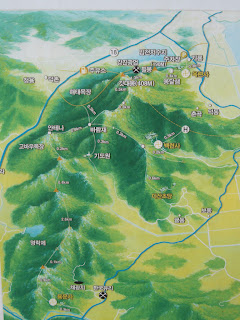

Map of Mandeoksan (click for a readable version)


Chunilgak Pavillion at Dasan Chodang, just over a half-kilometer from Baekryeonsa.

Once known as Mandeoksa, after the mountain, Baekryeonsa means "White Lotus Temple," and you'll see the name spelled Baegnyeonsa, Baekyeonsa, Paengryonsa, and other similar variations. According to the official website, the temple originally dates to 747 and was founded by the priest Chinpyo (진표), though Naver gives the date 839. Regardless, the structures on the site have been rebuilt many times. The main hall (대웅전), for instance, is said to have been rebuilt in the 18th century.

Dr. Kim Byung-kuk, a native of Gangjin, has written on the relationship between Dasan and Gangjin, and in this passage he writes, maybe a little overenthusiastically,

"Collecting abundant young tea leaves, in early spring, he indulged in drinking tea, the redolent fragrance of which has been identified with the lofty ideals of his thought."

In his collection of articles on Gangjin, which I talked about at the end of my earlier post on Gangjin, Kim mentions that some have suggested a relationship between Dasan's time near temples in Gangjin and his attitudes toward Buddhism. On page 13 of the particular journal I have, Kim writes:
Buddhism had an important place in the thought and historical reflections of Ta-san. There are many references to and expositions of Buddhist doctrine in his voluminous works. Ta-san compiled, among other volumes, "Manduk-sa Ji" (History of Manduk Temple), "Taehung-sa Ji" (History of Taehung Temple) [in Haenam county], and "Taedong Sonkyo Ko" (A Study of Eastern Zen Buddhism). The "History of Manduk Temple" recorded important events related to Buddhism in the latter period of the Koryo Dynasty with emphasis on the Paekryon (White Lotus) movement, a popular Buddhist reform movement initiated in 1236. The "History of Taehung Temple" described the development of Korean Buddhism in the latter period of the Yi Dynasty after the demise of Saint Sur-san who played a leading role in the popular resistance movement during the Hideyoshi invasion (1592 - 1599). The "A Study of Eastern Zen Buddhism" was a systematic compilation of the highlights of the development of Buddhism from the Three Kingdoms till the Silla Kingdom. However, Ta-san did not leave behind any systematic treatise on his personal view of Buddhism. it is therefore intriguing to contemplate Ta-san's views of Buddhism and his understanding of the history of Korean Buddhism.

On the next page, Kim gives some background on Manduk-sa (a different spelling of Mandeoksa):
Manduk-sa is located some 12km south of the town [today's Gangjin-eup] on the hill looking down on picturesque Kangjin Bay. The temple was originally built in the Shilla period. It was reconstructed first in the Koryo period and gain during the reign of King Sejong (1418-1450) and lastly during the reign of King Hyojong (1649-1659). Manduk-sa has produced eight holy preceptors and was one of the two pillars of theoretical Buddhist learning in the south during the latter part of the Yi Dynasty. A forest consisting of some 1,500 camellia trees surrounding the compound of Manduk-sa is unique and may not exist anywhere else in the world. Tea plants grow on the forest floor.
Beside the temple is a grove of camellia trees, which Kim mentions above, and a few small stupas. According to a placard on site, the "Camelia Forest of Baengnyeonsa Temple" contains several thousand trees and was designated as Korea's Natural Monument no. 151 in 1962. One of the stupas inside the forest dates to the 14th century and has been Local Tangible Cultural Property no. 223 (전남유형문화재 제233호) since November 20, 1999. Because there are no markings on the stupa, it is unknown whose belongings are inside. Other cultural properties on site include the main hall, Local Tangible Cultural Property no. 136, and a stele erroneously labeled as National Treasure no. 1396 (it is not a national treasure, and the number of treasures does not exceed 307 anyway). According to a placard nearby, it is actually "Treasure no. 507," which isn't any more helpful. It does say, though, that the turtle-shaped base on the stele reportedly came from a 13th-century stele at the temple.


"Bell-shaped stupa of Baengnyeonsa," Jeollanam-do Tangible Cultural Property no. 223

A second temple, Okryeonsa (옥련사, 玉蓮寺), is located two kilometers northeast of the mountain's peak, and roughly three-and-a-half kilometers from Baekryeonsa. Not that you would, but don't get this one confused with the more notable Okryeonsa in Euiseong county, Gyeongsangbuk-do. About the only thing worth mentioning about this rather small temple is the 77-cm-high wooden seated Buddha statue (목조석가여래좌상) in the main hall, which, according to the Gangjin county site, came from Jangsusa temple in Gangjin's Daegu-myeon in 1951. Also from the Gangjin county website,

In May, 1991, clothing was introduced by the Gangjin Culture Office and students of Gangjin local history.

It continues in a less amusing manner:


In this Buddha style, several characteristics are shown, such as downward tilt of his head, lifted eyes, unseparated hair, and the physical appearance of the head, etc. The material of the Buddhist clothing is thick silk and the trail of clothing is down to the elbow. From these details, we are able to recognize that this style is from late Koryo to late Chosun dynasty. Also, it indicates that this is Sakyamuni Tathagata as Sakyamuni is written on the wrist of left hand.

In 1995 it was designated as Local Tangible Cultural Property no. 188. It's also worth pointing out that the Japanese invaded in 1592 and not, as the website tells us, in 1952.


Picture of the Wooden Seated Buddha at Okryeonsa, stolen from here.

There is a third temple on Mandeoksan, called Yongmunsa (용문사), located 5.3 kilometers south of the mountain's peak, 깃대봉. I haven't found much information about this temple, although I've included a photograph below, which looks east over the temple and toward Gangjin Bay. The complete photo album is available here.


Photograph of Yongmunsa, stolen from here.

Buses run to Dasan Chodang about once an hour from the brand new bus terminal in Gangjin. You can tell the bus driver to drop you off at Baekryeonsa, although the bus stop is roughly a mile away from the temple. After getting off at Dasan Chodang, you will have to walk for about fifteen to twenty minutes, but as long as you stay on the road, walk toward the mountain, and follow the signs, you can't miss it. Double-check the pick-up times at the bus terminal before you leave. Both times I've been in that area I had a hard time getting back. I recommend also writing down the number of one of the call taxi companies across from the bus station, just in case. You can call yourself or somebody at one of the tourist sites can arrange it for you.

If you go toward that area, especially if you have a car, I recommend stopping at 들꽃이야기 (Wild Flower Story), a nice little tea house in front of the relic exhibition hall. There is a garden with maple trees, totem poles, and of course wild flowers surrounding the small house. The interior is decorated with items made at the workshop attached to the house, and some of the woodcarvings cost upwards of two million won ($2,000). They are decorated with animals, plants, or Korean proverbs, and are made by a craftsman whose name completely escapes me. The tea house is accessible by the same driveway that reaches the exhibition hall. You can see photo galleries here and here. Should you need it, the phone number is (061) 432-9080.

In the near future I will write a little about Nammireuksa (남미륵사) and Omcheonsa (옴천사), the two most interesting temples in Gangjin, and Muwisa, which is also arguably the most "famous" temple in the county.
Gangjin's new bus terminal!


I apologize for being late in bringing you the latest news from Gangjin county. On November 22 the new bus terminal finally opened after 7 months and 2.3 billion won. I'm very eager to see it, though unfortunately that means actually going to Gangjin.


Story here from Naver and here from the Gangjin newspaper, 강진신문.

Tuesday, December 4, 2007

Suncheon's 국도극장

A little while ago I posted an entry about Suncheon's movie theaters, mostly to make it easier for me to find show times. I mentioned a few theaters that don't exist anymore, one of them being 국도극장, in Suncheon's "Old Downtown."


It's located next to the Lotteria, although if you look at this map from Naver, you'll see that the Lotteria is in the wrong place. The Lotteria, and the theater, are next to the 의료원, about 240 meters north, which is why I'm convinced the theater is actually one of the two dark masses you'll see appearing just east of "서인과" up there. Anyway, the one-screen theater is pretty small, and if you trust the crude measuring stick on Naver maps it's around 30 meters long. The theater and Lotteria are a few spots south of McDonald's, which you can see on the map here.

In front of the theater today is an empty, glass-fronted room that used to hold a "Crocodile" clothing store. There's an old-timey poster for the movie "만죽거리잔혹사," a poster that was not there when I first noticed the theater a few months ago.


You'll also see that general admission tickets at the time of the theater's closing cost 5,500 won. One of the few websites I found mentioning the theater was a Naver 지식 answer from January, 2004, so the was either still open or still thought to be open at that time. Running a very rudimentary search with my dumb-ass Korean ability, I see that 5,500 was the going rate in 2003 and 2004, so I guess the theater first closed around that time. The blog entry I just linked is from February, 2004, and it talks about seeing the movie "Ing," which came out in November, 2003, so I wonder if these smaller theaters showed movies that had past their first run. But, to piss on that theory, the movie in the poster, "만죽거리잔" came out in January, 2004.


Anyway, I'd been meaning to post a picture in the old entry I made, but the reason I bring it up today is because, as I had suspected, the theater will reopen. Well, if you trust my judgment and the authority of the lady working at the "로즈버드" across the street.