Thursday, November 15, 2007

Brand New Muan International Airport

a
The Muan International Airport (무안국제공항, MWX) opened last week (November 8th), but will operate at a fraction of its capacity until at least the middle of next year, according to a Korea Times article. It has replaced* Mokpo Airport, will take over international flights from Gwangju International Airport next June, and is expected to have some 1.8 million passengers in 2008. This newest airport, the third-largest in the country behind Incheon and Gimpo, is slated to have 42 international flights per week and 8 domestic flights per day, but currently only 9 and 7, respectively, are working. Reasons given for the delay are the lack of restaurants and convenience stores, customs and immigration stations, and insufficient transportation from Gwangju to Muan.

The airport was apparently under construction for 8 years, and as I mentioned in an earlier post there are articles that say the airport was supposed to open as early as 2004 (I saw one that said 2003, but I can't find it now). So the current delays are face-slappingly mind-boggling. According to a Korea Times article from November 2, the highway between Gwangju and Muan isn't scheduled to open until June, 2008, and that the KTX may eventually pass through Muan. I don't understand why the transportation issue wasn't the first hammered out, instead of being among the last. All of the issues mentioned in the initial KT article I linked are pretty serious deficiencies, and I guess by "open" it is meant that airplanes are physically able to take off and land.

President Noh was there to help open the airport.
"Muan International Airport will become a new milestone in the development of Gwangju and Jeollanam-do. Together with Incheon International Airport and Gimhae International Airport, it will further elevate Korea's status in the global air
logistics sector," said Roh.

The airport is a large component of the Namak New City project, which will swell the resources and population in Namak-ri, Muan county. Namak became the capital of Jeollanam-do in 2005, replacing Gwangju, and though Samhyang-myeon (삼향면, which contains Namak-ri) had a population of 8,768 in 2001, Namak is expected to have a population of 150,000 when the project is finished in 2019. Besides the airport and the new provincial office, other development thrusts include parks, cultural centers, and of course apartments. No, I haven't had any opportunity to talk to anyone over there about the New City or the airport, but the website does say
When selecting Namak-ri, Samhyang-myeon, Mooan County, Jeonnam as the place of New Provincial Office which, we think, would be the best place to be corresponded with the developing direction of 21st century Jeonnam, andthe function and the status of Jeonnam Provincial Office in the era of Local self-government., make it the turning point to develop Jeonnam, and set up the developing plan to maximize the potentiality of the regional development
so there you go.

I do have a soft spot in my heart for all these grand development initiatives taking place throughout Jeollanam-do. There's also a "Tourism and Leisure City" in Haenam, with hotels, casinos, a theme park, a convention center, and an F-1 racing track. And the Gwangyang FEZ, which I don't understand at all. I guess it's partly because the enthusiasm and activity here contrast with the failed urban renewal programs in downtown Pittsburgh. But, when an entire country is smaller than Pennsylvania, it's easier to develop in a hurry, and eventually poliiticians will make it rain on the neglected corners. And it does make me chuckle a little to note the frequency with which 신도시 gets thrown around.

Anyway, according to the founder of the feast:
"Honam is now experiencing turbulent changes due to the emergence of China, political democratization and because it is overcoming of longstanding isolation. The changes will offer Honam new opportunities for prosperity," said
Roh
.
You can have a look around the airport's official website here, although I don't put much stock in it yet. The English page, for example, redirects to the Gimhae Airport's website, as does the duty-free shopping section. I suspect the airport will have similar amenities as the Gwangju International Airport, which means you'll have plenty of opportunities to buy giant wooden tables and lewd paintings. I get a kick out of these tiny airports, and it made me smile when I drove past the little airport in Sacheon.
* I don't know if Mokpo Airport is closed yet or what. Naver encyclopedia and the Mokpo Airport's official site don't say anything about it.

Thursday, November 8, 2007

Gangjin: Its people and their places.

I'm in the process of writing profiles on some of Jeollanam-do's places and things. I've decided to break up the entry on Gangjin county into a few smaller posts. This one deals with three of Gangjin's most famous residents and the places associated with them. Next I will write a little about the notable temples in the area. Please see the end of the post for information about one of the secondary souces I've used here.

Gangjin is one of Jeollanam-do's 17 counties, and is about an 80-minute bus ride south of Gwangju. A few noteworthy people have passed through Gangjin over the centuries, giving the area a little more character than would normally be granted an otherwise plain county. Granted, Gangjin is "famous" for celadon pottery (청자)---actually, legimiately known for it, so the quotation marks aren't really necessary---but I'm not very interested in pottery. Biographies are more interesting, in my opinion, and the most famous person to have Gangjin mentioned in his is Jeong Yak-yong (정약용, 1762-1836), penname Dasan, a notable writer and philosopher during the Joseon Dynasty. A Neo-Confucianist and pioneer of the Silhak school, Dasan was exiled to Gangjin for nearly 18 years, from 1801 to 1818, and some of the places associated with his stay have become regional tourist sites. Another notable writer is Kim Yun-sik (김윤식, penname 영랑, 1903-1950), born in Gangjin, and known for writing poetry in his native Jeolla dialect. A third luminary is the Dutch explorer Hendrick Hamel (1630-1692), who was shipwrecked off of Jeju island and, with his surviving crew, was taken into custody and eventually imprisoned in Jeollanam-do. Hamel would spend nearly 7 years in Byeongyeong-myeon, Gangjin county, before eventually escaping to Japan. More about all three men can be found below.

Also, according to one site, President Roh Moo-hyun's grandfather was from Gangjin. I really have no idea how reliable that is--accurate information on Korea written by Koreans is very hard to come by--but such an upbringing might lend some credence to the charge of "North Korean lackey" sometimes thrown at Roh. A guy once told me that baseball player Lee Seung-yeop's father lives in Seongjeon-myeon, but I sort of doubted that until I ran a google search just now and I guess it's true.

Evidentally the Royal Asiatic Society has tours that sometimes come through the southern part of the country. They are doing a "Land of Exile Tour" through Gangjin on November 17 and 18, with (it looks like) trips to Dasan Chodang, Kim Yun-sik's birthplace, and some of the celadon kilns.

There are a few different sites associated with Dasan, the most notable being Dasan Chodang (다산초당), where he lived in exile for 12 years (some sources say 10 or 11, though). He reportedly composed over 500 works during his time there. Dasan Chodang is set on the foothills of Mandeoksan, a 409-meter-high mountain in Doam-myeon. On site are two houses (one for Dasan, one for his followers), a cottage, a pond, and an observatory called Chun Il Gak (천일각) that overlooks Gangjin Bay. There is also a rock a few meters west of (behind) Seoam (서암), his followers' cottage, on which two Chinese characters are written. Of his time in Doam-myeon, Dr. Kim Byung-kuk, a native of Gangjin, has written:


"Collecting abundant young tea leaves, in early spring, he indulged in drinking tea, the redolent fragrance of which has been identified with the lofty ideals of his thought" (6)
According to placards at the site, the structures were rebuilt in 1975-6 by the county.


Chun Il Gak pavillion and Gangjin Bay, at Dasan Chodang.

There are trails that crisscross the mountain and that connect Dasan Chodang to Baekryeonsa (백련사) temple, formerly known as Mandeoksa (만덕사). It has been suggested that a monk living at Baeknyeonsa influenced Dasan's writings on Buddhism during his exile. Other nearby attractions include the Camellia Forest of Baeknyeonsa, Dasan's Relics Exhibition Center, and Okryeonsa temple. There is also a really cute tea house in front of the relics center named 꽃이야기. Buses go to the temple and to Dasan Chodang fairly regularly from the terminal in Gangjin-eup, but both times I've been to Doam-myeon I've had a hell of a time getting back. I recommend jotting down numbers of call taxis before you go (you can find two taxi stands outside the terminal), and if you can't get a bus back, call a cab or have somebody at the temple or Dasan Chodang call for you. Oh, and I ought to mention that hiking from Dasan Chodang to Baekryeonsa (and back) is a fairly leisurely time, but hiking to the top of Mandeoksan from that linking trail is a bit steep and challenging. If you want to hike to the top of Mandeoksan, start from the path just next to the bathrooms at Baekryeonsa. Much easier.


(Top) Gangjin Bay as seen from Baekryeonsa. (Bottom) Map of hiking trails on Mandeoksan.

Back in Gangjin-eup there are two other sites linked to Dasan. One is Goseongsa (고성사) temple, on the west side of Boeunsan (보은산) mountain. Dasan came to Gangjin in 1801, set up his study Boeunsanbang 보은산방) at Goseongsa in 1805, and stayed there for roughly two years (6). He befriended a monk here named Haejang, ten years his junior, and composed ten poems in his honor. Dr. Kim writes, in the overzealous manner that characterizes his pamphlet,


"the intellectual companioship of Ta-san and Hae-jang is one of the most warmhearted comradeship (sic) recorded in history and symbolizes the meeting of Catholicism, Confucianism, and Buddhism" (6).
Goseongsa is a pleasant little temple, one of two large ones on Boeunsan. There are two ways to get there. One is to hike: trails begin behind the police station and behind the apartment complex located to the south (right) of Yeongrang Saenga (mentioned below). It should take roughly 25-30 minutes to get there, and the way to Goseongsa will be marked as you move up Boeunsan. A second option is to arrive by car. That may be the more convenient option if you plan to visit other sites in Gangjin during your stay. Street signs will point the way to Goseongsa.
The other Dasan-related site in Gangjin is located about two blocks from my old place, and was built in the spring of 2007. It is known as Seoeuije (서의제) and was Dasan's home and study for roughly his first 4 years. Dr. Kim has a few sentences on a "Sayijae," and there are some similarities between it and what I know of Seoeuije, so I will assume they are one and the same. According to Dr. Kim:
In the winter of 1801, [he] arrived at Kangjin but the people in the street tried their utmost to distance themselves from him as if he was a carrier of an epidemic disease Only an old lady inkeeper was kindhearted enough to accommodate him with a room. Ta-san named his room as "Sayi-jae" which meant "the room in which four righteous manners should be performed," namely "thought" should be clear, "countenance" should be dignified, "speech" should be deliberate, and "motion" should be measured. These four yardsticks were self-imposed in order to
discipline him strictly (5).
It's a pleasant enough park today--a couple of buildings, a pavillion, and a little pond--though it's a little harder to find. If exiting Yeongryang Saenga (mentioned below), turn left onto the road and walk for roughly 5 minutes. You'll pass the police station on your left, and about a block away you'll come to a four-way intersection and see 동서빌라, a tudor-ish building to your right. Make a left at the four-way intersection (or make a right to visit my old place) and make a right at the next alley a few meters away. Seoeuije is a few buildings down the hill on your left.


A pond and buildings at Seoeuije.

It's also worth mentioning the second major temple on Boeunsan, known as Geumgoksa. I hiked here from my old apartment, some 5.5 kilometers, although I probably wouldn't do it again. Geumgoksa, which translates to "Golden Valley Temple" is a slightly larger site than Goseongsa, and is known for a couple of things. There is a 3-story stone pagoda, five meters tall, designated a regional cultural property. The temple has an interesting opening, flanked on both sides by huge stone cliffs, and the rockiness of the hills around this valley is one big reason why I wouldn't hike to this temple again. Buses run periodically to and from the temple---people at the restaurants in front of it can help you there---but I recommend driving, in the springtime at least. The road that begins at the Gangjin Sports Complex and runs past Geumgoksa is lined with cherry trees and is a very scenic drive when the flowers are in bloom. This road ultimately leads to Byeongyeong-myeon, site of another notable Gangjin resident, Hendrick Hamel.

On the road to Byeongyeong, springtime.

Hamel was shipwrecked off of Jeju in the 17th century and held in Gangjin for some 7 years (his crew also spent time in Yeosu, Suncheon, Namwon, and Namhansanseong in Seongnam). From 1656 to 1663 he was held at 병영성지, known in English as Byeongyeong Sacred Site (evidentally), former army barracks that today are about a kilometer long and are just about the only thing worth seeing in that part of the county. Hamel and his men, though, have left an interesting legacy. You really ought to check out this site, which suggests that the Dutch mariners taught the locals irrigation techniques and how to make a certain type of wooden sandals. They also may have contributed to the genepool:


It is also possible that some men met local women and through marriage or 0therwise fathered children, whose descendants still live here. The Dutch were given the Korean name Nam. There are several roots for the clan of Nam in Korea, but one originates from around Byeongyeong. And it is from this region, that many people named Nam have typical features like a large body and facial characteristics that may well be from the foreigners in the 17th century. When professor Kim Tae Jin of the Chonnam University in Gwangju did research on this subject, he encountered resistance and a lack of cooperation from the people, as it is regarded as shameful to have mixed blood and not to be of pure Korean breed. Maybe the grand grandparents of these nice old ladies could tell more! Long time ago, before the Korean war, a tall man from Byeongyeong with western facial features called Nam, moved to the north and became a general in the army. It is said that when the North Korean army raided this area, the village of Byeongyeong was spared on special orders from general Nam.
There has been a fair bit of diplomatic friendship between Korea and Holland on account of Hamel's residence here. And, according to the above-mentioned site, there have been plans to redevelop the wall and the village for the past few years (at least), although neither he nor I have found any signs of progress yet.

The final site is located about 400 meters from the bus terminal, and I'd consider it to be the best-known attraction in Gangjin-eup. Yeongrang's birthplace (영랑생가) consists of three buildings, an assortment of different trees and shrubs, and stones on which some of his more famous poems have been carved. Yeongryang was the penname of Gangjin-born poet Kim Yun-sik (김윤식), a man most active in the 1930s and 1940s, and most acclaimed for writing in the Jeolla dialect. When I last visited his birthplace the loudspeakers were playing recorded versions of some of his poems. His best known poem is "Till Peonies Bloom," and a nearby motel is named the 모란모텔, perhaps as an odd tribute.

Snow falling at Yeongrang's birthplace.

There is another home of a notable artist a short walk away. 금서당 is located on the hill behind Yeongrang's birthplace, and as you exit 영랑생가 you will see an arrow leading you left, up the hill. I do not know much about this site, and I don't know if anybody is living there now--I would guess so, though--but there is a placard in front of the house that will help those proficient in Korean. I do know that it was the birthplace of artist Kim Youngryeol (aka Wang Hyang, 1923 - ), and that there are a few comical totem poles at the yard's edge.


금서당

There are a few other things worth seeing in Gangjin, but for the sake of readability I will save them for another entry. I do want to mention, though, that the Gangjin Celadon Museum is a fairly popular attraction, as is the harbor at tiny Maryang-myeon. The scenic little village of a few hundred people is one of my favorite spots in the entire county.

A little note about "Dr. Kim" and the page numbers in this entry. Last year I was given a little photocopied pamphlet containing, in English, ten little chapters on Gangjin's notable people and places. It was written in 1994 by Kim Byong-kuk, Ph. D., and is entitled Kangjin and its Cultural Legacies (Anthology). On the photocopied cover it says Seoul Institute of International Economics, but I have no other publication information, nor do I know if there are other chapters beyond the tenth. If anyone is interested in seeing it, send me a private message on Dave's ESL Cafe or Galbijim, and I can snail mail you a copy.
Gangjin-eup, as seen from atop Boeunsan.

Read Gwangju News online.

You can read the Gwangju News online, as well as each issue online via issuu. Published by the Gwangju International Center, if the link breaks in the future you can probably find it by poking around the organization's website.

This post originally had a different title, and was about an unpleasant error in the magazine, but since it was still turning up third in Google search rankings four years later, I wanted to replace it with something more useful and more positive for the local community. There are scores of other outlets for news and information in the area; the "Jeollanam-do resources" page lists many of them.

Monday, November 5, 2007

Naju and Yeongsanpo.

Also see my post "Naju's Gates."

Since the Galbijim Wiki is down for the forseeable future, I'm going to do a few small profiles of places in Jeollanam-do. I don't want to put all my eggs in the Galbijim basket, especially if it's prone to disappearing without any warning. Anyway, the first entry will be about Naju.

Naju is the smallest of the five cities in Jeollanam-do. I actually considered applying for a job in a foreign languge high school there in spring 2007---a job Christopher Neil also expressed interest in---but I figured a normal public school position would have less aggravation. There is a nice little park near the bus terminal, and there are two large gates and a few other historical sites. But Naju doesn't have other amenities you'd expect in a "city." Aside from the few historical remnants, which can be seen in an afternoon, the best thing about Naju is that it's 25 minutes from Gwangju.

In my opinion, the two most interesting sites in Naju are two large gates that were once part of Najueupseong, a wall that was built around the city before the Imjin War. Dongmun (동문, east gate) is a few blocks from the bus terminal. When you exit the bus terminal, turn right and walk for a few minutes. The two-story gate will be visible pretty quickly. It originally dated to the mid-1450s, but according to the placard out front the original gate was destroyed in 1912. You can go up to the second story and look out onto the parking lot and abandoned buildings. *cough*


The front of East Gate.


The other surviving gate is Namgomun (남고문), about 10-15 minutes away on foot. If you exit the bus terminal and turn left, you'll quickly come to an intersection with a large thoroughfare. Look to the left and you'll see Namgomun at the end of the street.


Namgomun (남고문)


Next to Dongmun is Namsan Park, which has a few exercise areas and some statues and pavillions. There were some nice-looking cherry blossoms there in the spring.


(top) Dongmun (동문) from Namsan Park; (bottom) Exercise equipment from The Flintstones.


I guess if you ask a Korean, they'll say "Naju is famous for pears." Then again, every county, city, town, village, and street corner in Korea is "패머스" for something or other. Anyway, there's a pear museum in Naju, although all the displays are in Korean. To get there, take bus 180 from the terminal. Each spring there's a Naju Pear Blossom Festival (나주배꽃축제) in and around the museum, although it's pretty lame. There are maybe two dozen tents with snacks and souvineers, and you can walk through some of the neighboring orchards. If you're already in the area, then go, but don't make the trip especially for it.


(top) The pear fields that surround the museum are pleasant; (bottom) A pear at rest.


In eastern Naju is a part of town called Yeongsanpo (영산포). I've searched around the internet in Korean and I've found very little information about it, but I'm going to assume it was once a separate town. Based on the little information in English, and on the fact that there were factories, a lighthouse, a train station, and a larger population than now, I'm led to believe it was a fairly active port (one site refered to it as a gateway to Gwangju, but I don't know how reliable that is). I've asked a few foreigners, who work there, if they live in Naju, and they have said "No, I work in Yeongsanpo," but I don't think Canadians know any better. Anyway, the bus from Gangjin to Gwangju stopped in Yeongsanpo, so I've passed through it countless times. There's really not much to write home about, although it does have a few examples of Japanese colonial architecture, which might interest some. There is also a market next to the bus terminal, and there was a train station, 영산포역, in operation until the 90s (I think), and which is still there if I'm not mistaken. According to some blogs I've seen, I guess they intend to turn the station into a park/museum, although I haven't heard any news on that. (Based on this blog entry, I don't know if you'd really want to visit it nowadays.) Anyway, below are some pictures and profiles that I stole from the official Naju site. Except for the ligthhouse, I've never seen any of these things, and I don't know how to get there. The website does, however, say that they're all within a few minutes from the Yeongsanpo Bus Terminal.


The Yeongsanpo Lighthouse dates to 1915, and is considered to be the only inland lighthouse in Korea. Buses from Yeongsanpo to Gwangju pass it on that bridge.


Old Main Street. I'd be interested to see this.


Heukju House. Home of a Japanese landowner, I guess.


There are other minor historical and tourist sites in Naju, including a bunch of tombs and Naju Lake. There are some sites that were in and around the old Najueupseong, the wall around the city. You can visit them on foot using the information provided here.


Something else that might be of interest is the Samhanji Theme Park (삼한지테마파크), used as a filming location for the popular MBC drama Jumong. Koreans of all ages seem to like this show, although I find the facial hair amusing. Anyway, the set looks interesting, and I'll probably visit it in December. To get there, according to Tour2Korea, take a bus bound for Gonsan-myeon from the terminal in Yeongsanpo. It (supposedly) comes every 15 minutes. Then take a taxi to the park. The park is open from 9 to 6--closed during filming--and has an entrance fee of 3,000 won for adults. Pricey. There's a profile on Jumong and its filming locations here, and a Naver image search for 삼한지테마파크 is here.


Images of Samhanji Theme Park, stolen from Tour2Korea (what a clusterfuck of a site that is).


Oh! And I forgot that there's a new waterpark(-type thing) that opened this past year. It's called Jungheung Gold Spa and Resort (중흥골드스파&리저트) and it looks all right. There are a few water-related rides including a wave pool and a "lazy river." The website is here, though you need an ID to make reservations. It doesn't look half-bad. And, according to the pop-up that just arrived, they have the Doctor Fish treatment at the spa (by which fish eat the dead skin from your body).

EDIT: omigod, I can't believe I forgot to mention this. Also in Naju is the "Our Lady of Naju" phenomenon. It is a statue of the Virgin Mary that is reported to have wept blood daily from 1985 to 1992. The miracle first appeared to Julia Kim, a beauty salon owner. There have been other miracles reported since that time. The chapel is located in Gyo-dong, though I haven't been able to find the name. There are pilgrammages several times each year, corresponding to Christian holidays and observances. The official site has some information and details about pilgrammages, as does the Galbijim Wiki page, which is currently not operational. One interesting tidbit is that a doctor examined the blood and determined that Mary had Type B blood, so there you go.

Links:
* Official Naju site (in English)
* Self-guided tours, from the Naju site.
* My shitty Naju gallery on flickr.
* There are a few Korean blogs on Yeongsanpo: here for old buildings, and here for Yeongsanpo Station, circa 2006.

Wednesday, October 24, 2007

Local Link Dump

*Looks like the Muan International Airport is finally set to open on November 8. It will replace the rarely-used Mokpo Airport, and looks to take over the flights handled by Gwangju International Airport. At least one writer isn't happy about that. (Chosun Ilbo)

If you look at older reports---like this or this---you'll see that the airport was scheduled to open as early as 2004 (though I came across a report a few days ago that said the target was 2008, and that they were actually ahead of schedule). *cough* Anyway, the airport is part of the Namak New City initiative, which will swell the population and develop the resources of Namak-ri, a small village in a small township. At last census the township had a population of around 9,000, though that is expected to rise to 185,000 by the time the whole thing is finished in 2019. I suspect that a lot of those people will come from nearby Mokpo, though. Namak, by the way, has been the capital of Jeollanam-do since 2005, taking the job from Gwangju. I don't understand why they'd go to the trouble to build a new city, but whatever.

*A nice entry from The Marmot's Hole about a trip to Geomun-do island in Yeosu. The island is way out there, but looks worth a visit. (The Marmot's Hole)

*I hope this list of Ten Surprises of Korea isn't in order. (The Korea Times)

*"The U.S. Department of Homeland Security estimates the number of illegal Korean residents in the U.S. is around 250,000, the Korean Embassy in the U.S. said Tuesday." (Chosun Ilbo) Remember, the US and South Korea are in talks over a visa waiver program.

*Education departments around the country are (again) making an effort (again) to verify (again) degrees (again) of teachers on E-2 visas (again). I just got asked for mine today, and I politely declined. I have shown my degree no fewer than 7 times since arriving in July, 2005. Lots of threads on Dave's about this latest moral panic: here and here.

*Ruling Party is Reviving Korean Regionalism. (Donga Ilbo)

*Here's a piece profiling some "Hanok hotels," including one in Gurye county. Pretty neat. Some of the prices are comparable to your average love motel, while othere are in pension territory. (JoongAng Ilbo)

*My students have started laughing when I ask them to "tell me" something. Turns out "Tell Me" is the name of a popular song by the Wonder Girls, a pop group with five girls, aged 15 to 19. You can watch the video here. Borderline criminal.

*Here's a 2005 New York Times article about the German Village in Namhae county, Gyeongsangnam-do. I passed through that area a few weeks ago, and it was overrun with tourists. Had I known people actually live there---I figured it was just used for dramas and summer camps---I would have taken less part in disturbing their much-deserved rest. (New York Times) Here's a picture I took of a few houses near the coast.
A lot of places in Namhae, including the house in the foreground on the left, were used as filming locations for the drama 환상의커플. The internet says that means "Fantasy Couple." Is that the best translation?

Wednesday, October 17, 2007

Photo galleries on Korean blogs.

Koreans like to travel and take pictures. That's nice, because it means that a Naver search on just about any location, large or small, will point to at least a few blogs and cafes about the place. There are photos and often profiles about tons of different villages, temples, abandoned train stations, mountains, harbors, you name it. Another nice thing is that a lot of people post their day's photos in sequence, meaning its easy to retrace their footsteps and estimate driving directions, hiking trails, or itineraries. People looking to visit or live in a particular area of Korea should poke around Naver or another portal site, as you can probably find pictures and information on just about anything. Anyway, I've linked to a few below. I was going to post more, as I've seen tons of great photo galleries, but just like when you can easily find PC방 or convenience stores, except when you really need one, I had trouble finding the links I'd collected earlier.

*Here's a group of women who walked from Suncheon Station to Guryegu Station, some 30.32 kilometers away. Looks like they went along Dongcheon for a while, and it looked like something I'd like to try . . . but after seeing that they walked through the tunnel and along the highway, I dropped the idea.


*This guy as three quality posts on Gageo-do (가거도), an island in Shinan county that looks to be among the furthest removed from peninsular South Korea. It's roughly 136 kilometers from Mokpo. His entries are here, here, and here.

Friday, October 12, 2007

Yeosu, Suncheon, and Gwangyang to merge by 2010.

This is pretty big news for me, and I just found out about it while doing a google adventure. I guess news of the agreement broke in early September. In an effort to bolster Yeosu's chances of hosting the 2012 World Expo, these 3 neighboring cities plan to merge, creating a metropolitan area of 700,000 + in three districts. Basically, what that means for me is there will be a lot more work to do on the Galbijim Wiki, haha.

From the Chosun Ilbo:

The cities of Yeosu, Suncheon and Gwangyang in South Jeolla Province are to be merged into a new metropolis-level city. The new city will have an area of 1,856 sq.km, a little larger than Busan and Ulsan combined (1,820 sq.km), and a population of more than 720,000. At a debate hosted by Yeosu MBC on Wednesday, Yeosu Mayor Oh Hyun-sup, Suncheon Mayor Roh Kwan-kyu and Gwangyang Mayor Lee Sung-woong agreed to merge the three cities by 2010 to maximize the effect of investments in the region around Gwangyang Bay and create a new, more competitive city.


From the Dong-A Ilbo:

The city is reportedly planning to further integrate with Hadong and Namhae in the Gyeongnam region. That is an ambitious scheme to remove the distinction between the Yeongnam and Honam regions. The immediate objective for the integration of Yeosu, Suncheon, and Gwangyang is to be selected as the host of the World Expo. Currently, Yeosu is far smaller than its competitor cities overseas in terms of population size. The three cities intend to sign an MOU for integration before November 27 when the host will be selected. As the World Expo’s effects will equate to 10 trillion won of output growth and the employment of 80,000 people, it is an opportunity that cannot be missed. Gwangyang has POSCO’s steel mill, which is the largest in the world, while Suncheon has long been a famous education city. Therefore, once integrated, they could be an invincible team. There have been 40 cases of integration of local administrative districts. The Yeosu of today was born by merging Yeosu City, Yeocheon City and Yeocheon County in 1998. Suncheon is the combination of Suncheon City and Seungju County in 1995. Likewise, Gwangyang is the combination of Dong Gwangyang City and Gwangyang County in 1995.


From the Korea Times:

According to Yeosu Community Research Institute, 62.6 percent of Yeosu residents, 65.1 percent of Suncheon residents and 60.9 percent of Gwangyang residents were in favor of the merger.

Again, this is pretty surprising, and will create a very bizarre metropolis. As the Dong-A Ilbo article says, all three cities were assembled countless times by absorbing, realigning, and renaming different towns, villages, and fields. In fact, much of Jeollanam-do is this way, which is why, when you see the banner in your school describing your town's history, there are so many name changes throughout the centuries, as suchandsuch-ri was elevated to suchandsuch-myeon, which was absorbed into someother-myeon, which was divided . . . and so on, until the Japanese came and undid all that.

Anyway, when you drive through Suncheon or Yeosu (can't speak for Gwangyang), you find a lot of sprawl, and a few minute outside of either city you'll find factories, mountains, rice fields, or water. Suncheon, as we know it today, is a product of Seungju and Suncheon towns; Yeosu has three city halls from prior mergers; Gwangyang . . . is boring. So this will be messy.

Local link dump

*Foreign teachers are still lazy, incompetent, AIDS-carrying pedophiles. (Scribblings of the Metropolitician)

*Hillary Clinton is "fascinated" by her new curtains/hanbok. (Chosun Ilbo)

*At least one South Korean politician has the right idea about the North Korean Arirang Mass Games. (Chosun Ilbo)

*My article on Beolgyo was published. (Gwangju News)

*A foreigner died at Incheon Airport because the security guard wouldn't let the EMTs through to the baggage claim. Korea Sparkling! (Marmot's Hole)

*Two days ago I saw the movie "Daesopo Girls," based on a controversial comic book. Here is a very informative post that puts the movie in context, and provides interesting statistics on teenage prostitution in South Korea. (Gusts of Popular Feeling)

*A couple of videos of Korean pest control. "How ironic is it that in Korea a fan will kill you, but breathing in massive amounts of pesticide won't." (Mongdori)

Tuesday, October 2, 2007

70-year-old fisherman confesses to serial killings in Boseong.

* Update March 21, 2008: He was sentenced to death in February, 2008.

Original Post:

News out of Boseong county, Jeollanam-do. A 70-year-old man has confessed to killing four people in two incidents in August and September. From the Chosun Ilbo:

According to police, on the evening of Aug. 31, the fisherman identified as Oh was preparing for a fishing trip at a dock in Bosung, South Jeolla Province, when he was approached by a couple who asked for a boat ride. They were 21-year-old Kim (male) and 20-year-old Choo (female), both college students from Gwangju.

Oh took them on board and sailed for about 30 minutes into nearby waters. After fishing for about an hour, Oh threw Kim into the water in order to rape Choo. Kim struggled to climb back into the boat, but Oh beat him five times with a hook on a pole, killing him. Oh then advanced on Choo, but she fought back by grabbing Oh's waist. Finally Oh threw her into the water, too, and stopped her from climbing back into the boat with the pole, police said.

Just 25 days later, on Sept. 25, Oh was preparing for another fishing trip at the same spot when he was approached again, this time by two women who asked for a boat ride. Oh took 24-year-old Cho from Gyeonggi Province and 23-year-old Ahn from Incheon on board and returned to his fishing spot where he worked for about three hours. On the way back, Oh tried to touch one of the women. Both women fought back and all three fell into the water.

One woman was swept away by the tide and Oh climbed into the boat. When the other woman tried to climb in, Oh killed her with the same pole, fearing that she would otherwise go to police.


Read the rest here.

I was in Boseong a few days ago, and was hanging around the green tea fields on the evening of his second set of murders. I wonder how many crimes "Oh" committed before these

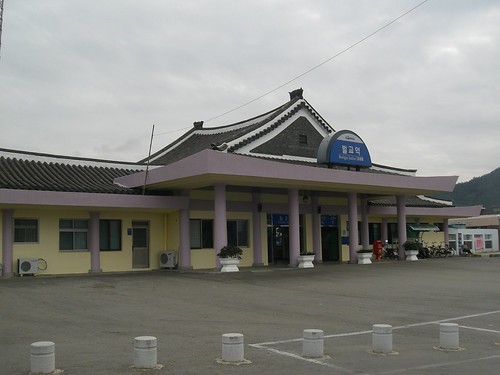
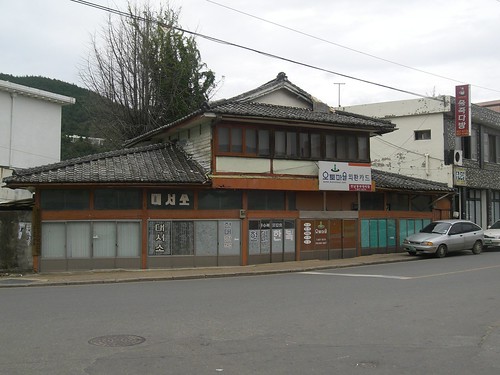
Beolgyo (벌교)

A few days ago I visited the town of Beolgyo, in Boseong county. It's thirty minutes away by bus, has 19,000 people, and is known for its Japanese colonial architecture, for its violent 1940s, and for being the setting of the novel Taebaek Sanmaek. Before I get into the post, I'll link to two great posts from two great bloggers: (1) this one, from The Marmot's Hole, has good pictures and talks about Beolgyo's history, and (2) this one, from Antti Leppanen, talks a little about the sites mentioned in the novel.

Here's a little background from The Marmot's Hole:

If you’ve got an interest in contemporary Korean history, there’s plenty to see and feel in Beolgyo, a town that is, for all intents and purposes, a product of Japanese colonial policy. The town was developed as a transportation center to ship agricultural goods from the Jeolla provinces to ports like Yeosu. The Japanese also engaged in a number of ambitious but divisive land reclamation products in the area. The Japanese penetration of the region and the colonial projects they pursued intensified class and ideological conflicts in the Beolgyo area that long outlived colonial rule. Jo’s The Taebaek Mountains examines this colonial legacy and the tragic conflicts that ripped South Korean society in the years between Liberation and the end of the Korean War.

Beolgyo’s downtown area is a place only a Japanese colonial administrator could love. Which, in a way, makes it kind of interesting. Like Gunsan, there are a number of old colonial-era buildings maintained as reminders of Korea’s difficult past. The town does get a fair number of visitors who come looking for the different places described in Jo’s book. Many of them, including the old Japanese Financial Collective building, Kim Beom-woo’s home, the Japanese-style Boseong Inn (now called the Namdo Inn), and the Sohwa Bridge, where mass executions took place during the 1948 Yeosu-Suncheon Uprising and, in the novel, rightists and leftists apparently traded turns executing political opponents.

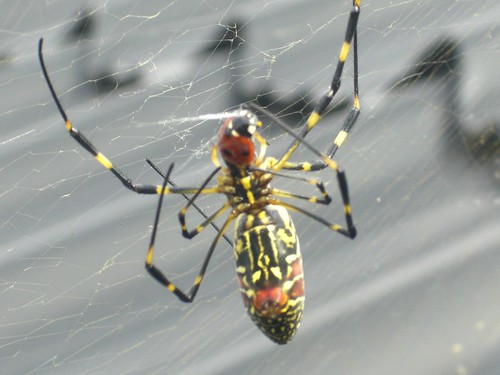
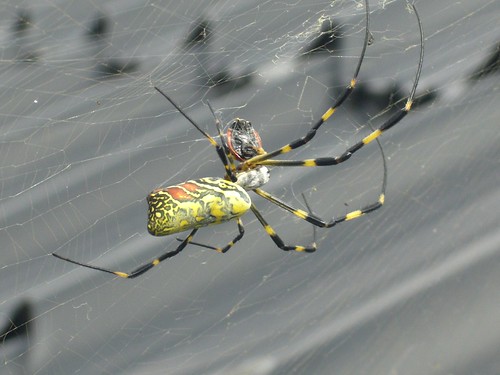
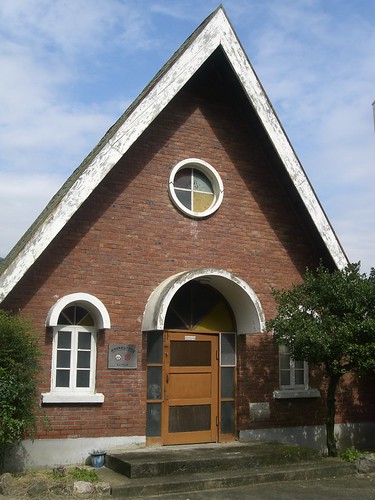
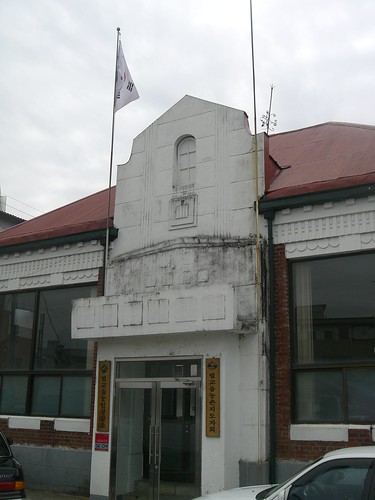
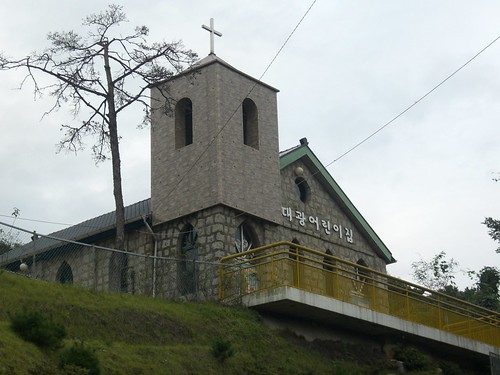
Overall it was a pretty rotten trip, but I'll talk about that below. Here are some pictures, sans captions. For some reason, the spacing and text get screwed up whenever I preview, and what looks like one space here becomes three spaces in the published version. After about four tries, I've given up on explanatory captions, and instead refer you to my flickr page for more information. Here are photos of: Rainbow Bridge, Beolgyo Pogyodang, a Joro spider, an abandoned church, a view of Beolgyo from Buyongsan Park, the Financial Collective building, Beolgyo Station, another Japanese-style building, and Hoejeongni Church.


There are 40-some pictures on my flickr page, and further information about these sites, or about a Beolgyo self-guided walk-through can be found on the Galbijim page.

Anyway, the trip was pretty shitty. The tourist map I was able to find hanging in town said "you are here," but I was not "here." It took me a long time to realize that the map had been moved some 5 blocks away, a big difference in a small town. The map showed the location of 16 sites from Taebaek Sanmaek, though I was only able to find 7. The small mountain, 부용산 (Buyongsan) had maps along the trails, but they seemed more for decoration than for guidance, and basically pointed in contradictory ways. And, I had to put up with pretty aggressive and abusive behavior from some of the local students. Screams of "Fuck you," curses and taunts in Korean, the finger, and having a tennis ball thrown at me made me really happy to finally get back to the bus terminal.

Korean students tend to be disrespectful to foreigners as their default behavior. Unless they are taught to act otherwise, its fairly common to get shouted at, to get pelted with "하이이이이" (mispronounced "hi"), "hello," "hey," "you," "and other misused salutations. I teach my students how to greet me on the first day of school, and I don't tolerate "hi," "hey," "you," "come here," or "hello," nor do I respond to people shouting my name. I've been with plenty of foreigners who consider this behavior cute, or polite, or a demonstration of Koreans' curiosity, or interest in English, or interest in foreigners, and I've seen it explained in journals as a liberating experience, as English does not have the various speech levels Korean does (thus many Koreans incorrectly assume that politeness need not be minded in English). I ignore the "hi"s, and "hello"s, and "나이스투미츄"s on the street, and I always request that Korean speak to me in Korean. Sadly, I've been around foreigners who respond to every piece of shit who yells "hi" at them, and it sort of undermines what I'm doing. Anyway, I'm not sure exactly how the habit of shouting at foreigners came about, but it's one I try not to encourage.

Update: A write-up I did for the Gwangju News was published in the October, 2007 edition. Click here to visit their page, which links to a .pdf file of the October issue.