Monday, May 31, 2010

Students commemorate anniversary of Gwangju Uprising with guardhouse experience tours.

A little while ago a teacher and blogger in Gwangju, Wanderlust: Korea, shared some pictures from the field trip her middle school took on Monday, May 17th to commemorate the Gwangju Uprising that began on May 18th, 1980. The students toured a few sites associated with the uprising and made the news posing with politician and Jeolla favorite Chung Dong-young, all in all a busy day.


Anyway, here are a few of my favorites, reposted with permission. The students had a tour guide to show them around the National Cemetery in Gwangju (which was also captured by Newsis):


An interesting placard at the museum:


The series that interested me most was at an old guardhouse, a site I didn't even know was still in existence and open to the public:


The students were yelled at by guards and then led across the grounds into holding cells.


Beyond the white buildings is a brick semicircle building "used as a detainment facility" a placard explains
where those who struggled against the military dictatorship during the May 18 Democratic Uprising were held in custody. In this fan-shaped guardhouse consisting of 6 chambers detainees could easily be monitored with a single glance. Detainees had to sit up straight for 16 hours a day and were beaten with a club regardless of age if they moved an inch. In one chamber as many as 150 were imprisoned, which made it almost impossible to sleep. Detainees often suffered from rashes and skin disease in the scorching heat. They were served two portions of food in one tray and were given only three spoonfuls of rice. The captives were under a constant threat of violence from the military police. Yet, they never caved in to such atrocities having the firm belief that truth always prevails in the end.


There are mannequins demonstrating how prisoners had to sit:


And, as in this Newsis photograph, how they were interrogated:


A Naver search turns up videos of these guardhouse experience tours (영창체험) for students, such as one with a local elementary school from 2006---with inappropriately-pleasant background music---and this one with Honam University students and Japanese yuhaksaeng from 2007.

The facility is located in the 518 Freedom Park (518자유공원) in Chipyeong-dong, behind the Kim Daejung Convention Center. It's accessible via a number of buses and by the Kim Daejung Convention Center subway station. The National Cemetary is accessible by the aptly-numbered city bus 518.

2010 English Fair in Gwangju, June 4th through 6th.


David Carruth of 10 Magazine told me last month about the English Fair 2010 (대한민국영어교육박람회) at Gwangju's Kim Dae-jung Convention Center from June 4th through 6th. Attractions include an English job fair, speeches by celebrities in the English racket, and a Dokdo Love Photo Exhibition.

If it sounds lame, don't worry, it's not for you. I know English in Korea is almost entirely for domestic purposes, taught almost entirely by Koreans, but it still irks me that the festival's website---like most English meetings, English tests, and English textbooks in Korea---is entirely in Korean. When you visit other pages on the site you'll notice an English tab in the top-right corner, but it doesn't work and doesn't lead to English-language information kind of like some of your co-teachers.


Celebrity English teacher and buffoon Isaac Durst was there last year.
20-year-old Jeong Hyeon-hwa, a dance major from Hanyang University, was picked as Miss Gwangju/Jeonnam at the Kim Daejung Convention Center on Friday in one of the regional preliminary rounds for the 2010 Miss Korea contest. Chosun University's Ha Ryeo-won placed second, and Hwang A-hyeon of Gwangju Women's University third.

Saturday, May 29, 2010

Internet-addicted husband gets 2 years, pregnant wife gets suspended sentence, for starving real-life baby.

A verdict has been handed down in the case of an internet-addicted couple who nurtured a baby online while letting their real one starve to death. From the JoongAng Daily:
The Korean couple who received international media attention after they let their infant daughter starve to death while they spent most of their time in a nearby Internet cafe raising a virtual child were convicted and sentenced yesterday.

But while the husband, 41, received a two-year jail sentence, a two-year prison term for his common-law wife, 25, was suspended as she is due to give birth to their second child in three months. She will escape going to jail if she is not convicted for another crime within the next three years.

. . .
Prosecutors had sought a five-year jail term for both the husband and wife, who were surnamed Kim. Judge Yu decided to give a lighter sentence because they had expressed remorse and were awaiting the birth of another child. The wife promised the judge that she would take good care of her new baby.

That poor baby on the way doesn't have a chance in the world.

Friday, May 28, 2010

Chosun University lecturer's suicide raises questions about promotion system, academic fraud.


A makeshift memorial and protest at Chosun University. Screen capture from SBS video report.

The Korea Times reports on a lecturer at Gwangju's Chosun University (조선대학교) who killed himself in his apartment on the 25th and left behind a lengthy suicide note on corruption and academic dishonesty at Chosun and other universities:
Police will investigate allegations raised in a suicide note by an hourly lecturer who accused some universities of having requested kickbacks in exchange for professor jobs.

Gwangju Seobu Police Station said Thursday that its officers are trying to verify the contents of the five-page suicide note left by a 45-year-old hourly university lecturer at Chosun University, identified only by his surname Seo, who died from carbon monoxide poisoning.

The note is reportedly addressed to President Lee Myung-bak.

Seo also alleged that he was forced to write a number of academic papers on behalf of his supervising professor, insisting all the papers were published in the professor’s name. Investigators are currently questioning his family members and colleagues at the university to find out what drove him to end his life.

. . .
According to the police, Seo said in his note that he was offered the chance to buy a faculty position at a private university in South Jeolla Province for 60 million won two years ago. In March this year, he was also asked to donate 100 million for professorship by a private university in Gyeonggi Province.

Seo alleged that Chosun University was trying to kick him out, saying he had no choice but to kill himself under the mounting stress. ``The country should do something for part-time lecturers. We also must do something to change the increasingly corrupt Korean society. I want an investigation into what I went through,’’ he was quoted as saying by the police.

The dead lecturer also claimed that he wrote a total of 54 thesis and other academic papers for his supervising professor and they were all published in the professor’s name, demanding investigation into the matter.


Suicide note, again from SBS.

The 광주일보 reports on it as well, and Naver and Daum searches for the 자살시간강사 reveal other Korean-language news articles and blog entries.

The Ministry of Food, Agriculture, Forestry and Fisheries should have left English alone.


This is your authority on the English language and what foreigners like.

The Korea Times reports, via The Marmot's Hole, that the dolts interested in "globalizing" Korean food and beverages have decided that makgeolli will be given the nickname "Drunken Rice" (드렁큰라이스) in English to make it more appealing for non-Koreans.
"Makgeolli," the country's traditional rice wine, has garnered the nickname "Drunken Rice" through an event aimed at boosting sales of the milky white drink outside Asia's fourth-largest economy.

The Ministry of Food, Agriculture, Forestry and Fisheries (MOFAFF) said Wednesday that Drunken Rice got the highest score as the nickname for makgeolli in a rivalry with such candidates as Makcohol, a combination of makgeolli and alcohol.

Other contenders included were Koju, Kori, Soolsool, McKorea and Rainydaywine but they failed to beat Drunken Rice.

"Midway through this month, up to 3,910 people offered various English nicknames for makgeolli, which is hard to pronounce and understand for expatriates," MOFAFF official Park Seong-gi said.

"Drunken Rice topped the podium at the screening of the five-member panel, which features a linguist, a food columnist, an alcohol specialist and tourism experts. These names will hopefully help the brisk exports of the wine."

The Korean-language articles say other names under consideration were Markelixir---a combination of makgeolli and elixir---and makcohol.

I'm curious, how many on the five-member panel were members of the target audience? And how many English-speakers did they consult before creating an English nickname? There is every reason to believe the answer to both is zero, given Korea's track record (1, 2, 3, 4, 5, 6, to cite but a few) but it looks like they talked with Korean-American food blogger and consultant Daniel Gray of Seoul Eats and marketing manager Michael Spavor.

The Korea Times closes with:
In the meanwhile, MOFAFF asked 210 foreigners last month in 11 cities including New York, Los Angeles, Singapore, Hong Kong and Tokyo regarding what is the best English-language explanation of makgeolli. The best one on the list was Korean rice wine.

Clearly, Drunken Rice isn't as laughable as makcohol, as absurd as markelixir, but what's the point of an English nickname? What does "Drunken Rice" accomplish that makgeolli doesn't? In what way does it make it easier for non-Koreans to comprehend and understand makgeolli, considering most non-Koreans have even never heard of the drink? Finally, what evidence is there of a lack of comprehension and understanding among non-Koreans of makgeolli, and does it exist to so great an extent that an entirely new English name is necessary? The answers to these important questions were likely trumped by the desire to have an English nickname to sound cosmopolitan and smart, forgetting of course that it has the opposite effect on people who actually use the language.

The government's interference in English to further the globalization of Korean food reminds me of the decision last spring to change the English spelling of 떡볶이 to topokki, because, according to one researcher at the Topokki Food Research Institute:
“Using a name that’s easy for foreigners to pronounce is our first step to help the spicy rice cake gain global popularity.”

You won't build a strong connection with non-Koreans and "foreigners" when the English-language name is different from the Korean one, and incomprehensible to Korean-speakers.

Thursday, May 27, 2010

2010 Haeundae Sand Festival (해운대모래축제): June 4th - 7th.


The 2010 Haeundae Sand Festival (해운대모래추제) will be held at Busan's huge Haeundae Beach from June 4th through 7th. It's accessible via the eponymous subway and train stations in Busan.

In spite of the huge crowds---actually, usually because of them---Haeundae was one of my favorite spots in Korea. The attractions at the festival include, in addition to just enjoying the beach and having fried chicken deliverymen walk over to your towel, performances, sporting events, photo contest (Korean and English), fireworks (Saturday the 5th at 9 p.m.), and all the sand art. There is a timetable available online, in Korean and something approximating English that makes you wonder why they even bother at all.


(1, 2, 3)

Plenty more pictures via a Naver news search, Naver image search, and Chris in South Korea's post of last year's visit.

The festival's English language website says one of the aims of the festival is "MAINTAINING TOURIST IN A SLACK SEASON," but clearly summer has started in Busan. How do we know? Because the news sites have started running pictures of white women in bikinis.


From last weekend (1, 2)

I looked at that trend last year in my post "Tap that ass," inspired by the creepy camerawork of the Chosun Ilbo, and by news that two foreign men were arrested last year for taking pictures of Korean women in bikinis without their permission. The Chosun Ilbo added this warning on its webpage:
Photographers need to be careful where they point their cameras when they're at the beach. Those who snap shots of women in bikinis without their permission can wind up booked for violation of the sexual violence law and face public humiliation.

The Haeundae Police Station in Busan on Monday booked without detention two Indonesian men for taking photos of bikini-wearing women without their consent at Haeundae Beach. The two men wandered the beach for five hours from 10:30 a.m. on Sunday and took pictures of some 50 women without permission.

Neglecting to mention that it's apparently only a crime to do so without Korean press credentials.


Chosun Ilbo photographer hard at work in Seoul last summer.

North Korea to aid South Korean citizens, expats this election season.

Posing for me
2006 in Seongnam's Taepyeong-dong.

In a move unexpected during this time of heightened tension and fear on the peninsula, North Korea has expressed its support for beleaguered citizens and expatriates in South Korea by threatening to fire on that country's loudspeakers.
"If South Korea installs new speakers for psychological warfare, we will directly aim at them and open fire to destroy them," an unnamed North Korean military commander said in a statement, carried by Pyongyang's official Korean Central News Agency.

"If the South Korean traitors challenge our rightful response, we will counter with mightier physical strikes to eliminate the root cause of their provocation," the statement said.

The Korea Times reports on the laws governing use of loudspeakers and dancers during election season:
According to the National Election Commission (NEC), candidates running for mayors, provincial governors, district chiefs and city or province council members can use only one speaker. They can make speeches from 7 a.m. to 10 p.m. with car speakers and from 6 a.m. to 11 p.m. with portable speakers.

"For recorded songs or speeches, we reduced the hours to 8 a.m. to 9 p.m. starting in 2010 to mitigate inconveniences," an NEC official said.

No laws are being broken when trucks roll through the neighborhood blaring "If You're Happy and You Know It" for some no-name candidate at 6:12 a.m., but people aren't happy. Earlier in the article:
Kim Won-ho, a 30-year-old office worker, had his weekend ruined because of the loud campaign jingles played in front of his apartment building.

"For the June 2 elections, I have to choose from eight candidates. With so many candidates vying to win seats, their campaigns seem to be louder than usual," Kim said.

Though he recognizes the need for election campaigns, he was annoyed by the unwanted noise. "I know one thing for sure - I will not vote for the city council candidate who canvassed so loudly on Saturday morning," he said.


How to leave South Korea in a hurry.

Chris in South Korea has compiled the information provided, in some cases, by embassies in South Korea on what to do and where to go in case of emergency evacuation. The United States embassy says Gwangju, Jeollanam-do, Jeollabuk-do except Gunsan, and the two Gyeongsang provinces comprise Area 4, an area with three evacuation points for American citizens, the nearest one to most Jeollanam-do residents being Chinhae (Jinhae, 진해).

Chris, and the embassies that provide information to their citizens online, reiterates the need to have an emergency kit ready with not only food and supplies, but your important paperwork. It's also advisable to register with your embassy.

Wednesday, May 26, 2010

Paju English Village gets some work before the World Cup.

The Paju English Village (경기영어마을 파주캠프) is the setting for the video of the latest Korean World Cup song "빅토리코리아" by boyband Super Junior:


The country's huge English Villages do little more than lose money, and in spite of the promise to provide a domestic English-immersion environment, often don't even provide that (1, 2), so it's not surprising that the one in Paju is recognizable more as a filming location than an education experience. Whether or not it's built to resemble what they imagine an American university campus might look like it has that effect, though it has a street car and a building labeled "City Hall." It's frequently used to replicate both urban and collegiate settings in music videos, commercials, and television shows, perhaps most notably in "Boys Over Flowers," and most recently in a commercial for 미닛메이드 orange juice:


I visited in February, took some pictures, and came to this conclusion:
It's worth a visit only as a curiosity, in a country where they build English Theme Parks, but just be aware that the programs aren't aimed at adults, and there won't be much for you to do but look around and avoid the students. The bad reports in the media, and negative experiences from teachers and native English speakers, are helping guarantee the place gets more work as a filming location for music videos, commercials, and TV shows than as an educational center.

SDC10903
Taken in February. In front of the large building, and beside the street car, is where the Super Junior video was filmed in April.

Monday, May 24, 2010

Bad market for teachers in the US will mean nothing for Korea.

I used CareerBuilder.com earlier to browse positions in Pittsburgh, and they recently sent me a list of job matches.


Click to enlarge.

k, that's not helping.

If you search for "English" on CareerBuilder or Monster, Korean EFL recruiters are atop the search results, regardless of location. Gee, I think I'll go with the one that says
"Over 100,000 English teachers are currently beign employed in Korea"
ALL MAJORES WELCOM... NO EXPERIENCE NECESSARY!


Anyway, a poster on Dave's ESL Cafe shares this May 20th New York Times story, "Teachers Facing Weakest Market in Years," and asks
Wonder how this will influence the market for qualified teachers in Korea.

It won't have any effect on qualified teachers in Korea.

Browse recruiter websites, whether the ones I found in my job search here or the ones Google gives you, and you'll find most if not all advertise things like "No experience necessary" or "all majors welcome" or "ALL MAJORES WELCOM."

In a May 2009 post I noted that when bitching about "unqualified" foreign English teachers you have to look at how recruiters are selling Korea to applicants. Park English, which for a while was spamming me with teacher resumes, sent me an advertisement last May with the headline "What's in your future after graduation? How Would You Like To Travel & Teach in South Korea?" Elsewhere on the page it gives answers to "Why Korea?"
-Annual salary of US $24-35K at 30 hrs/wk
-Renewable 12-month contract
-Gain international experience while enriching students lives
-Safe, modern country with the highest investment in private education in the world
-Intriguing language, rich culture and central location for continued travel in Asia
-Great ongoing positions available year-round
-FREE furnished housing, FREE round-trip airfare, paid holidays, health insurance coverage, etc.
-Save up to $15K/year

ESL Park, the recruiter I found via CareerBuilder telling us that ALL MAJORES WELCOM, asks on its homepage
Are you a University graduate?
Are you looking for a great adventure?
Do you want to Travel and make money?

CraigsKorea, another recruiter advertising on CareerBuilder, has in the top right corner of its homepage
Announcement
Are you looking for great
adventure? Do you want to
Travel and make Money?
All Bachelor degree Holders
are Welcome to Korea Now!

Whether teaching in Korea is "real teaching" is beyond the scope of this post, and has already been the subject of a bajillion messageboard threads and blog entries already. The point is if the companies put in charge of hiring native speaker English teachers are selling it as a place to travel and make money, Korean administrators ought to expect their hires to view the job as a means to travel and make money. We would certainly want incoming teachers to have a sense of duty and professionalism---the quote-unquote professionalism of the EFL business in Korea is definitely up for debate---but the middle(wo)men aren't trying to appeal to teachers' professional development.

I think newly-graduated teachers from the US and other countries might give South Korea and Asia a second look. Spending a year or two overseas teaching English as a certified, credentialed teacher might be preferrable to spending a year or two unemployed, or underemployed, or substitute teaching, or working in an unrelated industry. "Teaching" "English" in a Korean cramschool or working as a native speaker assistant teacher in a public school is hardly the same as teaching your subject back home, and there's no guarantee potential employers are going to be impressed with your international experience. But even though salaries in Korea's EFL industry have been stagnant for years, and the start-up costs for new teachers have gone up, it still remains a good deal for a 22-year-old.

That's good, because schools and recruiters pretty much just want 22-year-olds. Last month I posted about English Program in Korea [EPIK], Gyeonggi English Program in Korea [GEPIK], and the Seoul Metropolitan Office of Education [SMOE] not wanting to hire older, experienced, "qualified" teachers because they are unable and unwilling to pay them. I'll have an update to that news in the near future, but just to refresh a reader forwarded me an email from WorknPlay Consulting, about the chances of a 53-year-old teacher with four years experience with GEPIK finding something in Seoul or Bundang:
I know many experience teachers are having hard time to find a job in Korea because of their age. And it’s very hard for a recruiter to promise that I can find her job in or around Seoul. GEPIK has cut down on their budget for native English speaker teachers from this coming semester and now they can’t afford higher level teachers.

Another recruiter, Korvia, says on its website that teachers over 50 "may be excluded for the selection process" by the three organizations, with the EPIK official website saying teachers are to "Be a maximum of 55 years of age".

It wouldn't make financial sense for most 50-year-old teachers in the US to leave their jobs and move to South Korea, and fiftysomething teachers who find themselves unemployed aren't likely to have the freedom to pick up and move halfway across the world, even if public schools would hire them and even if schools would pay them more than $30,000 per year. But the policies of these organizations, and the recruiters that hire for them, damage the industry by preventing teachers with experience in Korea from staying with their schools, and ultimately staying in Korea. However, as everybody saw from that April post, and as everybody has been saying for years, it doesn't really matter if native speaker English teachers here are "experienced" or "qualified," and the role a 22-year-old biology major plays in the classroom is essentially the same as a teacher with experience and training. South Korea is potentially missing out on an opportunity to attract trained teachers to its schools, but a lot about the English business here would have to change to accomodate them, a change that people with experience in Korea know isn't coming anytime soon. In fact, I would be surprised if the native speaker English teacher experiment lasts another five years in South Korean public schools.

Browse the "English in the news" category for more posts on English and English education in South Korea, and see the following selection for discussion on the issues and challenges faced by native speaker English teachers there.

* (3/19/2010) Korea's robot English teachers won't go away.
* (12/3/2009) Are native speakers part of English here? Your thoughts on the 2009 GETA International Conference.
* (12/2/2009) In the Korea Herald, writing about mandatory culture classes for foreign teachers.
* (6/26/2009) Korea Herald: Just what makes a teacher "qualified"?
* (6/15/2009) Not enough applicants for those "English Lecturer" jobs.
* (6/5/2009) Seoul wants English classes to be taught in English, will give TEE certs out.
* (5/13/2009) Korea Herald: The media bias against foreign teachers.
* (5/6/2009) 12% of native speaker teachers in Ulsan not retained.
* (5/1/2009) Korea Times: Foreign teachers wrongly portrayed in Korea.
* (4/7/2009) Korea Herald: Stop the scatter-shot approach to English.
* (12/30/2008) Half of foreign teachers leave after one year? GREAT! That's an article that should be brought up every now and again, because a MOE official in charge of native speaker English teachers says
``They are neither regular teachers nor lecturers who can conduct classes independently. They are `assistant teachers,' hence their teaching experience doesn't matter much,'' he said. ``Rather, it's better for students to have more new teachers so that they can meet various kinds of foreigners,'' he added.

* (12/10/2008): Poor guy.
* (11/24/2008): EPIK in the news some more.
* (11/21/2008): 4,000 "English Lecturers" coming in 2010.
* (11/14/2008): A must-read: an account of teaching English in South Korea in the sixties.
* (10/6/2008): More money going into English education next year.
* (9/11/2008): More English-Only classrooms, more gimmicks.
* (6/23/2008): Pronunciation matters.
* (11/28/2007) A reaction to Kang-Eun-hee's "Korean English Teachers."

Young people coming of age in motels.

As I wrote last week, the 17th was the annual Coming-of-Age Day in South Korea. It's a boon to retailers, writes the JoongAng Daily, with an increase in sales of not only "traditional" gifts like roses and perfume, but also higher-end items at department stores:
To lure young consumers and their families to spend money for that special day, local department stores are promoting various events.

Lotte Department Store is offering a 10 percent discount through Monday on casual brands including Calvin Klein, Guess and Buckaroo. The retailer is also giving away high-end portable speakers to customers turning 20 years old this year who spend more than 200,000 won ($176).

Shinsegae Department Store is offering discounts on casual brands including Gap and Banana Republic, as well as on jewelry and shoe brands, while Hyundai Department Store will mark down its cosmetics brands and young casual wear.

The article closes by saying that May is "is considered one of the most important months of the year for retailers to raise sales" because it's "Family Month," with Parents' and Childrens' Day at the beginning of the month. Then again, there are plenty of other holidays in South Korea newly imported or fabricated to not only increase sales of specialty products---Wine Day, Ace Day, Peppero Day, Garaetteok Day, Christmas---but also to provide much-needed fun and consumerism to traditional Korean holidays that are dominated by obligations, traffic jams, days of cooking, and dead people.

Another traditional gift on Coming-of-Age Day is a kiss, but the Chosun Ilbo writes that some couples are, unsurprisingly, a little beyond that.
Many who turn 20 this year go to motels for their own "coming-of-age" rituals. Ten out of 28 motels in Sinchon, Jongno and Gangnam were full on Monday and the rest saw the number of guests shoot up by at least 50 percent. One female university student who visited a motel near Ewha Womans University at 9:30 pm on Monday said, "Everyone comes to these places these days. Some of my other friends even booked a hotel room."

Korean-language version here, and a 2008 article on the same topic asks "성년의 날이야 '성(性)'의 날이야?"

The former quotes a guy saying he got a job at a convenience store the month before in order to earn money toward a special Coming-of-Age Day for his girlfriend. It also reports an increase in sales of underwear and adult items. A survey of 1,000 17-19-year-olds by Lotte Department Store this year found that underwear was the second-most wanted gift, behind a kiss and ahead of perfume. Here's a sample of what one online shopping site, G-Market, is selling as 성년의날 선물. I was amused to find, when searching for the Korean-language story by Navering 성년의날 모텔, the portal offered three variations of "성년의날 남자 선물" as suggested search terms.

The English-language Chosun Ilbo article is, obviously, very unspecific, and ignores that on any given Monday ten out of 28 motels in Sinchon, Jongno, and Gangnam are likely to be full. Likewise, when the student quoted says "everyone comes to these places these days," we don't know if she means on a regular basis, or for couples holidays and Coming-of-Age Days.

I've written a lot about love motels, as my "motels and hotels" category shows, most recently and most publically for the Korea Herald last fall. While love motels do still carry a stigma---enough that a foreigner writing about them in the Gwangju News last year got chewed out in a local paper---and would probably not be the best surprise present for your girlfriend, people are slowly starting to realize how awesome they are. I highlighted some examples in that Herald piece and the accompanying post, and used as support a Yonhap article from August 2009 which looked at the amenities the nicer ones are starting to offer.
But in the face of a steep increase in competition, motel owners are transforming their guest rooms into private entertainment complexes, renovating once spartan furnishings into lavish accommodations.

Couples can now find rooms in some of the country's leading motels equipped with a swimming pool, a sauna or jacuzzi, and flat-screen displays. Popular game consoles like Play Station or Wii, as well as karaoke machines, multiple PCs and a tastefully decorated bed are all part of the package.

"Lodging facilities used to be just for sleep or sex," said Lee Kyung-su, head manager at Seoul Mate Hotel. "But these days, such limitations don't make money."

. . .
"Motels used to be a place I go at night, have sex, and wake up in the morning," said an 28-year-old office worker who identified himself only by his last name Lee. "But now I go there also during the daytime with my girlfriend watching movies, playing games, or just lying in bed together listening to music."

A 2007 article talks about hotels offering "Pink Light Events" to mark Coming-of-Age Day and Couple's Day---부부의날, which I learned just now falls on May 21st---and talks about the amenities that make luxury motels attractive on days special and regular.

Sunday, May 23, 2010

No, 동아대학교, that's not how you do it.

Looking around for pictures of university smiling contests, as most bloggers do, I came across a Busan Ilbo article with an animated banner advertisement for Dong-A University promoting the school's international sensibility, among other qualities.


They did it wrong.

Saturday, May 22, 2010

A year later.


Gravesite of former President Roh Moo-hyun, via Yonhap.

One year ago Sunday, former president Roh Moo-hyun killed himself near his home in Bongha Village (봉하마을), Gimhae, Gyeongsangnam-do. The Hankyoreh and JoongAng Daily both have articles in English about Roh supporters who travelled to Owl Rock to mark the occasion.
Roh’s grave site, which was opened to the press on Wednesday, measures 3,206 square meters (34,509 square feet) and is shaped in an isosceles triangle. The boundaries of his tomb, funded with donations from his supporters, were completed this month after six months of construction. More than 38,000 granite stones line the tomb, each engraved with a message that mourns his death. One from former President Kim Dae-jung, written by his widow, Lee Hee-ho, reads: “I feel like half of my body collapsed.”

The graveside memorial service for Roh begins at 2 p.m. today and will be presided over by popular comedian Kim Jae-dong. Performances, a video clip and a memorial address and speech by a representative of Roh’s family are all scheduled. A pre-service memorial mass will be held at 11 a.m. at Jeongtowon, a Buddhist temple where Roh’s ashes had been kept.


From Yonhap.

And while playing around on the internet a couple days ago, not actually looking for pictures of cute babies, I was surprised to see this series, easily my favorite of the late president, turn up on "Babies Making Faces" in April.


I was in Seoul for a couple meetings that weekend last May, and my girlfriend and I ran into a massive number of riot police while walking along Cheongyecheon. I assumed it was more trouble over American beef, which produced violence in that area a couple weeks earlier, and when I learned the next morning that he committed suicide amidst a bribery scandal, and that the police were preparing for some trouble downtown, I have to admit I wasn't terribly surprised. I'm not passionate about Korean politics, but I can appreciate where he came from and what he represented to a lot of people.

Friday, May 21, 2010

Reader request: coupons and group discounts in Seoul?

A reader emailed me the other day asking about coupons and group discounts available in Seoul. I didn't have much of an answer, so with his permission I'll throw it open to the group. Here are excerpts from two of his emails:
I've been an avid reader of your site and always find it to be very informative and entertaining :)

Awwww.
I was wondering in Seoul if you saw much in way of local lead generation for companies. ie a website/websites that does online advertising for group coupons, deals, discounts etc.. for Seoul entertainment businesses, restaurants, spas, and the such. I know here in the US it is commonplace, but wondered if culture differences may lean away from such practices. Any examples if they do exist?

. . .
I guess what I was most interested in was group buying power in S. Korea. Largely discounted services based upon X amount of customers buying the service. Was also very curious about some of the larger social & entertainment sites there in Seoul.

Thursday, May 20, 2010

Yep, they did it: North sinks Cheonan, South Korea says.


From the Chosun Ilbo.

Every newspaper, blog, and scroll at the bottom of the TV has already reported on South Korea's announcement on Thursday morning, Korean time, that the North is responsible for the sinking of the Cheonan.

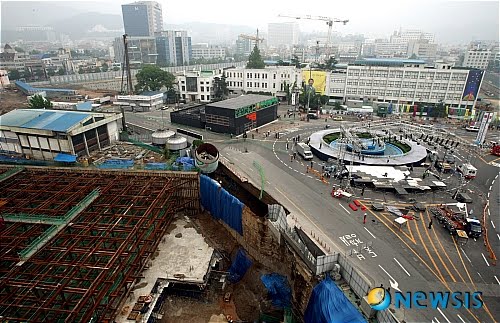
Damage to Gwangju's underground shopping center after roof partially collapses.


From Newsis.

I was alarmed to read on Facebook that Gwangju's Geumnam Underground Shopping Center (광주금남지하상가) had collapsed on Wednesday, but the little news that's out so far shows scale of the damage is considerably less, and that there have not yet been any injuries reported.

At 5:38 pm on Wednesday the 19th, according to the Dong-A Ilbo and Newsis, a cooling tower across the rotary from the Old Provincial Hall fell over, causing the roof to collapse and damaging three stores in the underground shopping center that stretches between a couple subway stations downtown.


From Newsis.

Articles out now don't say which stores were damaged---a Korean news article wouldn't mention that anyway---but you might be able to piece together something if you're familiar with the layout of the shopping center. The Dong-A Ilbo has photographs taken both above and below ground, and Yonhap provides a video report that looked promising but which won't play on my computer.


Two days earlier thousands of people were gathered along the huge Geumnam-no near the Old Provincial Hall to mark the 30th anniversary of the Gwangju Uprising. The area around there is being renovated into a pedestrian plaza as part of a controversial "Hub City of Asian Culture" (아시아문화중심도시) plan that will give a facelift to the most cultural part of the city.


If readers in the area have any updates or pictures, please pass them along.

Jeonju Bibim Sound Festa, May 21st.


The Korea Tourism Organization tells us about the Jeonju Bibim Sound Festa (전주비빔사운드페스타), a "Delicious, Bibimbap-like Festival of Music" on Friday, May 21st:
Like Korea’s beloved food bibimbap (비빔밥), from which the event gets its name, the festival is a mixture of everybody’s favorites! It celebrates some of the most beloved ‘old’ and the ‘new’ aspects of Korean culture by showcasing trendy and modern genres of music (think clubs in Hongik University area) in the setting of the tradition Hanok Village in Jeonju, a historical jewel.

That's a really shitty name, though, Christ. If somebody at the KTO had paid me a few bucks I would have told them to just call it "전주비빔밤," with it written out in English so people don't think it's a typo. 밤, meaning night, is more clever 사운드 (sound), and a better fit next to 비빔, if they insist on keeping the reference to the city's representative food.

The lineup includes TV Yellow, Ynot?, I&I Jangdan, and Kingston Rudieska, among others and some DJs. There's a 10,000 won cover charge, with performances at the Confucian academy (전주향교)---in the vicinity of the Hanok Village---and Nambu Market. A little more information available via the KTO article and the event's Korean-language Naver cafe.

Wednesday, May 19, 2010

Korea's latest "_____ girl."


In the papers today is a story of a university student caught on tape berating a cleaning lady. You can guess what happened to her personal information. From the JoongAng Daily:
Last Saturday, the cleaning lady’s daughter made a posting on the local Web portal Nate, the country’s third largest, saying that her mother was verbally abused by the student May 13 for failing to toss out a milk carton on a shelf in a campus toilet.

“Since the day I was born, I’ve never felt more miserable and useless than today,” read the post. “My mother was insulted in all sorts of ways by a female college student who’s just around her daughter’s age.”

The daughter alleged the student swore at her mother and demanded she throw away a paper milk carton in a public toilet. The cleaning lady explained she didn’t move it because there was milk left in the carton, so she thought it belonged to someone using the facility. According to the daughter, the college student cursed at her again and left the toilet.

. . .
Within hours, the student became the target of an Internet-based witch hunt. Photos of a female student and her address on a local social networking site spread on the Web, but the university said the hunters identified the wrong female.

The audio recording of the "경희대 패륜녀" is all over the Korean internet and is up on YouTube for the time being:


She joins 2005's "Dog Poop Girl" and last year's "Loser Girl" as young women made infamous, and public, thanks to the quick fingers of local netizens.
A murder-suicide in Jeollanam-do, as a 50-year-old man suspected of murdering his ex-wife in Suncheon's Jorye-dong on the 18th was found dead early Wednesday morning in Gwangyang.

The Cove and other documentaries at Gwangju Theater, May 20th - June 9th.

The Gwangju Theater (광주극장) will be showing several documentaries as part of the 다큐열전 going from May 20th through June 9th. Somebody over on their website must love me because they looked up and posted the English titles this time so I don't have to:
셉템버 이슈 The September Issue (2009.미국.90분.전체.35mm) (5/27 부터)

맨 온 와이어 Man on Wire (2008.영국,미국.94분.12세.35mm) (5/27 부터)

선라이즈 선셋 Rassvet/Zakat. Dalai Lama 14 (2008.러시아,중국,인도.73분.전체.D-Cine) (5/20 부터)

예스맨 프로젝트 The Yes Men Fix the World (2009.프랑스.미국.90분.12세.35mm) (5/27 부터)

더 코브 : 슬픈 돌고래의 진실 The Cove (2009.미국.92분.전체.35mm) (5/20 부터)

반드시 크게 들을 것 Turn It Up To 11 (2009.한국.95분.15세.D-Cine) (5/27 부터)

위대한 침묵 Into Great Silence(2005.프랑스,스위스,독일.165분.전체.35mm) (5/27 부터)

아마존의 눈물 (2009.한국.88분.15세.D-Cine) (5/27 부터)

회복 Restoration(2009.한국.94분.12세.D-Cine)

A timetable for May 20th through 26th is here, though there isn't yet one online for the 27th through June 9th. The Cove, an Oscar-winning documentary about an annual dolphin hunt in Japan---a film that receives a lot of coverage on Japan Probe---will open on Thursday at 8:40 pm, and will have its lone weekend showing on Sunday at 2:40.

The Gwangju Theater regularly shows foreign and independent domestic films new and old, and often holds small film festivals that showcase a particular theme or a particular country's output. The theater is one of several old ones in the city, though it's the only one to my knowledge still in operation. It seats 856, but the one time I visited for a Japanese movie I was one of about a half-dozen people in attendance. Nonetheless I consider it an important part of the city, significant both historically and culturally, and I would encourage expats in the area to pay a visit once in a while.

To get there from downtown Gwangju, go to the four-way intersection near the McDonald's Lotteria---nearest exit 1 of Geumnamro 4-ga subway station---then cross the street and wander into the older part of town and make the second left. It's on your right. There's a map here, via Naver.

Tuesday, May 18, 2010

Gwangju Uprising anniversary.


A parade downtown to the Old Provincial Hall, on May 17th.

May 18th is the 30th anniversary of the start of the Gwangju Uprising (5.18 광주민주화운동), an occasion marked each year with a parade and speeches. Coverage of Tuesdays events is provided by English-language papers the JoongAng Daily and the Korea Herald:
About 2,500 people, including Prime Minister Chung Un-chan and leaders of political parties, attended the ceremony at the national cemetery in Gwangju.

More than 300,000 people have visited the national cemetery this month ahead of the ceremony, according to city officials.

Ceremonies were also held elsewhere in the nation including Seoul, Busan, Ulsan and Daegu.

About 600 people gathered at a plaza in front of the Seoul City Hall earlier Tuesday, offering a prayer for the victims of the May 18 uprising.

The president did not visit Gwangju on Monday, unsurprisingly inviting criticism; from the JoongAng Daily:
President Lee Myung-bak will not attend the anniversary ceremony, prompting complaints from the commemorative groups. The May 18 groups issued a joint statement, urging the president to reconsider his decision.

. . .
“When he was a presidential candidate, President Lee had spoke carelessly about the May 18 democracy movement,” said Democratic Party Chairman Chung Sye-kyun. “For the second year in a row, he is skipping the anniversary ceremony. The May 18 anniversary is designated as a national observation day, but concerns grow that Lee is treating it coldly.”

There is also an index of Korean-language articles available via Naver and a Daum search, and the local English-language magazine Gwangju News has a few articles in its May issue.

An excellent source of insight and information in English is the blog Gusts of Popular Feeling, which provided a summary of its writing in a post yesterday.

If you're ever in Gwangju you can visit the National Cemetery (5.18 국립묘지) and other historical sites associated with the uprising via the aptly-numbered city bus 518. In 2008 the calendar was more cooperative and the 17th and 18th fell on a weekend, so I could witness some of the proceedings downtown and at the cemetary on both days. In the middle of the Mad Bull Shit protests against President Lee Myung-bak and American beef, though, the struggle for democracy 28 years earlier was updated in a rather bizarre way.


Downtown Gwangju on May 17th, 2008 was less about the battles in 1980 and more about the perceived dangers of big, bad American beef.


Some still make the connection.

About the only other time I wrote about the uprising was a week later when I looked at placards set up in Gangjin county, south of Gwangju, one of the several outlying rural areas where violence spread in 1980. An excerpt from the placard in front of the county office:
The Demonstration Movement in Kangjin area has been ignited by demonstrators arrived in Kangjin from Kwangju City by eight buses on May 21, 1980.

As the demonstrators entered the Kangjin, the police forces voluntarily withdrew their forces avoiding physical clash. Citizens being already aware of the Kwangju massacre welcomed the student demonstrators and joined with them.

Having set up their headquarter at the Kangjin church, the students and citizens made an organized demonstration in several places such as County Hall and Bus Terminal. At night, they stayed at the church or the inns nearby and the sisters from the church offered foods to them.

On May 23, 1980, about 500 students from Kangjin Agricultural High School gathered together and joined in the demonstration screaming "Lift the Martial Law", "Recover the democracy", and "Free Kim Dae Jung". The demonstration reached its climax as the members from the Regional Young Man's Association and Young Man's Counsel add to the demonstration group. On May 23rd, there were two bullet wounded people and many other wounded ones from Haenam Wooseljae clash against the Martial Law Command and they were hospitalized and cared for in the provincial hospital, the current Kangjin clinic.


Photographed in 2006.

Further research into the events in rural Jeollanam-do in May 1980 would be an interesting academic hobby to try before the 31st anniversary.